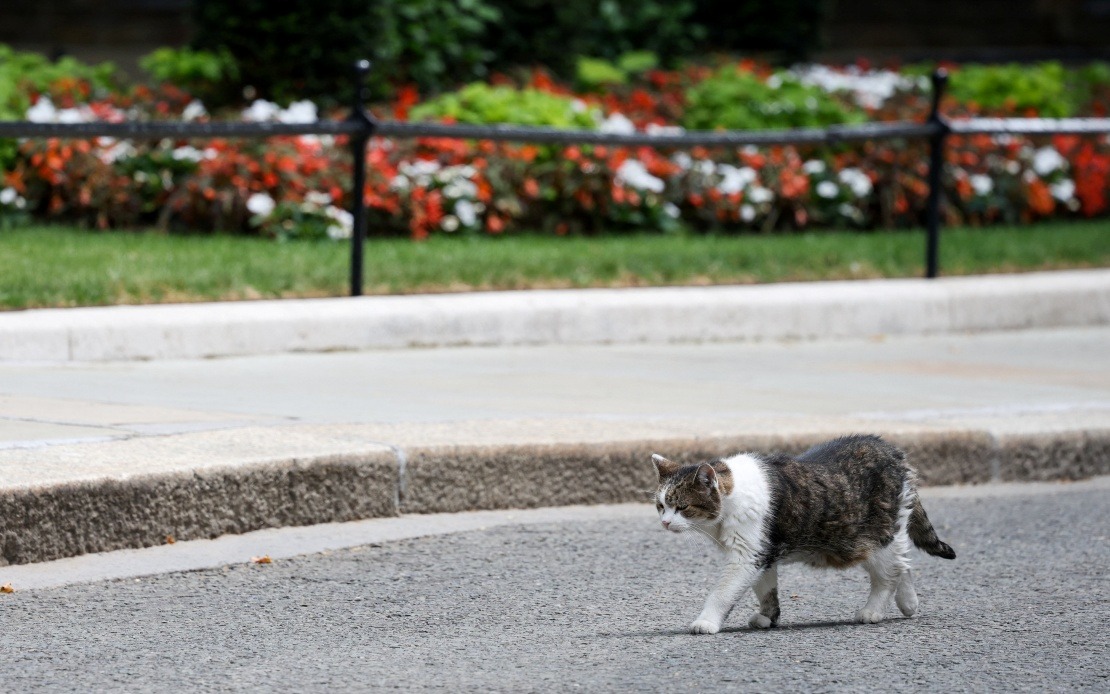
Larry, the renowned tabby cat who has made 10 Downing Street his home for years, continues his remarkable tenure as one of Britain's most enduring political fixtures. The feline resident has witnessed extraordinary political turbulence, surviving six changes of prime ministerial leadership—a testament to his staying power in an institution marked by frequent upheaval. On Tuesday, July 21, as Andy Burnham convened his first Cabinet meeting following his ascension to the office of Prime Minister, Larry was observed wandering the grounds outside the official residence, seemingly unbothered by the momentous occasion unfolding within its walls.
The contrast between Larry's continuity and the rapid succession of prime ministers reflects the volatility that has characterized British politics in recent years. While political leaders have come and gone, often after relatively brief tenures marked by internal party conflict, economic challenges, or electoral setbacks, the Downing Street cat has maintained his position with steadfast indifference to the machinery of government. This resilience has made Larry something of a cultural icon, embodying a form of institutional stability that many Britons find comforting amid political uncertainty.
For Malaysian and Southeast Asian observers, the spectacle of Larry outlasting multiple prime ministers offers an intriguing lens through which to examine the nature of political leadership and institutional permanence. While parliamentary democracies across the region grapple with questions of governmental continuity and leadership transitions, the image of an apolitical animal transcending political divisions serves as a humorous reminder of what endures beyond the machinations of electoral politics. The cat's indifference to the weighty matters decided within Downing Street's walls speaks to a certain philosophical perspective on the relative importance of political office.
The tradition of maintaining a cat at 10 Downing Street carries historical weight. Previous occupants of this role have achieved their own fame, becoming beloved figures in British popular culture. Larry, in particular, has garnered substantial social media following and public affection, with his movements tracked and celebrated by citizens who view him as a symbol of continuity in an otherwise turbulent political landscape. His presence at the residence serves not merely as pest control—the original purpose of introducing cats to the building centuries ago—but as a cultural institution in his own right.
As Andy Burnham settles into his new role, the presence of Larry at Downing Street connects his administration to the long chain of predecessors who have similarly tried to govern with the watchful, indifferent gaze of a cat observing from the margins. The Prime Minister joins a select group who have held the office while Larry has been in residence, adding his name to a list that, by the cat's own tenure, appears to be growing at an accelerating pace. The political careers of prime ministers are measured in months or years; Larry's residence is measured in decades of political change.
The symbolism is not lost on British observers and commentators. In an era when prime ministers face unprecedented scrutiny, demanding schedules, and mounting pressures from both domestic and international crises, Larry represents a form of unchanging domesticity. His presence grounds the office in the tangible reality of a working residence, not merely an abstract seat of power. Cabinet ministers gathering for their first meeting under new leadership encounter the same cat that greeted their predecessors, a living bridge across administrations.
For the international community, including observers from Malaysia and other Commonwealth nations, such quirks of British institutional life demonstrate the deeply rooted cultural elements embedded within Westminster democracy. The acceptance and celebration of Larry as a significant figure in the life of the nation reveals something about British attitudes toward tradition, continuity, and the human—or in this case, feline—dimensions of political life. It suggests a political culture willing to acknowledge that not everything of importance can be reduced to policy outcomes or electoral mandates.
The appointment of a new Prime Minister typically involves elaborate ceremonial transitions, including the movement of personal belongings, briefings on classified matters, and the establishment of new priorities and working relationships. Through all this disruption, Larry's routine remains fundamentally unchanged. He continues his daily rounds through the residence, perhaps occasionally venturing outside as he did during Burnham's first Cabinet meeting, utterly unconcerned with the historical significance of the moment or the weight of the decisions being made mere meters away.
As Burnham's government begins its work addressing whatever challenges precipitated the previous administration's fall, Larry serves as a reminder that some aspects of governance transcend individual leaders. The institutional structures of Downing Street, the protocols and procedures that govern the operation of the Prime Minister's office, and yes, even the presence of a cat roaming its corridors, provide continuity that no single prime minister can disrupt. In this sense, Larry's longevity speaks to the resilience of British institutions themselves, even as the individuals who temporarily occupy positions of leadership come and go with increasing frequency.

