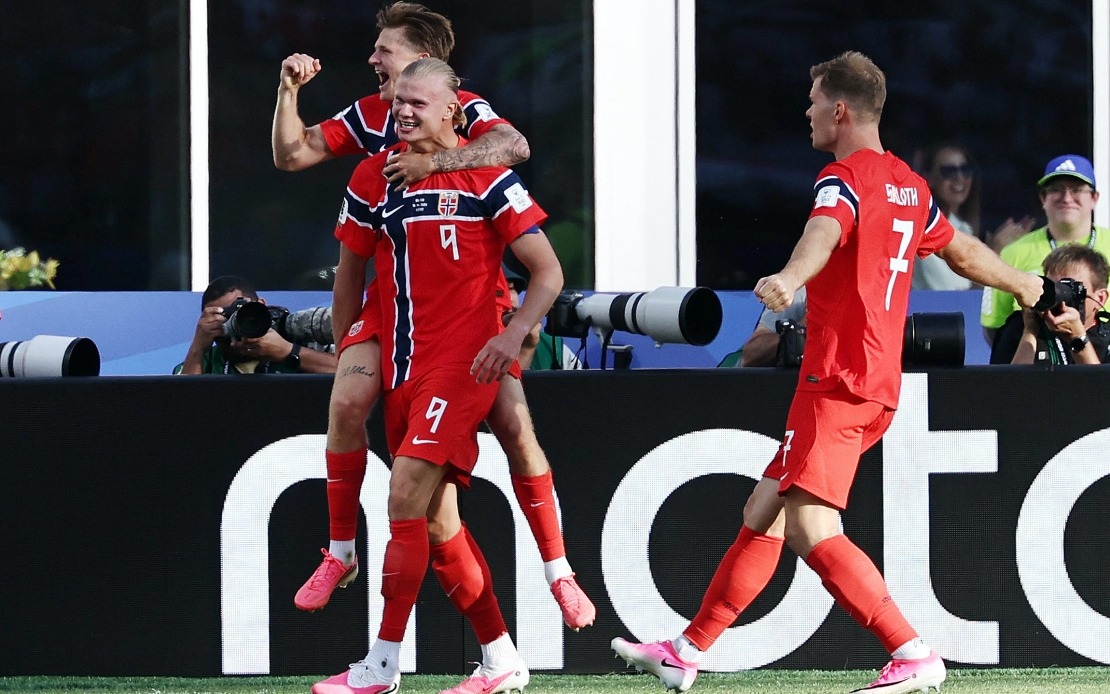
Norway's World Cup campaign carries an unusual emotional weight this year, with three of the team's key players drawing inspiration from their fathers' participation in the 1994 tournament hosted in the United States. Erling Haaland, Alexander Sørloth, and Kristian Thorstvedt represent a generational bridge in Norwegian football, each carrying forward a family legacy while attempting to achieve what their fathers could not—a progression beyond the group stage. The connection between past and present has created a compelling narrative that extends far beyond typical sporting motivation, resonating throughout Norwegian society and offering Malaysian observers an intriguing perspective on how family history shapes athletic ambition.
Norway made a commanding entrance to this World Cup with a dominant 4-1 victory over Iraq, immediately establishing themselves as credible contenders within their group. This strong opening performance provides genuine momentum for the squad's remaining fixtures, particularly as they prepare for a crucial encounter against Senegal on Monday. Should they secure a positive result in New Jersey, Norway would secure passage to the knockout rounds—something their fathers' generation never managed. The stakes feel particularly high for Haaland and his teammates, as a successful progression would represent not merely a personal achievement but a symbolic breakthrough for Norwegian football, erasing three decades of group-stage disappointment at the sport's premier tournament.
Erling Haaland himself has become a towering figure in global football, his phenomenal goal-scoring record at Manchester City making him one of the world's most feared attackers. Yet even with his considerable individual talent and experience at one of England's most successful clubs, the younger Haaland has expressed genuine amusement and connection when confronted with images of his father, Alf-Inge "Alfie" Haaland, from the 1994 campaign. The visual contrast between the youthful, long-haired midfielder of thirty years past and modern professional standards struck Haaland with an almost humorous familiarity. Beyond the generational fashion differences, Haaland follows directly in his father's footsteps by playing for Manchester City, creating a parallel trajectory that underscores the family's deep connection to football excellence.
Alexander Sørloth brings similarly significant credentials to Norway's World Cup squad. Currently plying his trade at Atletico Madrid, one of Spain's most competitive clubs, Sørloth has consciously acknowledged the profound influence his father Gøran exerted on his football education and career development. In statements to the media, Sørloth described the opportunity to compete in a World Cup like his father as "simply great," while crediting his father as the fundamental source of his football knowledge. This explicit recognition of paternal influence sets Sørloth apart as someone deeply aware of—and motivated by—the family continuity in Norwegian football. Interestingly, Sørloth's formative World Cup memory traces back not to 1994 but to 2002 in Japan and South Korea, where he watched matches alongside his father during a family holiday in Denmark, illustrating how his football consciousness was shaped through shared family experiences rather than direct competition.
The narrative of family legacy extends to the third player in this generational trio, Kristian Thorstvedt, whose father Erik Thorstvedt represented Norway in the 1994 World Cup. Like his teammates, Thorstvedt carries the implicit expectation and motivation to surpass what his father's generation achieved, though his particular role within the squad and career trajectory differs from those of Haaland and Sørloth. Nevertheless, the collective presence of these three players creates an unusual dynamic within the Norwegian squad, whereby multiple senior players are simultaneously driven by personal ambitions and family historical resonance.
Norway's path forward in the tournament presents both opportunity and difficulty. Following Monday's encounter with Senegal in New Jersey, the Norwegians conclude their group stage campaign against France, ranked among the tournament's elite contenders. A win or draw against Senegal would effectively secure their advancement, given their strong opening victory. However, France represents an entirely different challenge—a team with formidable technical and tactical resources. The scheduling creates a compelling narrative arc: if Norway can navigate past Senegal, they would face France with their progression already secured, potentially allowing tactical flexibility or rotation. Conversely, failure against Senegal would make the France match a straight knockout-style encounter, where the stakes intensify dramatically.
The generational motivation animating Haaland, Sørloth, and Thorstvedt appears to have permeated Norwegian society at large. Royal patronage underscores the national significance of this World Cup campaign, with hereditary Princess Ingrid Alexandra and Prince Sverre Magnus—the children of Crown Prince Haakon and Crown Princess Mette-Marit—expected to attend Monday's match in New Jersey. Such high-profile support demonstrates how Norwegian football achievement resonates across social strata, from parliament to the royal household. The presence of royal family members at key fixtures sends a powerful message regarding the cultural importance of football within Norwegian identity.
Perhaps most striking is the manner in which Norwegian football fandom has embraced ancient cultural symbols to demonstrate support. Crowd rituals drawing on Viking ancestry have gained such prominence that they have spread from stadium environments into Norway's parliament itself, where MPs from across the political spectrum participated in supportive demonstrations on Thursday. This phenomenon reveals how football provides a vehicle for expressing national identity and collective pride, transcending traditional political divisions. For Malaysian observers accustomed to football's role as a unifying force within diverse societies, the Norwegian example demonstrates how sports competition can crystallize national sentiment and cultural expression across different contexts.
The personal stakes for Haaland, Sørloth, and Thorstvedt extend beyond mere sporting competition. Success in this tournament would definitively answer the unspoken question haunting Norwegian football since 1994: whether the current generation possesses the quality, resilience, and fortune to achieve what their fathers' generation could not. Each player brings elite club-level experience—Manchester City, Atletico Madrid, and other top-tier environments—suggesting they possess the technical and tactical sophistication to compete effectively. Their collective hunger to surpass 1994's group-stage exit provides powerful psychological motivation. Should Norway progress to the knockout rounds, the triumph would belong equally to Haaland, Sørloth, and Thorstvedt as individuals, yet would simultaneously represent vindication of the family legacies driving them forward.
For regional football communities like Malaysia's, the Norwegian situation offers instructive parallels regarding generational cycles in international football and the manner in which family history shapes athlete motivation. Norway's experience demonstrates that maintaining competitive international football requires sustained talent development and cultural continuity, elements that transcend individual brilliance. The presence of multiple players with World Cup heritage creates an unusual scenario where recent tournament experience and family institutional knowledge intersect, potentially providing psychological and tactical advantages that younger, less experienced squads might lack.

