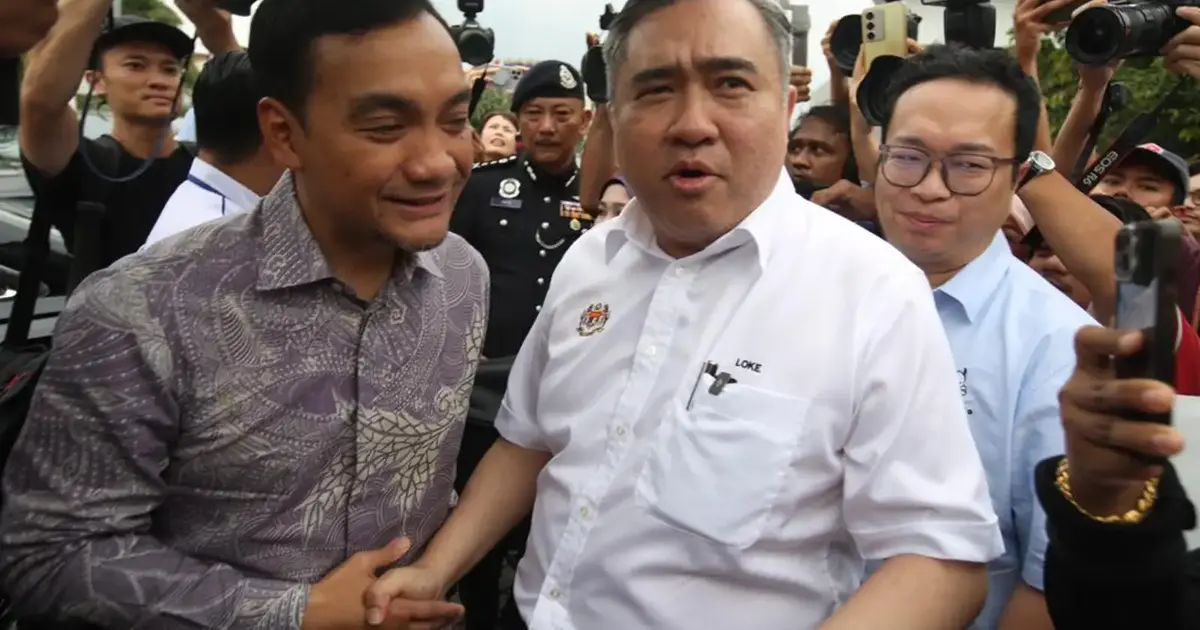
Transport Minister Anthony Loke and Johor Menteri Besar Onn Hafiz put aside recent friction to meet face-to-face for the first time following their online disagreement, demonstrating the political discipline both leaders are keen to maintain despite persistent tensions between the federal transport portfolio and the state administration. The encounter at a ministry-organised event showcased how Malaysian political figures manage relationships across party lines and different levels of government, even when public disputes have created visible cracks in official cordiality.
The meeting took place at an event hosted by the transport ministry, marking a significant moment in the relationship between two influential figures who have found themselves at loggerheads over various policy and administrative matters affecting the state. While both maintained professional decorum throughout the proceedings, the undercurrents of their disagreement remained evident in the carefully chosen words and measured interactions between them, reflecting the delicate balance required in Malaysian coalition politics.
Onn Hafiz seized the opportunity to make a pointed remark about Loke during his remarks at the gathering, commenting on the short notice with which he had been invited to the transport ministry event. The Johor chief executive suggested that he had been forced to reorganise his schedule at relatively brief notice to accommodate the ministry's invitation, a subtle criticism wrapped in the conventional language of political courtesy. This gentle rebuke illustrated how senior politicians can register displeasure while maintaining the facade of collegial cooperation required by the federal-state power structure.
The timing of such gatherings often carries political significance in Malaysia's governance framework. When a federal ministry official extends invitations to state-level counterparts, especially with minimal advance notice, it can be interpreted as an exercise of federal authority or a reflection of strained working relationships. Onn Hafiz's comment about schedule disruption thus served as a controlled expression of frustration without crossing into outright confrontation—a careful calibration that characterises much of Malaysia's upper-level political engagement.
The transport ministry portfolio holds particular relevance to Johor, which serves as a crucial economic corridor for the nation and hosts significant transportation infrastructure projects. Issues ranging from rail development to road management and port operations fall within jurisdictional overlaps between federal and state authorities, creating natural friction points where different visions for state development can clash. These systemic tensions often manifest in personality conflicts between officials at the helm of respective institutions.
Both Loke and Onn Hafiz represent significant political constituencies within their respective parties and regions. Loke commands considerable influence within the Democratic Action Party and the federal coalition, while Onn Hafiz has established himself as a key figure in Umno and Johor's state administration. Their relationship therefore extends beyond personal dynamics to encompass broader questions about how Malaysia's federal-state framework functions and how competing priorities are negotiated between different levels of government.
The earlier online dispute between the two leaders reflected real disagreements over governance approaches, resource allocation, or administrative autonomy—typical friction points in Malaysian federalism. Yet the requirement to appear united before the public, particularly when federal and state representatives gather in official settings, demands that such disagreements be compartmentalised and managed through diplomatic language and careful staging. The transport ministry event provided an opportunity to reset the public narrative while not necessarily resolving underlying substantive differences.
Onn Hafiz's reference to schedule rearrangement carried implications beyond mere logistical inconvenience. It subtly communicated that the Menteri Besar's time and priorities are not automatically subordinate to federal ministry convenience, a positioning important for a state leader seeking to demonstrate autonomous governance capacity to his constituents and political base. Simultaneously, his willingness to attend the event and maintain civility demonstrated recognition of federal authority and commitment to cooperative federalism, striking the balance Malaysian politics demands.
The professional atmosphere maintained by both leaders throughout their interaction reflects lessons learned from how public acrimony between federal and state officials can undermine governance effectiveness and create openings for criticism that other political actors may exploit. By keeping their meeting cordial despite genuine disagreements, Loke and Onn Hafiz avoided giving ammunition to political opponents and preserved the institutional dignity both occupy.
Moving forward, such carefully orchestrated meetings may become more frequent if their respective portfolios continue generating points of friction. The transport ministry's jurisdiction over projects affecting Johor almost guarantees future interactions, making the tone established at this gathering potentially foundational for how these two officials will manage their relationship over coming months. The civility displayed suggests both understand the costs of allowing personal disputes to escalate into public confrontations that could damage their institutional effectiveness and political standing.