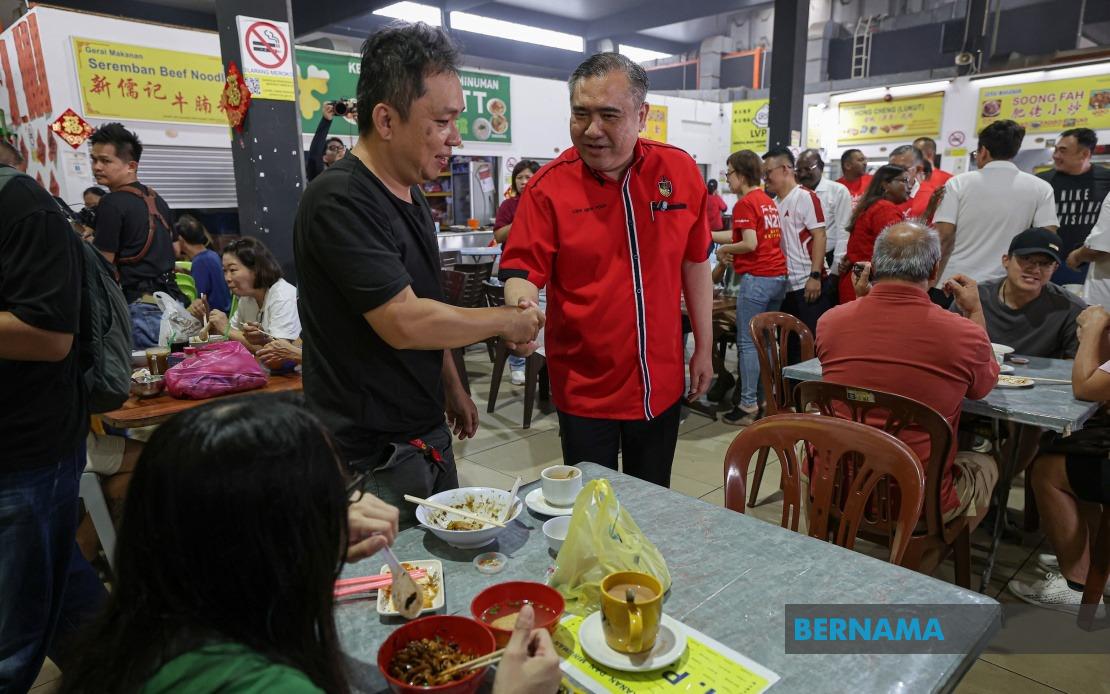
Transport Minister Anthony Loke has laid down an uncompromising requirement for strict adherence to traffic laws and road safety protocols throughout the 16th Negeri Sembilan state election campaign, underscoring that these standards are essential for preventing accidents and maintaining an orderly, secure political environment. Speaking in Seremban after a walkabout with Pakatan Harapan candidates, Loke emphasised that regardless of electoral ambitions, no political party should compromise public safety by ignoring traffic regulations during the campaign period.
The DAP secretary-general went beyond rhetorical warnings by implementing tangible directives within his own party structures. He revealed that he has personally instructed all DAP campaign teams operating in Negeri Sembilan to wear helmets without exception when riding motorcycles during the election period. This measure reflects a broader commitment to leading by example rather than merely issuing instructions that others must follow. Loke acknowledged the competitive nature of electoral campaigns, noting that while every party naturally desires victory, such ambitions cannot justify the deliberate breach of traffic laws that protect public welfare.
To illustrate his commitment to these principles, Loke cited his own conduct during the nomination day proceedings. When organising a convoy that travelled from Pekan Titi to Kuala Klawang, he established a clear prerequisite: participation in the convoy required wearing a helmet. This was not presented as a preference or suggestion but as a non-negotiable minimum standard. By enforcing this requirement uniformly across his own supporters, Loke demonstrated that the responsibility for compliance rests with campaign leadership rather than individual participants who might otherwise be pressured to compromise safety for political visibility.
Beyond helmet usage, Loke identified another dangerous practice that has apparently become common during campaign activities: supporters riding on the tailgates of moving four-wheel-drive vehicles. He characterised this behaviour as recklessly endangering lives and called for immediate cessation across all parties. This specific warning suggests that campaign vehicles, particularly those used for high-visibility activities in rural or semi-rural constituencies, have become sites of unsafe conduct that authorities and campaign organisers must actively police.
The Transport Minister's intervention carries particular significance given his ministerial portfolio and his dual role as the Member of Parliament for Seremban, one of the constituencies directly affected by the election campaign. His position allows him to speak with authority on road safety while also engaging directly with the political process unfolding in the state. This combination of roles lends weight to his directives, as they emanate from both a government safety perspective and a political participant's voice.
The Negeri Sembilan election context frames these safety concerns within a specific temporal and logistical reality. The state assembly was dissolved on June 5, with polling scheduled for August 1 and early voting set for July 28. This compressed campaign timeline intensifies activity, as candidates and supporters mobilise across constituencies in concentrated bursts. The state has 889,490 registered voters split across ordinary voters, military personnel and their spouses, and police officers eligible for early voting, representing a substantial electorate distributed across multiple constituencies requiring extensive campaign coverage.
Loke's call extends beyond his own party to encompass all political organisations contesting the election. He appealed to every party and campaign leader to adopt exemplary conduct regarding traffic compliance, recognising that campaign-related road incidents would damage public confidence in political actors generally. This broader appeal suggests that traffic violations have become sufficiently common during campaign periods to warrant ministerial attention and cross-party coordination.
The emphasis on campaign-trail safety reflects a Malaysian context where motorcycle usage remains prevalent, particularly in constituencies beyond major urban centres. Many supporters rely on motorcycles for campaign participation, making helmet compliance a practical rather than theoretical concern. Similarly, the practice of riders clinging to vehicle tailgates likely occurs in rural areas where campaign vehicles traverse longer distances to reach dispersed voter populations.
Loke's intervention also carries implications for how political campaigns are regulated and monitored during election periods. While the Election Commission establishes the formal rules governing campaigns, safety-related compliance often depends on self-regulation by parties and candidates. By publicly establishing and announcing his party's safety standards, Loke potentially creates informal pressure on rival parties to match these standards, as falling short could invite public criticism and media scrutiny.
The attention to campaign-trail safety represents a broader governance concern about how electoral activities interact with public order and citizen welfare. Accidents involving campaign participants generate costs beyond the immediate victims—they divert emergency resources, generate negative publicity, and can influence voter perceptions of campaign professionalism. By framing safety compliance as a basic requirement of responsible political conduct, Loke positions traffic law adherence as a marker of campaign credibility.
The Negeri Sembilan campaign thus becomes a test case for whether political ambitions can be pursued within strict safety parameters. The state's election, involving nine constituencies and substantial voter numbers, represents a significant electoral contest where the safety standards established now may influence expectations for future campaigns. If candidates successfully maintain safety compliance throughout the campaign period, it could establish a precedent for approaching subsequent elections with similar rigour.

