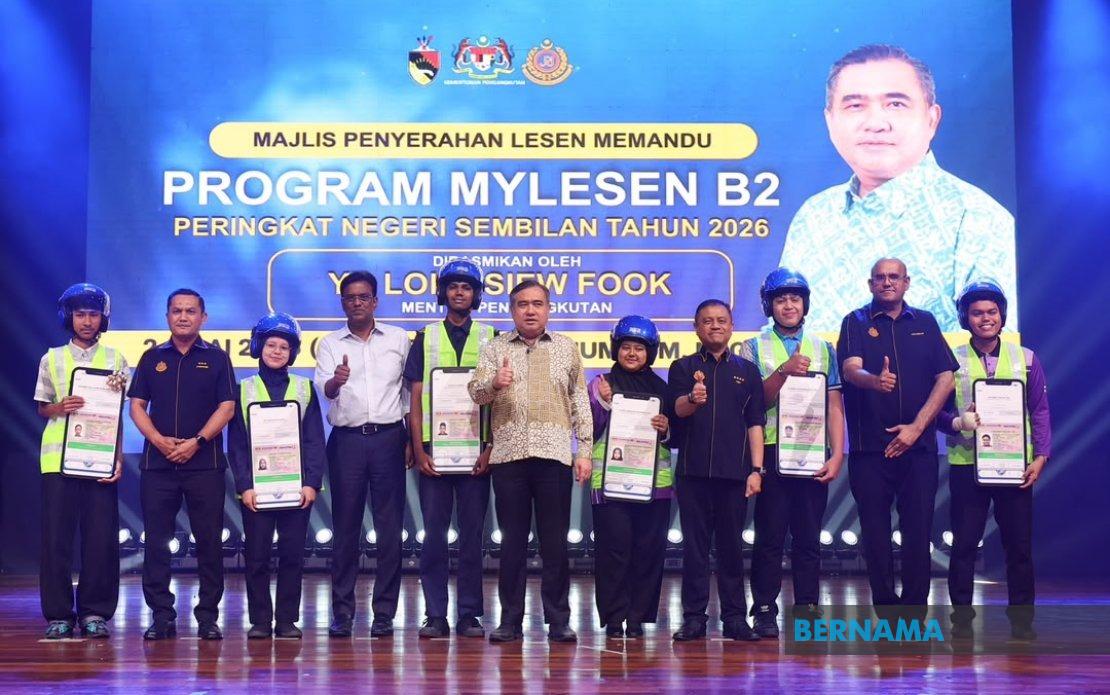
Transport Minister Anthony Loke has issued a stark reminder to young motorcyclists benefiting from the MyLesen B2 Programme: receiving a free motorcycle licence represents an opportunity to travel legally and safely, not a licence to engage in reckless riding or illegal racing activities. Speaking at a licensing ceremony in Seremban on July 2, Loke underscored the fundamental distinction between obtaining legal riding privileges and using those privileges responsibly within Malaysia's traffic framework.
The minister's cautionary message carries particular weight given the sobering statistics he cited about motorcycle-related fatalities on Malaysian roads. According to Loke, approximately 60 per cent of all road accident deaths recorded annually across the country involve motorcyclists and pillion riders, with a disproportionate concentration of victims under the age of 30. This demographic vulnerability has become a persistent public health and transport safety challenge, prompting the government to emphasise behavioural change among younger riders as a critical intervention strategy.
The MyLesen B2 Programme represents a government initiative aimed at democratising access to motorcycle licensing while simultaneously fostering a culture of responsible riding among Malaysia's youth population. Since its inception in 2023, the scheme has distributed licences to more than 100,000 recipients nationwide, effectively reducing barriers to legal motorcycle ownership and operation. However, Loke's remarks suggest that expanding access must be accompanied by equally robust messaging about the obligations accompanying such privileges, particularly during periods when young riders may be most tempted to engage in dangerous behaviours.
Negeri Sembilan has experienced significant expansion under the programme, with the state's quota increasing substantially from 1,000 participants in the previous year to 2,300 this year. Progress toward full implementation has been steady, with 1,979 participants having already secured their Learner's Driving Licences and 1,879 having completed training and passed competency assessments to obtain their Probationary Driving Licences. These figures demonstrate the programme's scale and reach within the state, underscoring the importance of ensuring all new licence holders understand their responsibilities from the outset.
Loke explicitly cautioned against weekend racing culture, a phenomenon that has troubled road safety officials across Southeast Asia for years. He framed recreational riding as an opportunity for safe, purposeful travel rather than a venue for speed competition or vehicle modification showcases. The minister's directive that riders should return home safely rather than engage in illegal street racing reflects mounting government concern about organised or spontaneous racing activities that have contributed to road fatalities and injuries among the young riding demographic.
The broader context of Loke's warnings extends to recent legislative developments designed to combat illegal racing comprehensively. The Dewan Rakyat recently passed the Road Transport (Amendment) Bill 2026, which introduces harsher penalties for individuals caught engaging in illegal racing or speed testing with any class of vehicle. These penalties transcend simple monetary fines to include potential imprisonment, marking a significant escalation in consequences and signalling the government's determination to eliminate dangerous street racing as a cultural and safety phenomenon.
The programme itself functions as both an opportunity and a responsibility mechanism. By providing free access to motorcycle licensing, the government has eliminated financial barriers that previously prevented many Malaysians from obtaining legal riding credentials. Beyond the immediate benefit of legal mobility, the scheme positions motorcycle licences as facilitators of broader socio-economic advancement, enabling recipients to commute to employment, pursue educational opportunities, and improve their overall economic circumstances through lawful transportation means. This framing transforms the licence from a mere operational permit into a tool for social mobility and personal development.
Loke's emphasis on proper safety equipment underscored another dimension of the responsibility narrative. He urged all new licence holders to invest in SIRIM-certified helmets and to wear them consistently, whether riding as the primary operator or travelling as a pillion passenger. This requirement, while seemingly basic, addresses a persistent gap in road safety compliance where many younger riders either neglect helmet use entirely or employ substandard protective equipment that fails to meet national safety standards.
The Road Transport Department and the broader Ministry of Transport apparatus have committed to strengthening the MyLesen B2 Programme's implementation as a cornerstone of the government's comprehensive road safety strategy. Rather than viewing the initiative as a standalone licensing scheme, transport officials now position it within a larger ecosystem encompassing infrastructure improvements, enforcement mechanisms, public education campaigns, and legislative reform. This integrated approach acknowledges that expanding access to licences simultaneously requires expanding education about responsible riding, enforcement of traffic regulations, and consequences for dangerous behaviour.
For Malaysian policymakers and transport officials, the challenge of managing motorcycle safety extends beyond licensing to encompassing cultural attitudes toward road use. Young riders in Malaysia, as across Southeast Asia, operate within social contexts where speed and risk-taking carry certain cultural cachet, particularly during weekend leisure hours. Loke's messaging attempts to reframe these narratives, positioning safe, responsible riding as the socially desirable norm rather than a constraint on personal freedom or social expression. This cultural reorientation represents perhaps the most ambitious dimension of the government's safety intervention strategy.
The expansion of the MyLesen B2 Programme to reach 2,300 participants in Negeri Sembilan reflects confidence in the scheme's effectiveness as a policy instrument, yet also acknowledges ongoing demand from young people seeking to obtain motorcycle licences. As the programme scales up, ensuring consistent messaging about safety and responsibility becomes increasingly important, requiring coordination among transport ministry officials, JPJ personnel, and potentially local community leaders and educational institutions. The presence of senior transport ministry officials and JPJ leadership at the Seremban ceremony underscores the importance attached to maintaining programme quality and safety messaging despite rapid expansion.
The convergence of expanded access, enhanced enforcement, legislative penalties, and sustained safety messaging characterises the government's multifaceted approach to youth motorcycle safety. Whether this combination of policy interventions will successfully reduce fatality rates among young riders remains to be seen, but the consistency of messaging from senior transport officials suggests a genuine institutional commitment to changing both the regulatory framework and the cultural environment surrounding motorcycle use among Malaysia's younger population. The coming years will provide crucial data on whether programmes like MyLesen B2, combined with enforcement and penalties, can bend the trajectory of motorcycle-related fatalities downward among riders under 30.

