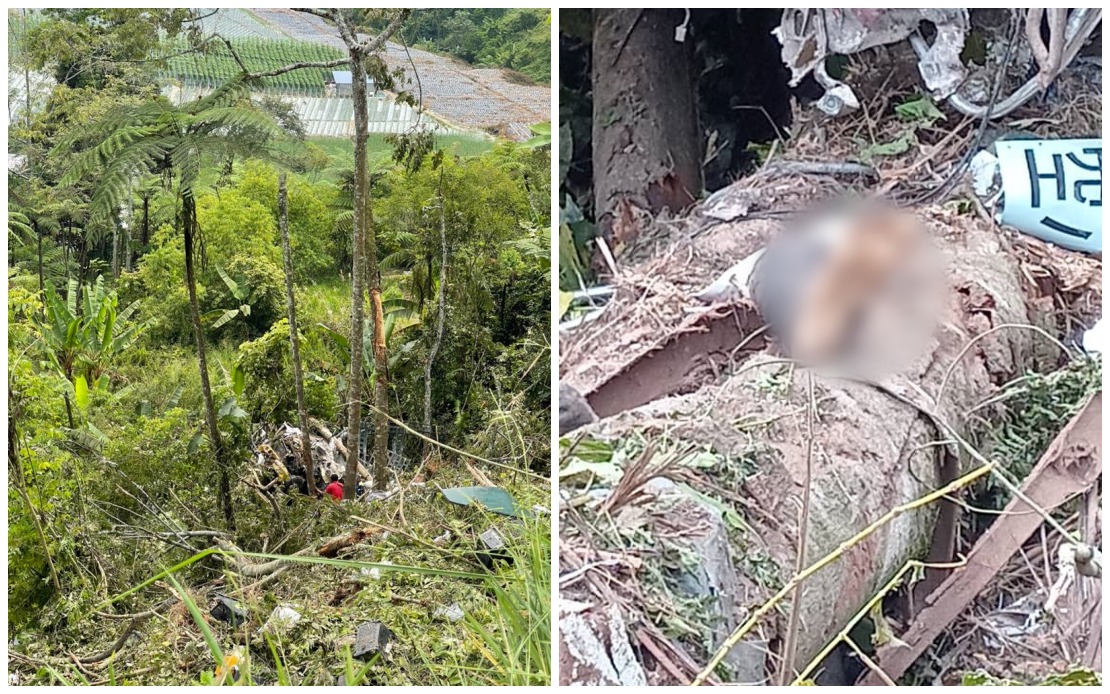
A fatal accident in the mountainous Gua Musang district has claimed the life of a lorry operator whose vehicle careened into a deep ravine on a road near the Pos Blau-Lojing Bridge. The 10-tonne lorry disappeared down the steep incline, which measures approximately 150 feet, ending in tragedy for the middle-aged driver who became trapped beneath debris at the crash site. The incident occurred in an orchard area along what appears to be a remote stretch of highway prone to such accidents due to its terrain and conditions.
Emergency responders were alerted to the situation at 11.58 am, triggering a swift mobilisation of rescue personnel. The Gua Musang Fire and Rescue Station, heading an operation from their base located roughly 98 kilometres away, dispatched a full firefighting team to the location. Due to the distance and challenging terrain typical of the Gua Musang region, the rescue unit did not arrive at the crash site until 1.59 pm, a delay of nearly two hours that hampered efforts to save the victim's life.
Upon arrival, the rescue team discovered a scene of significant destruction. The 10-tonne lorry lay in the ravine, having fallen from the roadway above. The driver, identified as a man in his 40s, had suffered critical injuries in the impact and became pinned beneath the weight of a large tree that had either fallen during the crash or lay at the bottom of the ravine. This combination of vehicle damage and natural obstacles created a complex extraction challenge requiring specialist equipment and careful handling to prevent further harm.
Asst Senior Fire Supt Muhammad Azrul Izzham Zulkifli, chief of the Gua Musang Fire and Rescue Station, detailed the recovery operation in his official statement. Firefighters worked to carefully remove the tree trunk that was trapping the victim, a delicate procedure in the ravine environment. Despite their efforts and technical expertise, the driver could not be revived. Medical assessment at the scene confirmed that death had occurred, likely in the moments following the initial impact or during the extended period before rescue teams could reach the location.
The deceased was not immediately identified by name in the initial police report, though authorities noted his age as approximately 40 years old. Following standard protocol in fatal vehicular accidents, the body was transferred to police custody for documentation, identification processes, and post-mortem examination. These procedures are routine when deaths occur in traffic incidents and help establish the official cause and circumstances of death.
Gua Musang district police chief Supt Sik Choon Foo acknowledged the incident and confirmed that investigative procedures had commenced. The early stages of any crash investigation typically focus on establishing the precise cause of the accident, whether mechanical failure, driver error, road conditions, or other environmental factors contributed to the vehicle leaving the roadway. In cases involving steep mountain passes and remote highways, investigators examine whether visibility, road maintenance, weather conditions, or speed were relevant factors.
The Pos Blau-Lojing area, situated in the Gua Musang district of Kelantan, forms part of a network of roads connecting the interior highland regions with populated lowland areas. These routes are vital for commerce and transportation but present significant hazards, particularly for heavy vehicles navigating winding mountain sections. The specific location near an orchard suggests this may have been a secondary road or a route used for agricultural commerce, which could indicate issues with road standards or maintenance appropriate for regular lorry traffic.
This incident underscores ongoing concerns about road safety in Malaysia's more remote districts, where challenging topography combines with sometimes limited emergency response capabilities. The two-hour delay in reaching this particular crash site exemplifies how distance and terrain can handicap rescue efforts in rural areas. While the firefighting team ultimately performed competently in extracting the victim, the extended response time meant that immediate medical intervention was impossible, a situation that highlights resource allocation challenges in emergency services across dispersed regions.
The death adds to Malaysia's annual toll from road traffic accidents, which disproportionately affect heavy vehicle operators and those travelling on secondary roads. Investigations into this incident will likely examine whether the lorry had undergone proper maintenance, whether the driver was fatigued or experienced, and whether road conditions or signage contributed to the accident. Authorities have indicated that further investigative findings will be released as the police inquiry progresses.
For the freight and logistics industry, such incidents prompt renewed discussion about vehicle safety standards, driver training, and the management of operations on challenging routes. The Gua Musang district and similar inland regions dependent on road transport face recurring safety challenges that require coordinated attention from transport regulators, local authorities, and industry stakeholders to reduce the frequency of such tragic outcomes.

