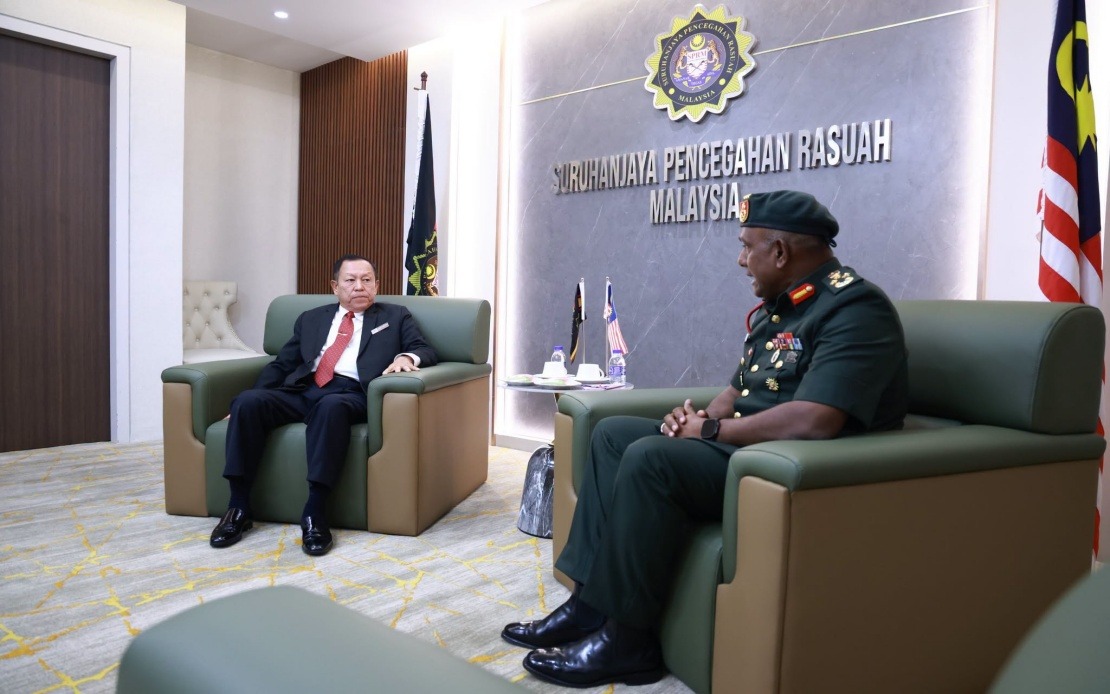
The Malaysian Anti-Corruption Commission and the Malaysian Armed Forces have jointly committed to deepening their institutional relationship in a significant move aimed at fortifying the nation's defences against graft and financial wrongdoing. The two agencies formalised their strengthened cooperation framework during a high-level meeting at MACC headquarters in Putrajaya on July 7, underscoring their mutual recognition that combating corruption requires coordinated effort across multiple government sectors. The initiative reflects a broader recognition within Malaysia's governance structure that no single institution can effectively address corruption in isolation, particularly when misconduct may involve military personnel or assets requiring specialist defence oversight.
At the centre of this enhanced partnership lies a commitment to systematised intelligence sharing and information exchange between the two organisations. MACC Chief Commissioner Datuk Seri Abd Halim Aman articulated confidence that the collaboration will yield tangible improvements in investigative capacity and detection capabilities. By pooling resources and institutional knowledge, the commission and armed forces aim to identify patterns of misconduct that might otherwise escape detection, particularly financial irregularities or procurement violations that span both civilian and military procurement chains. The emphasis on intelligence sharing addresses a documented vulnerability in Malaysia's anti-corruption framework—instances where misconduct has been masked by compartmentalisation across different government agencies or exploited gaps in communication protocols.
Governance enhancement constitutes the third pillar of the cooperation framework, reflecting acknowledgment that institutional reforms and preventive measures often prove more cost-effective than reactive investigation and prosecution. This dimension encompasses improvements to internal controls, audit mechanisms, and accountability structures within defence organisations that handle significant public resources. Malaysia's defence sector manages substantial budget allocations annually, and strengthening governance within these institutions reduces vulnerability to embezzlement, bribery, and tender manipulation. The focus on preventive governance aligns with international best practices in anti-corruption work, where countries have increasingly recognised that systemic institutional strengthening yields superior outcomes compared to pursuing individual cases in isolation.
Lt Gen Datuk Fazal Abdul Rahman, who assumes the directorship of the Malaysian Defence Intelligence Organisation following his official appointment on May 21, articulated the armed forces' unwavering commitment to upholding rigorous governance standards. His emphasis on discipline and professionalism within defence operations signals institutional readiness to subject military personnel to the same scrutiny as civilian public servants. This represents a noteworthy development in Malaysian governance culture, historically marked by somewhat insulated treatment of military institutions. By explicitly endorsing MACC's oversight role and pledging active cooperation, Malaysia's defence leadership demonstrates acceptance of civilian anti-corruption authority and commitment to transparency within traditionally hierarchical and compartmentalised organisations.
The timing of this partnership formalisation carries strategic significance within Malaysia's broader anti-corruption agenda. Following years of major scandals and public pressure for government accountability, establishing visible inter-agency collaboration serves multiple policy objectives simultaneously. Institutionalising cooperation between MACC and the armed forces sends potent signals to both the Malaysian public and international observers regarding government commitment to integrity. For Malaysian citizens, it provides assurance that defence sector funds—derived from taxpayer contributions—will be subject to rigorous scrutiny. Internationally, it strengthens Malaysia's positioning as a jurisdiction serious about governance improvements, an increasingly important consideration for bilateral relations and foreign investment decisions in an environment where ESG criteria and anti-corruption compliance feature prominently in corporate decision-making.
The meeting's attendance by senior officials including MACC Intelligence Division senior director Datuk Saiful Ezral Arifin and MAF Security and Counter Intelligence Directorate director Lt Col Muhamad Zainol Md Yusof underscores the institutional depth of this commitment. These officers represent the operational echelon where intelligence gathering actually occurs and where practical cooperation mechanisms must function effectively. Their presence signals that this partnership extends beyond symbolic leadership statements to encompass genuine integration of working-level procedures and protocols. Such operational alignment proves critical for transforming high-level commitments into measurable improvements in investigative outcomes.
For Malaysian readers, this development carries implications extending beyond headline announcements about governance. The enhanced MACC-Armed Forces cooperation directly affects scrutiny of defence procurement processes, military personnel conduct, and asset management within military organisations. When defence contracts undergo heightened anti-corruption examination, competitive bidding processes become more transparent, costs potentially decrease, and resources reach their intended purposes rather than enriching corrupt intermediaries. Citizens and businesses engaging with defence institutions face clearer expectations regarding ethical conduct and standardised procedures. Moreover, military personnel themselves benefit from clarified standards and reduced tolerance for corrupt practices among their ranks—institutional cultures characterised by integrity and accountability tend to attract and retain higher-quality personnel.
The partnership also addresses a particular vulnerability within Malaysia's governance landscape—the potential for corruption to migrate between sectors. When one institution tightens controls, corrupt officials sometimes redirect their activities toward less-scrutinised organisations. By synchronising anti-corruption efforts across defence and general governance institutions, MACC and the armed forces reduce such displacement effects. Intelligence sharing means suspicious patterns identified in military contexts inform civilian investigations, and vice versa, creating a more cohesive national anti-corruption architecture than exists when agencies operate independently.
Regionally, Malaysia's explicit institutional commitment to joint anti-corruption work positions the country as a governance leader within Southeast Asia. The region faces persistent challenges with institutional corruption, and Malaysia's willingness to implement integrated multi-sector approaches offers a model that neighbouring nations may observe and potentially emulate. As regional economies increasingly compete for international investment and participate in cross-border initiatives, governance capacity and anti-corruption credibility become competitive advantages. Malaysia's institutionalisation of defence sector oversight through MACC cooperation strengthens its profile as a stable, rules-based jurisdiction.
Moving forward, the effectiveness of this partnership will depend substantially on whether initial commitments translate into operational changes. Success metrics might include documented increases in joint investigations, enhanced information flow between institutions, measurable improvements in defence procurement process integrity, and prosecution outcomes demonstrating coordinated effort. Malaysian civil society observers and international anti-corruption monitoring organisations will likely track implementation progress closely. The partnership's long-term impact will ultimately be determined not by ceremonial meetings or institutional declarations, but by observable changes in how defence organisations conduct business and how anti-corruption agencies access and utilise defence-sector intelligence in their investigative work.

