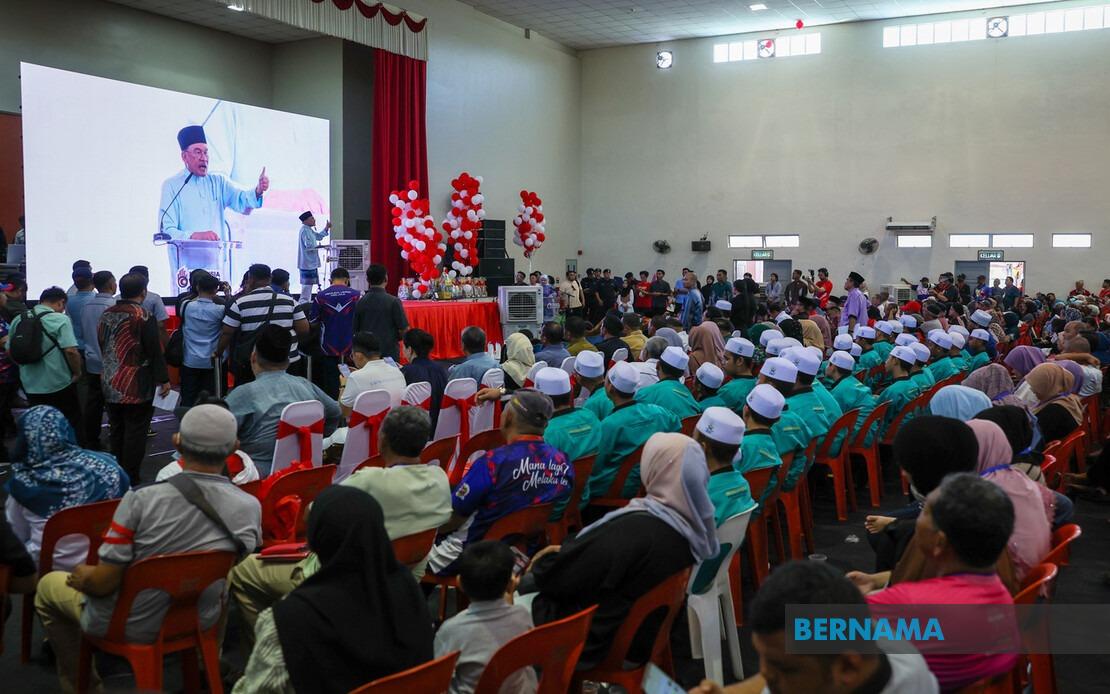
Prime Minister Datuk Seri Anwar Ibrahim has sought to quell concerns about educational equity by emphasising that the MADANI Government's increased allocation to Islamic educational institutions does not represent neglect of other school systems. Speaking at the Gelombang MADANI Carnival in Alor Gajah, Melaka on August 7, Anwar stressed that the government would continue ensuring all communities and educational streams receive fair treatment without marginalising any group, a statement designed to address sensitivities surrounding resource distribution in Malaysia's plural education landscape.
The Prime Minister's remarks come amid broader policy shifts toward strengthening Islamic educational institutions, which he characterised as having been historically overlooked. Anwar noted that pondok schools and tahfiz institutions had endured prolonged neglect and received minimal government support prior to the formation of the Unity Government in 2022, justifying the current push to increase allocations and modernise these institutions. This contextualisation is significant for understanding the government's rationale, though it underscores an implicit acknowledgment that previous administrations had deprioritised religious education.
To address concerns about vernacular schools, Anwar announced that comprehensive support packages for Chinese and Tamil educational institutions have already been scheduled for public disclosure. He indicated these announcements would occur in Kuala Lumpur within approximately two weeks, providing a concrete timeline that aims to demonstrate the government's concurrent commitment to non-Islamic education streams. This sequencing of announcements appears strategically designed to reassure different constituencies that funding decisions reflect inclusive planning rather than zero-sum resource allocation.
The immediate action taken on August 7 included distributing RM1.29 million across thirteen Islamic educational institutions in Melaka state, with funding ranging from RM100,000 to RM250,000 per institution. The recipients included madrasahs, tahfiz centres, and Islamic schools under the Jabatan Agama Islam Melaka, reflecting investments in infrastructure upgrades and educational capacity building. Notably, Anwar mentioned that modernisation efforts include introducing artificial intelligence and computer training programmes, positioning Islamic educational institutions as participants in contemporary technological advancement rather than preservers of tradition alone.
Anwar's broader philosophical argument centred on Malaysia's multicultural success as a cautionary example for divided societies. He observed that Malaysia's stability derives from communities of different backgrounds coexisting with mutual respect, contrasting this with international examples where suspicion, hatred, and distrust have fractured social cohesion and weakened national development. This framing implicitly suggests that equitable educational investment functions as a foundational mechanism for preserving social stability, a perspective that elevates education policy beyond bureaucratic resource management into the realm of national security and social harmony.
The Prime Minister invoked the Islamic concept of 'ummatan wasatan' from Surah Al-Baqarah, verse 143, as a theological foundation for balanced governance. He interpreted this Quranic principle as requiring Muslims to cultivate balanced communities characterised by strong faith, intellectual development, moral integrity, and respectful relations with both fellow Muslims and non-Muslims. Within this framework, Anwar presented environmental stewardship and the elimination of corruption as integral to this balanced approach, thereby connecting education policy to broader governance concerns including institutional integrity and sustainable resource management.
Anwar's vision of 'ummatan wasatan' extended into a call for Malaysia to serve as an exemplary model for global observers. He argued that demonstrable cleanliness, integrity, absence of corruption, and efficient administration should distinguish Malaysia as an aspirational reference point rather than a cautionary tale. This aspirational rhetoric positions educational equity not merely as a domestic policy matter but as an element of national brand and international standing, suggesting that how Malaysia manages education across different communities carries implications for its soft power and international reputation.
The timeline of government action on Islamic education reveals important policy sequencing. Anwar indicated that assistance for religious schools had been discontinued prior to his December 2022 appointment as Prime Minister, with restoration beginning in 2023 and further expansion occurring in 2024. This narrative positions the current administration as corrective, reversing historical underinvestment in Islamic institutions while simultaneously committing to maintaining support for other education streams. However, the precise historical context regarding vernacular school funding during previous administrations remains undefined in his remarks, leaving room for interpretation about whether comparative neglect occurred.
The emphasis on upgrading infrastructure at pondok schools specifically, including computerisation initiatives, addresses a legitimate concern that traditional Islamic institutions could become educationally disconnected from contemporary skill demands. This reflects recognition that isolated preservation of traditional religious curricula without complementary modern technical education could disadvantage students in competitive labour markets. The government's approach suggests integration rather than replacement, positioning Islamic educational institutions as capable of delivering both religious knowledge and practical modern competencies.
For Malaysian stakeholders, Anwar's statements carry practical implications regarding future budget cycles and educational development priorities. The promised announcements regarding vernacular school allocations will test whether rhetorical commitment to equity translates into proportionate resource distribution. Given Malaysia's history of education policy debates spanning communal lines, the government faces scrutiny regarding whether announced allocations genuinely reflect parity in per-student investment or merely maintain nominal parity while favouring growth in Islamic institutions.
The presence of officials including Melaka Chief Minister Datuk Seri Ab Rauf Yusoh and Deputy Higher Education Minister Adam Adli Abdul Halim at the event reflects multi-level government engagement with education policy. This institutional presence suggests coordination across federal and state structures in implementing education development programmes. However, the coordination mechanisms between central allocations and state-level implementation of education policy remain implicit rather than explicitly discussed.
For the broader Southeast Asian context, Malaysia's approach to balancing religious and secular education funding offers a comparative case study. Regional neighbours including Indonesia and Thailand manage similar tensions between strengthening Islamic institutions and maintaining inclusive secular education systems. Malaysia's articulated commitment to equity may influence regional dialogue regarding how plural societies can structure education spending to reinforce rather than undermine social cohesion.
Ultimately, Anwar's statements represent an attempt to reframe education funding as a cohesive rather than divisive policy domain, rooted in philosophical appeals to balance, excellence, and social harmony. Whether this rhetorical framework succeeds depends substantially on the magnitude of announcements forthcoming regarding vernacular school allocations and the degree to which implementation patterns demonstrate genuine equity rather than differential treatment dressed in unifying language.

