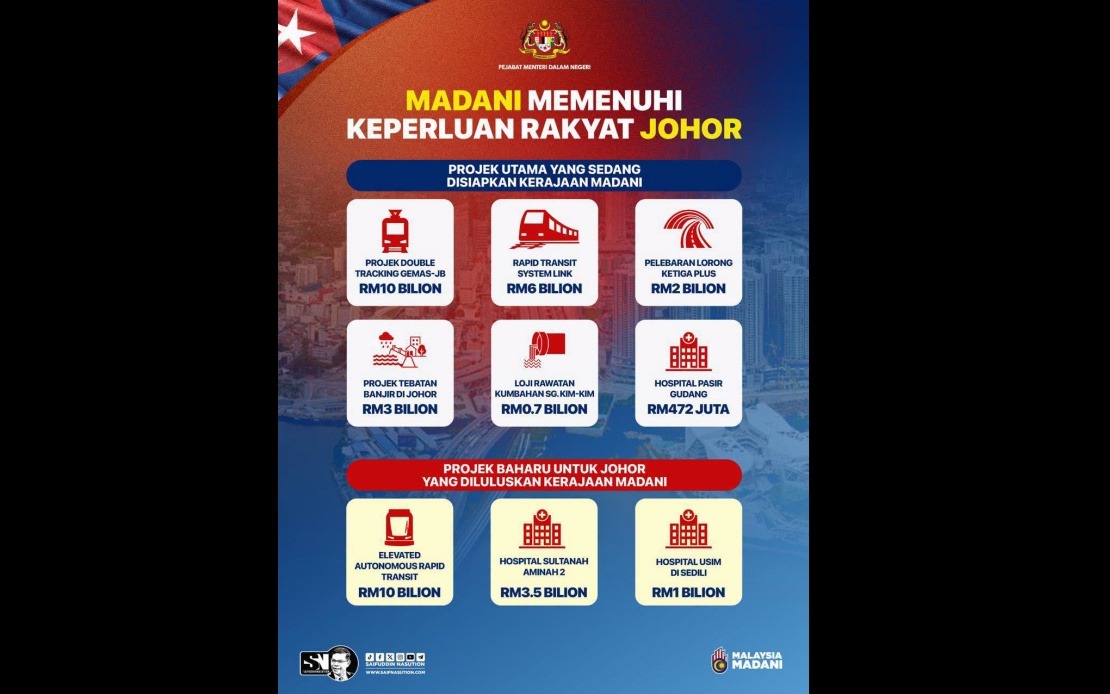
The federal government has reaffirmed its dedication to fostering balanced, inclusive growth across Malaysia's states, with Johor identified as a key focus for development initiatives. Speaking in Johor Bahru on June 29, Pakatan Harapan secretary-general Datuk Seri Saifuddin Nasution Ismail underscored the MADANI administration's resolve to translate policy commitments into tangible improvements in citizens' daily lives. Under Prime Minister Datuk Seri Anwar Ibrahim's direction, the government has prioritised four critical pillars—infrastructure modernisation, public transportation expansion, healthcare accessibility, and flood resilience—as the foundation for raising living standards across the country.
Johor has emerged as a substantial beneficiary of this developmental blueprint, with multiple high-impact projects already underway or in advanced planning stages. The Gemas-Johor Bahru Electrified Double Tracking Project represents a major investment in rail connectivity, designed to ease congestion and reduce travel times for commuters and freight operators alike. Complementing this is the Rapid Transit System (RTS) Link, which aims to create seamless cross-border mobility. The third-lane widening initiative on the PLUS Highway addresses growing traffic demands on one of Malaysia's busiest arterial routes, whilst the Johor flood mitigation programme responds to persistent seasonal challenges that have historically disrupted economic activity and displaced residents.
Water and waste management infrastructure also figures prominently in the state's development agenda. The Sungai Kim Kim Sewage Treatment Plant addresses environmental and public health concerns in Pasir Gudang, an industrial zone that has experienced multiple pollution incidents in recent years. This facility represents a broader commitment to environmental stewardship alongside economic growth—a balance that remains elusive for many Southeast Asian jurisdictions navigating rapid industrialisation.
Healthcare expansion constitutes another pillar of Johor's transformation. The Pasir Gudang Hospital enhances medical service distribution across the state, whilst two newly approved facilities—Sultanah Aminah Hospital 2 and USIM Hospital in Sedili—signal the government's determination to decentralise quality healthcare beyond Johor Bahru's urban core. This geographical dispersal of medical infrastructure is particularly significant for rural and semi-urban residents who historically faced long-distance travel for specialist treatment.
The Elevated Autonomous Rapid Transit (E-ART) system represents an innovative urban mobility solution, incorporating autonomous and elevated rail technology. If successfully implemented, this project could position Johor as a testbed for advanced public transportation models that other Malaysian states might subsequently adopt. Such demonstration effects carry strategic importance for a country seeking to modernise infrastructure while managing urbanisation pressures.
Saifuddin Nasution emphasised that development cannot be measured solely through investment figures or infrastructure asset counts. Rather, genuine progress manifests through employment generation, transportation efficiency gains, healthcare quality improvements, and measurable enhancements to citizen wellbeing. This framing reflects growing recognition that GDP growth divorced from distributional equity and quality-of-life indicators has limited political and social legitimacy in contemporary Malaysia.
The minister's emphasis on inclusive development carries particular resonance given regional economic disparities. Johor, despite its strategic position as Malaysia's gateway to Singapore and its substantial petroleum, manufacturing, and port sectors, has experienced uneven prosperity distribution. Infrastructure investments that enhance connectivity between urban and rural areas, coupled with healthcare and employment access improvements, address longstanding grievances about regional inequality.
For Malaysian readers and policymakers, Johor's development trajectory merits close attention as a potential model for state-level infrastructure governance. The integrated approach spanning transport, healthcare, flood management, and environmental remediation—rather than siloed departmental initiatives—reflects evolving best practices in infrastructure planning. Whether execution matches ambition remains the critical variable; previous Malaysian development initiatives have suffered from implementation delays, cost overruns, and suboptimal maintenance arrangements.
The government's commitment to sustainable, inclusive development also positions Malaysia within regional competition for investment and talent. Singapore's continued economic dynamism and Thailand's infrastructure modernisation efforts have spurred Malaysian policymakers to accelerate domestic upgrades. Johor's prominence in this narrative reflects its economic interdependence with Singapore and its role as a growth corridor attracting both domestic and cross-border investment.
Looking forward, the realisation of these projects will significantly influence voter perceptions of government effectiveness ahead of future electoral cycles. Infrastructure delivery operates as a visible, tangible metric against which ordinary Malaysians evaluate political performance—more so than abstract policy pronouncements. Public expectations have been explicitly raised through these announcements, creating accountability mechanisms that extend beyond formal oversight structures.
The MADANI framework's emphasis on sustainable development also signals ideological positioning distinct from purely growth-oriented policies. Environmental management, flood resilience, and healthcare accessibility represent investments in long-term social stability rather than short-term extractive gains. For a nation experiencing intensifying climate impacts and urbanisation pressures, this conceptual reorientation carries strategic significance.
Regionally, Malaysia's development priorities influence broader Southeast Asian trajectories. Successful implementation of integrated infrastructure solutions in Johor could inform development planning in neighbouring countries facing similar challenges around climate adaptation, urbanisation, and healthcare distribution. Conversely, implementation failures could reinforce scepticism about government capacity for complex, multi-sector project execution that extends beyond traditional engineering-focused infrastructure delivery.

