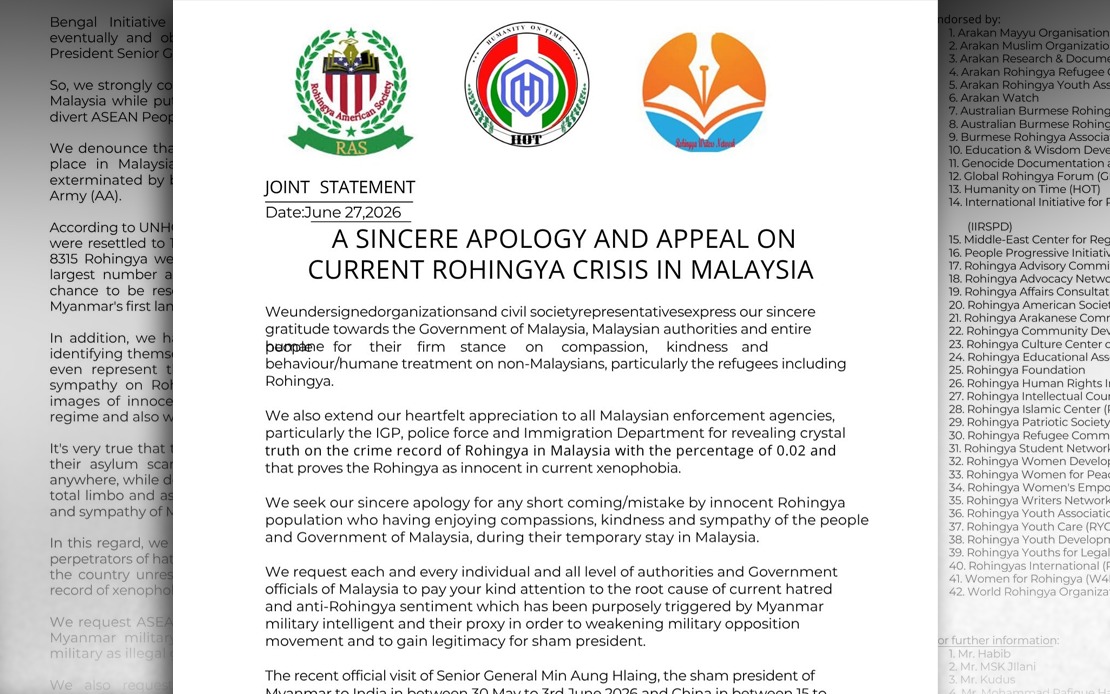
Malaysian Humanitarian Aid and Relief (MAHAR) has responded positively to an apology issued by 40 Rohingya non-governmental organisations, characterising the move as a constructive demonstration of accountability and responsibility within the refugee support sector. The endorsement comes at a time when relations between refugee communities and Malaysian society face ongoing scrutiny, making such gestures of self-awareness from civil society organisations operating within refugee spaces increasingly significant for broader social cohesion efforts.
While acknowledging the Rohingya NGOs' statement, MAHAR has articulated a broader vision for how humanitarian assistance should function in the Malaysian context. The organisation contends that meaningful relief work must transcend the traditional confines of distributing food and shelter—the foundational safety net that emergency responses typically provide. Instead, MAHAR argues that sustainable aid programming should incorporate educational components that help refugees understand their obligations and behavioural expectations while residing in Malaysia, creating a framework where assistance is paired with civic orientation.
Central to MAHAR's expanded vision is the conviction that Rohingya NGOs occupy a unique position to bridge cultural and legal divides between displaced populations and their host society. These organisations, which typically maintain deep trust relationships within refugee communities, possess the credibility and access to communicate the importance of respecting Malaysian laws, cultural norms, and traditional customs. By leveraging their standing, MAHAR believes these groups can cultivate appreciation for Malaysian values and social systems among the populations they serve, thereby strengthening intercommunal understanding rather than allowing parallel societies to develop.
JISMI Johari, President of MAHAR, emphasised that genuine humanitarian work must balance compassion for displaced persons with attentiveness to the security and wellbeing of the Malaysian communities hosting them. This framing acknowledges legitimate safety concerns raised by segments of the Malaysian public, some of whom have experienced incidents involving refugee community members or express anxiety about crime and social disruption. Rather than dismissing these concerns as xenophobia, Johari's statement validates them as reasonable considerations that merit serious engagement from both humanitarian workers and policymakers.
Johari further cautioned against the categorical condemnation of entire refugee populations based on the transgressions of isolated individuals, a logical fallacy that risks ossifying prejudice and undermining the potential for constructive coexistence. He framed this tension as reflecting a universal reality: misconduct and criminality exist across all demographic groups and social strata, whether among locals or newcomers. The challenge, therefore, lies not in identifying which community harbours wrongdoing, but in establishing mechanisms for addressing individual accountability while preserving the dignity of communities.
Achieving this balance requires what Johari described as empathy paired with mutual respect and collaborative problem-solving involving all stakeholders—refugees, NGOs, government agencies, local authorities, and Malaysian citizens themselves. This multi-stakeholder approach recognises that compartmentalised solutions—where humanitarian workers attend only to refugee needs or security forces focus solely on crime prevention—inevitably produce incomplete and potentially counterproductive outcomes. Integrated engagement, by contrast, can build social trust and create shared investment in peaceful coexistence.
MAHAR has also urged the Rohingya NGOs to strengthen their international advocacy operations, directing attention and resources toward systemic solutions rather than merely managing symptoms of displacement. The organisation argues that truly enduring humanitarian progress requires sustained international pressure on the Myanmar government to cease persecution of the Rohingya population and create conditions enabling voluntary repatriation. Without addressing these root causes, humanitarian organisations risk becoming providers of indefinite palliative care for a preventable catastrophe, perpetuating displacement rather than facilitating genuine resolution.
The call for intensified international advocacy reflects an understanding that the Rohingya crisis extends far beyond Malaysia's borders and capacities. While Malaysia has absorbed one of the largest refugee populations globally, bearing considerable burden in healthcare, education, and security provision, ultimate responsibility for resolving the crisis rests with the international community and the government of Myanmar. Malaysian NGOs and humanitarian actors can amplify Rohingya voices and document atrocities, but sustained diplomatic and economic pressure from major powers remains essential for achieving political change.
MAHAR's statement reaffirms its institutional commitment to humanitarian work constructed upon three foundational pillars: justice, safety, and human dignity. This formulation attempts to transcend false dichotomies between humanitarian concern and security pragmatism, instead positioning them as mutually reinforcing values. Justice demands protection for persecuted populations; safety requires functioning societies where communities can coexist without fear; and dignity necessitates treating both refugees and host populations as deserving of respect and agency. By articulating this integrated framework, MAHAR signals that meaningful humanitarian progress in Malaysia's refugee context will require both generosity toward the displaced and responsiveness to the concerns of host communities.

