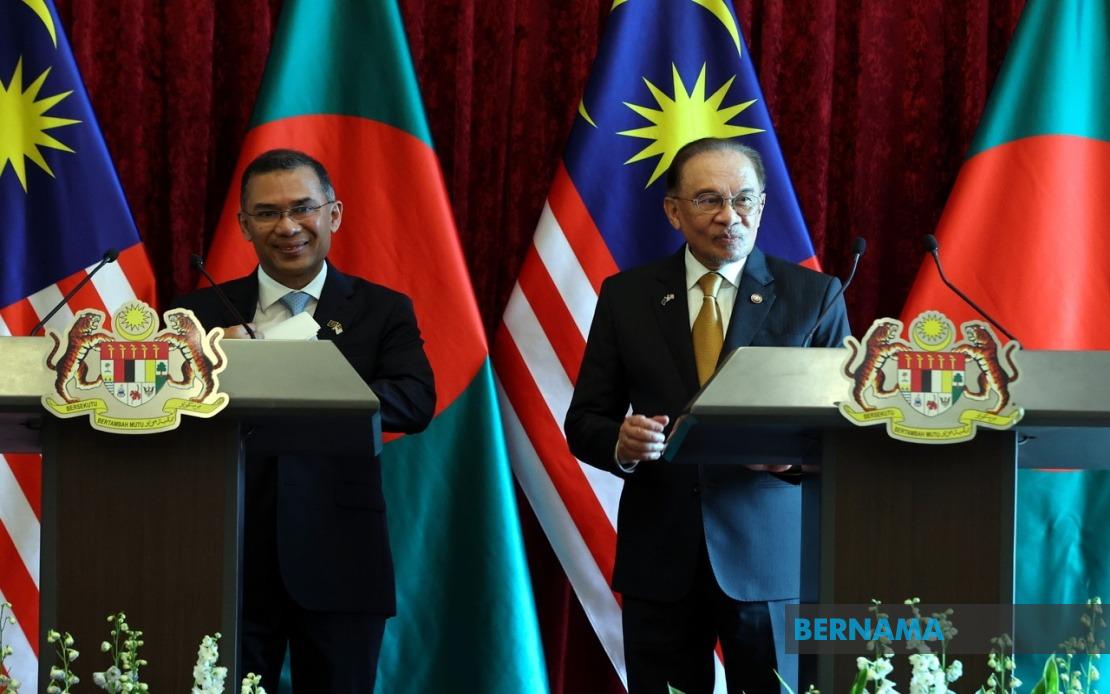
Prime Minister Datuk Seri Anwar Ibrahim has underscored the convergence between Malaysia and Bangladesh on several critical international matters, emphasizing that both nations maintain consistent positions regarding Palestinian affairs, the humanitarian situation in Gaza, stability across the Gulf, and Iran's regional role. Speaking during a joint press conference in Putrajaya on Monday, Anwar highlighted that Malaysia and Bangladesh remain united in their diplomatic outlook and will persist in dialogue with the broader international community to advance peaceful resolutions to these complex geopolitical challenges.
The alignment between Kuala Lumpur and Dhaka reflects a deeper shared worldview rooted in common historical experiences and regional interests. Both countries have positioned themselves as voices for Global South concerns, advocating for the rights of dispossessed populations and resisting what they view as imperialist foreign policy approaches. This convergence extends beyond rhetorical support to practical coordination within multilateral forums, where Malaysia and Bangladesh often coordinate voting positions and joint statements on contentious international matters. For Malaysian policymakers, Bangladesh represents an important ally within South Asia, offering opportunities to amplify Southeast Asian and Islamic world concerns in the broader Asian arena.
The Prime Minister explicitly referenced Malaysia's unwavering support for the Palestinian cause, characterizing the situation in Gaza as marked by systematic atrocities perpetrated by what he termed the Zionist Israeli regime. This framing reflects Malaysia's longstanding diplomatic posture, which has consistently prioritized Palestinian self-determination and criticized Israeli military actions. By publicly reiterating this stance alongside the visiting Bangladesh leader, Anwar demonstrated that Malaysia's position remains firm and enjoys support from significant regional partners, thereby reinforcing Malaysia's credibility among Arab and Muslim-majority nations.
Bangladesh Prime Minister Tarique Rahman's presence in Malaysia carried particular significance as his inaugural official foreign visit since assuming office in February 2024. The decision to make Malaysia the destination for this maiden journey signals the importance Bangladesh places on bilateral relations with Southeast Asia's largest Muslim-majority economy. For Bangladesh, which faces complex regional dynamics involving India, China, and Myanmar, Malaysia offers both a strategic partnership and a model for balancing great power competition while maintaining principled stances on international affairs. The visit itself becomes a symbolic gesture of prioritizing ties within the Muslim world and the Global South.
The discussion of Iran's regional position reflects both countries' interest in maintaining stable relations with Tehran despite international pressure and sanctions regimes. Malaysia and Bangladesh have historically maintained pragmatic diplomatic engagement with Iran, recognizing its geopolitical importance in the Middle East and Indian Ocean region. Both nations understand that excessive isolation of Iran could destabilize the broader region and complicate their own strategic interests. This shared perspective positions them as voices advocating for dialogue rather than confrontation in dealing with Iranian affairs, a stance that distinguishes them from more hawkish regional or international actors.
Anwar's emphasis on continuing engagement with international partners represents a diplomatic strategy aimed at building consensus rather than deepening polarization. Malaysia seeks to position itself as a bridge-builder capable of facilitating dialogue between different blocs, from the Muslim world to non-aligned nations to Western democracies. Bangladesh's agreement with this approach suggests both countries believe multilateral engagement and sustained diplomacy offer more promising paths forward than confrontational stances. This reflects a measured approach to international relations that prioritizes national interests while avoiding isolation or forcing allies into binary choices.
The Prime Minister's warm personal remarks toward Rahman, describing him as part of an enlarged family and emphasizing brotherly bonds, underscore the cultural and civilizational ties binding Malaysia and Bangladesh. Beyond mere diplomatic protocol, these expressions acknowledge the shared Islamic heritage, historical connections, and people-to-people links that characterize the relationship. Many Bangladeshis have family ties to Malaysia through migration patterns spanning decades, and Malaysia hosts a significant Bangladeshi expatriate community. This human dimension enriches bilateral relations beyond governmental interactions and provides durable foundations for sustained cooperation.
The bilateral relationship extends into multiple domains of practical cooperation. Both countries collaborate on maritime issues, trade and investment, labor mobility, and cultural exchanges. The reaffirmation of common international positions should be understood within this broader context of deepening multifaceted engagement. By aligning on major geopolitical questions, both nations signal that their partnership encompasses not merely transactional economic arrangements but shared commitments to principles and global governance issues. This holistic approach strengthens the relationship against inevitable fluctuations in any single sector.
For regional observers, the Malaysia-Bangladesh convergence on Palestine, Iran, and Gulf affairs carries implications for Southeast Asian diplomacy more broadly. As ASEAN member-states navigate complex relationships with major powers, the ability to coordinate positions with South Asian partners like Bangladesh provides additional leverage and demonstrates that Southeast Asian voices need not be isolated or marginal in global affairs. Malaysia's role in facilitating this dialogue reflects its ambitions to play a significant role in regional and international politics, particularly in representing Muslim and developing world interests.
The timing of Rahman's visit also merits consideration given global developments surrounding Middle Eastern tensions and great power competition in the Indo-Pacific. Both leaders' reaffirmation of commitment to peace appears to signal that despite regional turbulence, Malaysia and Bangladesh remain committed to diplomatic solutions and multilateral engagement. This message carries weight at a moment when military escalation and unilateral actions threaten stability across multiple regions. By publicly standing together on these principles, the two countries contribute to a broader narrative favoring negotiation over confrontation.
Moving forward, the Malaysia-Bangladesh relationship appears positioned for expanded cooperation across diplomatic, economic, and cultural dimensions. The successful management of this high-level visit and the clarity around shared international positions provide momentum for deepening institutional ties and people-to-people exchanges. Both nations benefit from stronger bilateral relations that enhance their individual voices on the world stage while creating mutual support mechanisms for advancing shared interests and principles. The visit thus represents not merely a diplomatic courtesy but a substantive affirmation of partnership with potentially enduring consequences for regional and international affairs.

