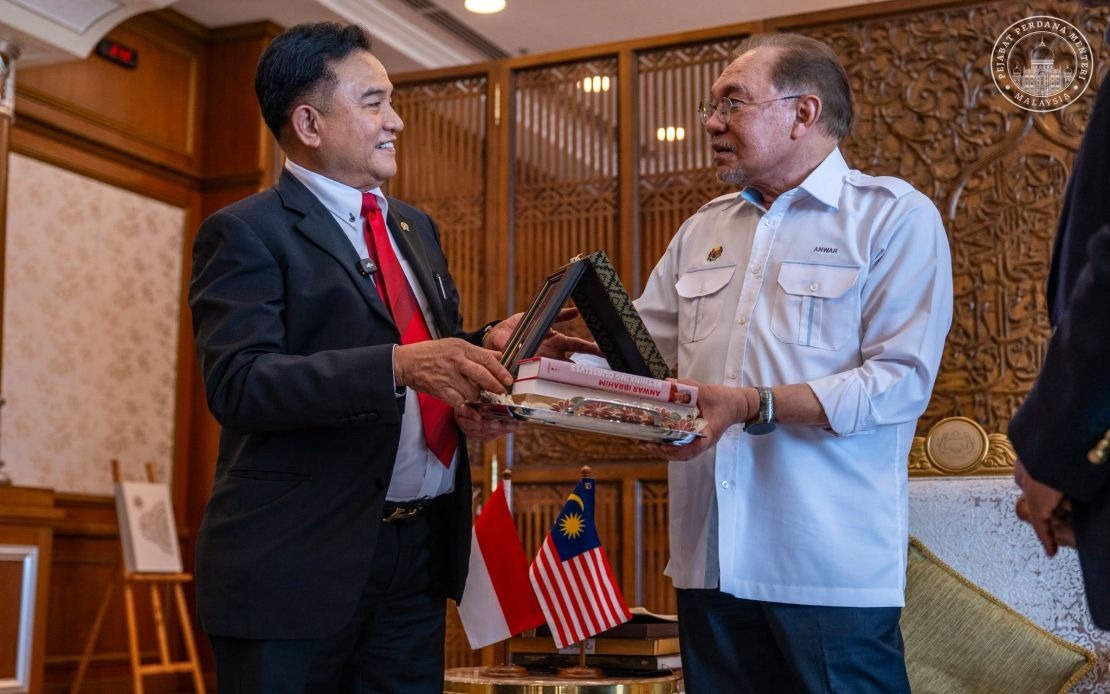
Prime Minister Datuk Seri Anwar Ibrahim has reaffirmed Malaysia's commitment to strengthening bilateral cooperation with Indonesia across legislative, governance, and key strategic domains. The affirmation came during a meeting at the Prime Minister's Office in Putrajaya with Indonesia's Coordinating Minister for Legal, Human Rights, Immigration and Correction, Prof Dr Yusril Ihza Mahendra, who visited to pay his respects to the Malaysian premier.
The bilateral engagement underscores the deepening institutional ties between Southeast Asia's two largest economies and most populous nations. Both governments recognise that harmonising legislative frameworks and governance practices can yield tangible benefits across multiple sectors, from trade and investment to security and people-to-people mobility. The meeting reflected a structured approach to bilateral relations, moving beyond ceremonial courtesy calls to substantive policy discussions on areas of mutual concern.
During their discussion, Anwar and Prof Dr Yusril exchanged perspectives on concrete mechanisms for elevating cooperation in their respective portfolios. For Malaysia, this engagement carries particular significance given Anwar's dual roles as Prime Minister and Finance Minister, positions that allow him to bridge both political and economic dimensions of the relationship. The Indonesian coordinating minister's portfolio—spanning legal affairs, human rights, immigration, and correctional services—touches on critical governance infrastructure that affects millions of citizens across both nations.
The emphasis on legislation and governance cooperation reflects pragmatic recognition that regulatory alignment can facilitate smoother cross-border operations. Malaysian and Indonesian businesses often navigate divergent legal requirements, creating compliance challenges and transaction costs. By working to harmonise legislative approaches in relevant areas, both governments can reduce friction and create more predictable operating environments for investors and traders. This is particularly relevant for regional supply chains and investment flows that treat the two countries as integrated markets.
Human rights and immigration frameworks also feature prominently in this cooperation agenda. Malaysia hosts a significant Indonesian migrant workforce, while Indonesians comprise a substantial portion of Malaysia's irregular migration challenges. Coordinated approaches to immigration governance, labour standards, and human rights protections can address shared concerns more effectively than unilateral action. The inclusion of these themes signals a commitment to addressing migration management comprehensively, combining enforcement with protection of vulnerable populations.
Beyond immediate bilateral gains, this cooperation serves broader regional stability objectives. As ASEAN's two largest members, Malaysia and Indonesia set the tone for regional institutional development. Stronger legislative and governance coordination between them can catalyse best practice sharing across the bloc and reinforce rule-of-law frameworks across Southeast Asia. The partnership also implicitly signals to other regional actors that Malaysia and Indonesia are committed to strengthening rather than fragmenting the regional order.
The timing of this engagement is noteworthy in the broader context of Malaysian-Indonesian relations, which have experienced occasional friction over resource disputes, maritime boundaries, and cultural sensitivities. By focusing on constructive institutional cooperation, both governments are channelling diplomatic energy into productive channels. This approach prioritises shared development objectives over historical grievances, reflecting a mature bilateral relationship capable of compartmentalising disagreements.
From Malaysia's perspective, strengthening governance ties with Indonesia carries implications for domestic policy development. Indonesia's experience with decentralisation, judicial reform, and anti-corruption initiatives offers lessons for Malaysian policymakers. Similarly, Malaysia's experience managing religious and ethnic diversity within constitutional frameworks may provide insights relevant to Indonesian governance discussions. Such knowledge exchange, conducted through official bilateral mechanisms, contributes to institutional learning and policy innovation.
The financial and economic dimensions also merit consideration. Enhanced legislative cooperation can facilitate greater bilateral investment by reducing regulatory uncertainty. For Malaysian companies expanding into Indonesia, harmonised governance standards simplify market entry. Conversely, Indonesian investors operating in Malaysia benefit from clearer regulatory pathways. Over the medium term, deepened bilateral cooperation in these domains can contribute to increased trade flows and investment volumes, supporting job creation in both countries.
Looking forward, the commitment articulated by Anwar suggests forthcoming technical-level discussions and possible working group formations to operationalise these intentions. Government agencies responsible for legislation, immigration, and human rights will likely establish regular consultation mechanisms. Such institutionalisation transforms rhetoric into actionable policy, creating sustained momentum beyond individual ministerial visits.
The broader implication extends to regional architecture. As Malaysia and Indonesia strengthen internal cooperation, they enhance their collective capacity to shape ASEAN's evolution. This cooperation can also model how regional powers balance sovereignty concerns with collaborative governance approaches—a balance increasingly critical as transnational challenges from pandemic response to maritime security demand coordinated action.
For Malaysian stakeholders—whether businesses navigating Indonesian markets, migrant workers, or civil society organisations engaged in cross-border advocacy—this bilateral deepening creates both opportunities and responsibilities. Clearer governance frameworks reduce uncertainty but may also increase regulatory requirements. The coming months will clarify how these cooperation commitments translate into specific policy changes affecting Malaysian interests operating in or connected to Indonesia.

