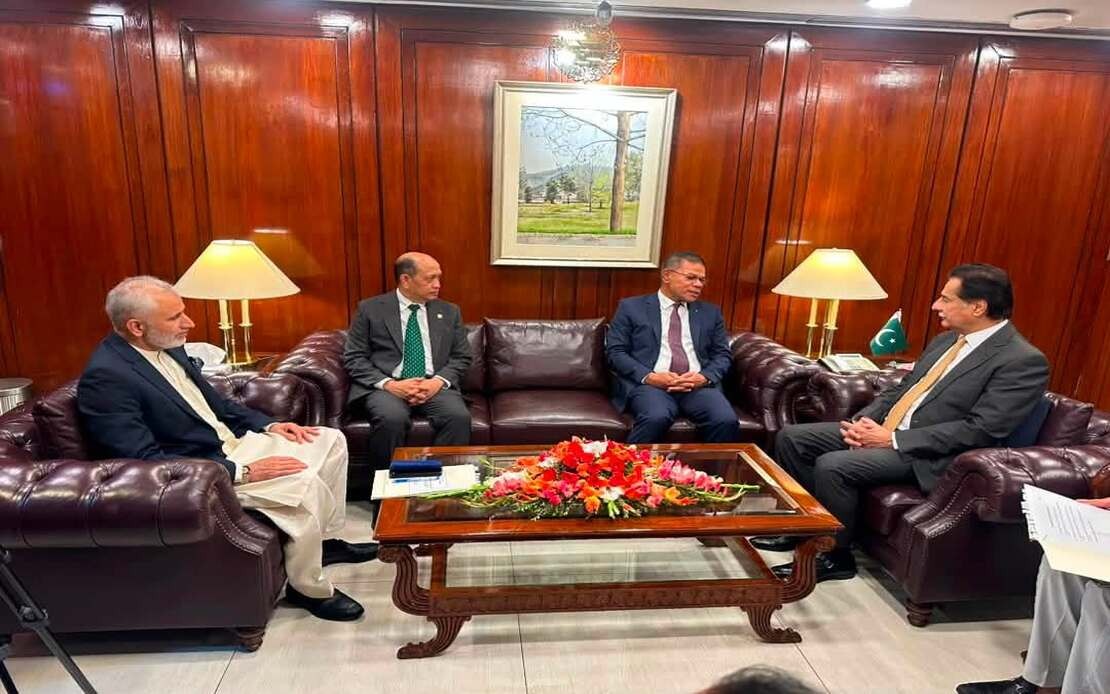
Home Minister Datuk Seri Saifuddin Nasution Ismail has reinforced Malaysia's commitment to peaceful conflict resolution during an official visit to Pakistan, where he engaged senior parliamentary figures in discussions centred on dialogue and diplomacy as tools for managing contemporary regional security challenges. The high-level meetings, conducted in Islamabad on the second day of his visit, reflected both nations' determination to tackle mounting geopolitical tensions through engagement rather than escalation.
During separate consultations with Sardar Ayaz Sadiq, Speaker of the National Assembly of Pakistan, and Syed Yousaf Raza Gilan, chairman of the Senate of Pakistan, Saifuddin Nasution outlined Malaysia's strategic approach to regional stability. He highlighted how Malaysia has leveraged ASEAN platforms to promote constructive engagement, positioning dialogue as a cornerstone of the bloc's efforts to preserve peace in Southeast Asia amid competing great power interests and localised disputes.
The bilateral discussions encompassed a broader assessment of Malaysia-Pakistan relations, which officials characterised as rooted in historical trust, mutual respect, and deep interpersonal connections between their populations. Both sides acknowledged that these foundational elements have enabled sustained cooperation across multiple domains despite geographic distance and distinct regional priorities. The relationship, spanning decades of diplomatic interaction, reflects shared Islamic heritage and common concerns about regional stability, terrorism, and economic development.
A significant focus of the talks was parliamentary diplomacy and the potential for expanded institutional exchanges between the two legislatures. Officials recognised that engagement between parliament members can complement traditional state-to-state diplomacy by fostering people-to-people understanding and creating informal channels for resolving disputes. This recognition underscores a broader global trend of legislatures playing increasingly active roles in shaping foreign policy and building cross-border consensus on contentious issues.
Saifuddin Nasution's visit to Pakistan's Parliament Museum provided him with practical insight into the country's democratic evolution and constitutional development. This educational component served a dual purpose: demonstrating respect for Pakistan's institutional history whilst gathering lessons relevant to Malaysia's own parliamentary governance. The museum visit symbolised Malaysia's genuine interest in understanding Pakistani perspectives and institutional frameworks, rather than viewing the relationship through a purely transactional lens.
The emphasis on dialogue carries particular significance given the contemporary regional environment. Southeast Asia and South Asia face overlapping security concerns ranging from maritime disputes and religious extremism to great power competition and economic fragmentation. Malaysia, as a key ASEAN member, has positioned itself as a voice advocating multilateral solutions and inclusive frameworks that accommodate diverse interests. By publicly reinforcing these principles during talks with Pakistan, Saifuddin Nasution signals Malaysia's consistency in pursuing cooperative approaches even as regional tensions mount.
Parliamentary diplomacy represents an often underutilised channel for building consensus on security matters. Unlike executive-level discussions which may be constrained by political sensitivities or strategic calculations, parliamentary engagement can sometimes generate more candid exchanges and longer-term relationship building. Both Malaysia and Pakistan have demonstrated willingness to invest in these institutional connections, recognising that legislators who develop working relationships across borders become advocates for continued cooperation within their respective systems.
The timing of this visit reflects broader diplomatic patterns in which regional powers are intensifying engagement to manage security challenges cooperatively. Pakistan, like Malaysia, faces pressures from terrorism, internal stability concerns, and the need to balance relationships with major powers pursuing competing agendas in Asia. The discussions about shared security challenges and dialogue-based solutions likely extended to terrorism financing, extremist recruitment, and cross-border security cooperation.
For Malaysian readers and policymakers, this engagement underscores a fundamental principle guiding national foreign policy: the belief that inclusive regional frameworks and sustained diplomatic contact produce better security outcomes than isolation or confrontation. As tensions between major powers influence Southeast Asian calculations, Malaysia's demonstrated commitment to dialogue with Pakistan and other nations reinforces its positioning as a bridge-builder rather than an aligned actor taking sides in geopolitical competitions.
The outcome of these discussions, whilst not yielding dramatic policy shifts, validates the incremental approach both nations employ to deepen institutional ties and mutual understanding. Regular high-level visits, parliamentary exchanges, and consultative forums create habitual patterns of cooperation that resilience during periods of tension. For Malaysia, such engagement with Pakistan also demonstrates commitment to the Islamic world's diplomatic community, reinforcing its identity as a moderate Muslim-majority nation capable of building consensus around shared interests.
Looking forward, the emphasis on expanded parliamentary cooperation suggests both nations intend to broaden their engagement beyond traditional diplomatic channels. This expansion could encompass legislative delegations, joint committees on regional security matters, and coordinated positions on multilateral platforms. Such institutionalised cooperation tends to outlast individual administrations and creates vested interests in maintaining good relations among political actors across the spectrum.
The visit ultimately illustrates a diplomatic principle increasingly relevant to contemporary geopolitics: that smaller and medium-sized powers can exercise meaningful influence by maintaining principled commitments to dialogue and by building networks of cooperative relationships. Malaysia's approach, reflected through Saifuddin Nasution's engagement with Pakistani counterparts, demonstrates how consistent advocacy for peaceful solutions, combined with sustained institutional interaction, can provide stability in an uncertain regional environment.

