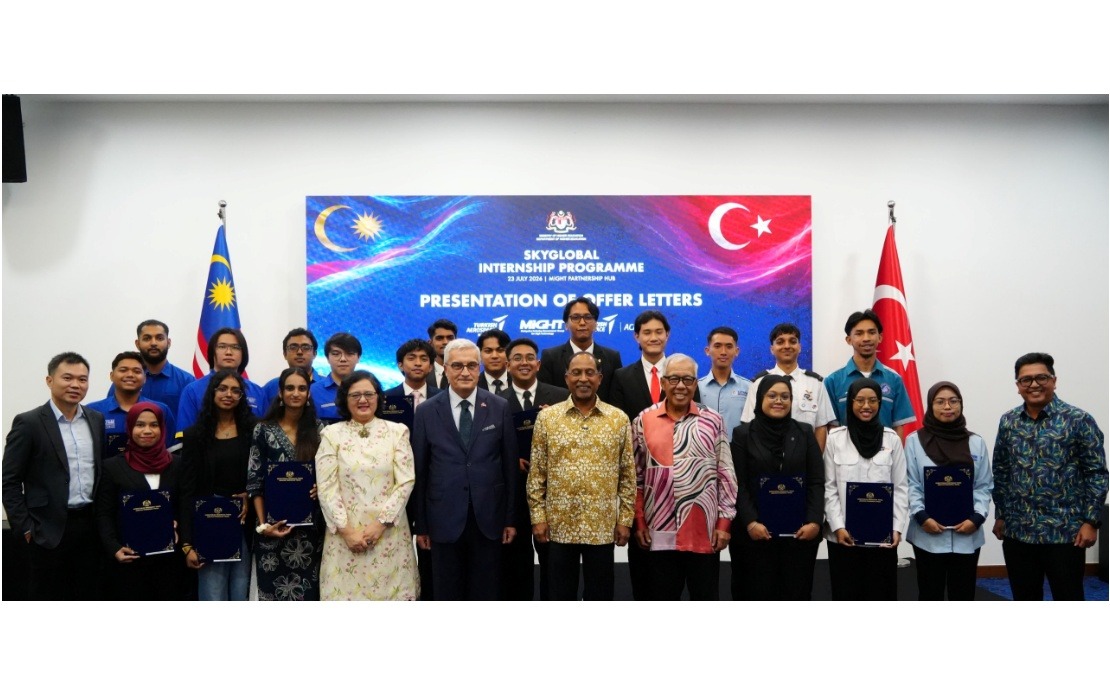
Malaysia and Türkiye are strengthening their bilateral partnership through a landmark aerospace talent development initiative, with twenty Malaysian students selected to participate in the SKY Global Internship Programme 2026. The announcement, made in Putrajaya on July 24, represents a significant milestone in human capital development for the region's aerospace sector, underpinning deeper institutional ties between the two nations while addressing critical skills gaps in advanced manufacturing.
The programme emerges from a collaborative framework involving the Malaysian Industry-Government Group for High Technology (MIGHT), Turkish Aerospace (TUSAŞ), TUSAŞ Akademi and the Consortium of Malaysian Universities (CMU). Now entering its fourth year of operation, the initiative has already shaped the careers of fifty-six Malaysian engineering graduates, with the latest cohort comprising students drawn from nine domestic universities. The expansion demonstrates growing confidence in Malaysia's capacity to produce globally competitive aerospace professionals and reflects sustained institutional commitment to this strategic partnership.
Participating students will undertake intensive, hands-on training across multiple aerospace disciplines during their time at TUSAŞ headquarters in Ankara. The curriculum spans avionics systems, electronic design and programming, aircraft structural analysis, and systems installation—fields essential to modern defence and commercial aviation manufacturing. By situating learning directly within an internationally recognized aerospace manufacturer, the programme ensures students gain practical exposure that transcends conventional classroom instruction, exposing them to industry workflows, quality standards and problem-solving methodologies employed by leading global players.
Higher Education Minister Datuk Seri Dr Zambry Abd Kadir emphasized during the offer ceremony at the MIGHT Partnership Hub in Cyberjaya that the initiative transcends conventional student exchange frameworks. Speaking alongside Ambassador of the Republic of Türkiye to Malaysia Dr Nevzat Uyanık, Zambry articulated how the programme strengthens people-to-people connections while facilitating institutional collaboration in research, technology and knowledge transfer. The minister framed aerospace talent development as integral to Malaysia's broader ambitions in higher education and innovation, positioning bilateral cooperation as a vehicle for building mutual prosperity.
TUSAŞ Malaysia Chief Executive Officer Mohd Shahiman Sulaiman highlighted the company's strategic interest in this talent pipeline, noting that partnerships with ten Malaysian universities provide a sustainable recruitment mechanism for the expanding regional aerospace ecosystem. Beyond immediate training objectives, the internship serves as a talent identification mechanism, allowing TUSAŞ to evaluate Malaysian graduates against international performance benchmarks while exposing the company to emerging innovators from Southeast Asia. This bidirectional value creation—where employers gain access to fresh talent while students access world-class technical exposure—underpins the programme's long-term viability.
The employment outcomes achieved thus far validate the programme's effectiveness. Three alumni have secured two-year placement positions with TUSAŞ in Türkiye, demonstrating that Malaysian engineering graduates successfully meet rigorous international standards and adapt effectively to global working environments. These placements carry broader significance for Malaysia's aerospace ambitions, signalling to regional and international aerospace companies that local talent can compete credibly on the global stage. The precedent encourages further hiring of Malaysian professionals by international aerospace manufacturers, creating pathways for sustained career advancement and knowledge repatriation.
Tan Sri Dr Ir Ahmad Tajuddin Ali, MIGHT's joint chairman for Industry, articulated the programme's strategic importance for Malaysia's positioning as a regional aerospace hub. He emphasized that world-class talent development constitutes a foundational requirement for competitive advantage in aerospace manufacturing, where technical sophistication and innovation directly determine market competitiveness. The initiative therefore represents not merely training provision but strategic investment in Malaysia's long-term industrial capabilities, acknowledging that aerospace sectors in advanced economies depend fundamentally on sustained human capital development.
The programme's scope extends beyond individual student development to institutional and sectoral strengthening. By expanding professional networks between Malaysian universities and Türkiye's aerospace industry, the initiative creates frameworks for ongoing research collaboration, technology sharing and joint problem-solving. Such institutional connections often generate follow-on partnerships in specialized research areas, technology licensing and manufacturing collaboration—domains where Malaysia and Türkiye can leverage complementary capabilities.
For Malaysian policymakers and industry stakeholders, this partnership illuminates strategic pathways for aerospace sector development. Rather than attempting to build domestic expertise in isolation, Malaysia leverages existing global expertise through structured exchange, acquiring tacit knowledge and building relationships with established manufacturers. The MIGHT-TUSAŞ partnership model demonstrates how developing economies can accelerate capability acquisition by engaging strategic collaborators, simultaneously building human capital while facilitating technology transfer and knowledge diffusion.
The broader regional context enhances the programme's significance. Southeast Asia's aerospace sector remains nascent compared to established regional players, with Malaysia aspiring to position itself as a manufacturing and innovation hub. Initiatives generating internationally-trained, globally-networked aerospace professionals directly support this ambition by ensuring the region can attract aerospace manufacturing investment and develop indigenous innovation capabilities. Students returning from Ankara carry not merely technical credentials but international exposure and industry networks that facilitate knowledge circulation within domestic aerospace clusters.
Looking forward, the programme's expansion trajectory merits attention. As awareness spreads among Malaysian universities and prospective students, demand for internship positions will likely exceed available placements, potentially driving programme scaling. MIGHT and TUSAŞ may consider mechanisms for accommodating growing interest while maintaining training quality and rigorous selection standards. Additionally, alumni networks could be formalized to facilitate ongoing collaboration, knowledge sharing and mentorship among programme participants and their employers across Malaysia and Türkiye.
The SKY Global initiative ultimately reflects a mature approach to aerospace talent development—one recognizing that excellence requires sustained investment, international exposure and institutional collaboration. For Malaysia, the programme represents tangible progress toward regional aerospace competitiveness, generating skilled professionals, strengthening bilateral relationships and positioning the country as an attractive destination for aerospace manufacturing investment. As Malaysia's aerospace ambitions expand, such strategic partnerships will prove increasingly central to realizing industrial aspirations.

