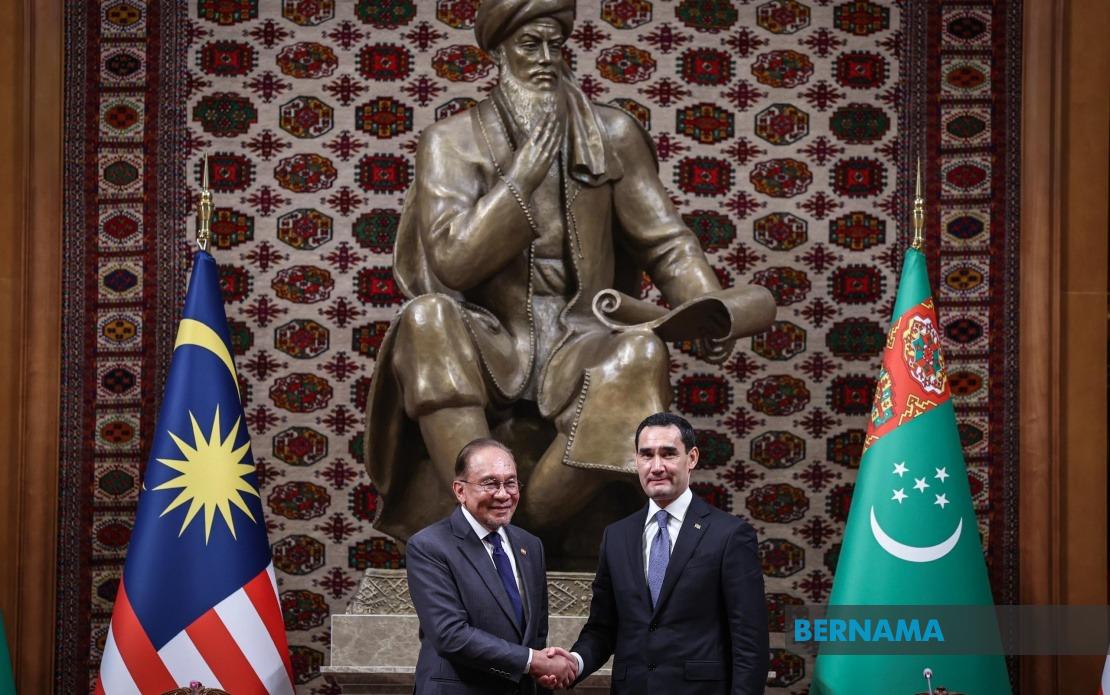
Prime Minister Datuk Seri Anwar Ibrahim has announced a fresh commitment from Malaysia and Turkmenistan to deepen their bilateral relationship through a carefully structured framework that prioritizes long-term strategic interests and tangible benefits for both populations. The declaration emerged following substantive discussions between Anwar and Turkmenistan President Serdar Berdimuhamedov at the Presidential Palace in Ashgabat on Friday, during which the two leaders and their delegations conducted comprehensive talks spanning multiple sectors critical to regional cooperation and economic growth.
The commitment takes concrete form through the exchange of multiple binding documents that signal serious intent from both governments to operationalize their stated partnership goals. Malaysia and Turkmenistan signed three memoranda of understanding alongside a formal Air Services Agreement, creating a legal foundation for expanded cooperation. These instruments include bilateral frameworks involving Malaysia's Institute of Diplomacy and Foreign Relations partnering with Turkmenistan's Institute of International Relations, linking the transport ministries of both nations, and establishing scientific collaboration between Malaysia's Academy of Sciences and its Turkmenistan counterpart. The breadth of these agreements underscores recognition that meaningful partnerships require institutional architecture spanning diplomatic, logistical, and knowledge-exchange dimensions.
During the joint press conference, Anwar emphasized that both delegations had aligned on implementation principles requiring disciplined execution, transparency, and measurable effectiveness across all cooperative ventures. This emphasis on governance standards reflects contemporary best practices in international partnerships, where aspirational declarations have given way to accountability frameworks. For Malaysian observers, this approach signals Anwar's administration prioritizing deliverables over rhetoric—a strategic positioning particularly relevant as Southeast Asian nations increasingly compete for influence and economic partnerships across Central Asia and beyond.
The scope of cooperation discussed spans sectors fundamental to Malaysia's economic diversification agenda and Turkmenistan's modernization priorities. Energy cooperation stands foremost, reflecting Turkmenistan's significant natural gas reserves and Malaysia's sophisticated downstream petroleum and liquefied natural gas expertise. Trade and investment discussions acknowledge mutual opportunities for Malaysian companies to access Central Asian markets while Turkmenistan explores partnerships with ASEAN-linked enterprises. The inclusion of halal industry and Islamic banking cooperation reveals strategic recognition that Malaysia's established position as a global halal hub and Islamic financial leader creates natural synergies with a nation where Islamic traditions intersect with state identity.
Education, research, and scientific technology collaboration represent longer-term investments in human capital and innovation capacity. These dimensions typically attract less media attention than commercial agreements but often yield substantial returns through technology transfer, skills development, and institutional knowledge-sharing. For Malaysia's research sector and academic institutions, partnerships with Turkmenistan's Academy of Sciences could facilitate joint projects while expanding Malaysian expertise into Central Asian markets and research networks. Tourism and air connectivity provisions address the practical requirements of deepening people-to-people contact—essential for sustaining diplomatic relationships beyond government-to-government exchanges.
The Air Services Agreement deserves particular attention within the Malaysian context. Enhanced air connectivity between Kuala Lumpur and Ashgabat facilitates business travel, tourism flows, and cultural exchange while positioning Malaysian aviation interests in Central Asia. Flag carrier Malaysia Airlines and regional carriers gain regulatory frameworks for expanded service offerings, potentially opening routes that strengthen Malaysia's position as a Southeast Asian aviation hub with genuine intercontinental reach. For Malaysian business travelers and investors seeking Central Asian opportunities, improved direct flight options reduce friction and transaction costs.
Anwar's visit represents his first official trip to Turkmenistan since assuming office as Malaysia's 10th Prime Minister in November 2022, suggesting deliberate prioritization of Central Asian engagement within his administration's foreign policy architecture. The accompanying ministerial delegation—including the Minister of Investment, Trade and Industry Datuk Seri Johari Abdul Ghani and Minister of Economy Akmal Nasrullah Mohd Nasir—indicates government commitment to translating diplomatic declarations into concrete investment and trade flows. This high-level participation signals to Malaysian business communities that Central Asian markets deserve serious strategic consideration.
Turkmenistan's geographic position along historic Silk Road corridors and its substantial energy resources position it strategically within broader regional competitions involving Russia, China, and Iran. Malaysia's engagement with Turkmenistan, conducted through established diplomatic protocols and formalized partnership frameworks, reflects careful positioning within complex Central Asian geopolitics. By emphasizing structured cooperation and mutual benefit rather than zero-sum competition, Malaysia positions itself as a reliable, principled partner—an approach particularly valuable given historical skepticism toward external actors in the region.
The joint statement signed by Anwar and President Berdimuhamedov provides the formal foundation for implementing the various memoranda exchanged during the visit. Such statements typically commit both governments to establishing joint commissions, scheduling regular high-level consultations, and establishing timelines for implementing specific cooperative initiatives. For Malaysian stakeholders monitoring this partnership's development, these mechanisms create accountability touchpoints and regular review opportunities.
The partnership framework reflects broader Southeast Asian engagement strategies toward Central Asia, where ASEAN members increasingly recognize opportunities for diversified partnerships beyond traditional regional and global great powers. Malaysia's approach—combining diplomatic sophistication with practical sectoral focus—demonstrates how middle-power nations can develop substantive relationships in distant regions through persistent engagement and clearly articulated mutual benefits. As global supply chains continue fragmenting and nations seek alternative partnerships, Malaysia's willingness to invest diplomatic capital in Central Asian relationships positions the country advantageously for future cooperation opportunities spanning energy security, trade diversification, and regional influence.

