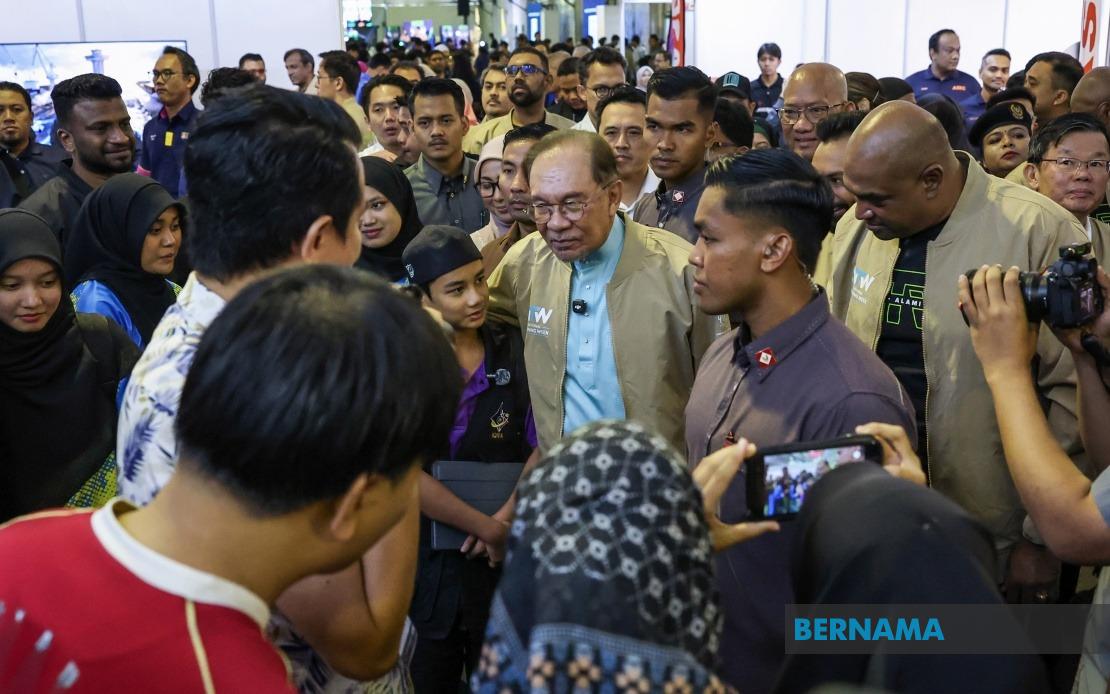
Prime Minister Datuk Seri Anwar Ibrahim has delivered a stark warning that Malaysia's path to becoming a truly developed nation remains blocked as long as its citizens cling to outmoded ideologies that fragment society along divisive lines. Addressing the closing ceremony of National Training Week (NTW) 2026 at Universiti Teknologi MARA (UiTM) Permatang Pauh in Bukit Mertajam on July 25, Anwar emphasised that entrenched hateful thinking among Malaysians—particularly the tendency to weaponise racial and ethnic differences—represents perhaps the nation's most insidious obstacle to progress.
The Prime Minister's intervention on this recurring theme signals mounting frustration within the government about the persistence of divisive political rhetoric in Malaysian public discourse. His comments come at a moment when the nation is attempting to consolidate economic gains and position itself as a competitive regional player, yet domestic political factionalism continues to consume energy and distract from development priorities. Anwar's framing of divisive politics as fundamentally incompatible with developed-nation aspirations reflects a deliberate rhetorical strategy: casting national unity not merely as a virtue but as an economic necessity.
Critically, Anwar positioned the younger generation as the fulcrum upon which Malaysia's future turns. He argued that today's youth must consciously reject the sectarian politics of previous decades and emerge as a cohesive force capable of driving meaningful transformation. This generational appeal carries particular weight given demographic shifts and the growing political volatility among younger voters who increasingly view traditional racial and religious framing as irrelevant to their lived concerns about jobs, housing, and economic opportunity.
The MADANI Government's governing approach, as articulated by Anwar, relies on dialogue and inclusive policymaking rather than exploiting divisions or mobilising constituencies through inflammatory messaging. This philosophy directly contrasts with the opposition's approach, though Anwar did not explicitly name rivals. The emphasis on resolving issues affecting all segments of society through structured engagement suggests the government sees collaborative governance as both ethically preferable and strategically superior to zero-sum political competition.
Anwar also used the platform to reinforce the government's commitment to human capital development through expanded training and upskilling initiatives. He specifically highlighted the expansion of programmes administered through the Ministry of Human Resources and the Human Resource Development Corporation (HRD Corp), framing skills enhancement not as charitable welfare but as essential infrastructure for economic competitiveness. This linkage between individual employability and national prosperity underscores an understanding that Malaysia's regional standing depends on workforce quality, not political rhetoric.
The Prime Minister urged young Malaysians to maximise the training opportunities embedded within National Training Week itself, while simultaneously calling for constructive feedback to refine the skills development ecosystem. This invites genuine participation rather than passive consumption, positioning youth as stakeholders in shaping vocational and professional pathways. The emphasis on earning potential and job security speaks directly to generational anxieties about economic mobility that transcend traditional political divisions.
Flanking Anwar at the ceremony were Penang Chief Minister Chow Kon Yeow and Human Resources Minister Datuk Seri R. Ramanan, both representing key constituencies within the governing coalition. Their presence underscored the pan-coalitional commitment to the training initiative and sent subtle signals about unity within the MADANI administration despite occasional factional tensions.
Simultaneously, Anwar referenced Malaysia's recent macroeconomic achievements to buttress his broader argument about national potential. The ringgit's emergence as Asia's best-performing currency, record foreign investment inflows, and sustained economic growth all represent tangible outcomes of the administration's policy direction. These accomplishments serve Anwar's implicit thesis: when political energy is channelled toward constructive governance rather than divisive mobilisation, Malaysia achieves measurable progress that benefits citizens across demographic lines.
The Prime Minister's dual emphasis on maintaining economic resilience amid global uncertainties and shielding citizens from inflation reflects governing realities that demand practical, inclusive responses rather than identity-based appeals. Cost-of-living pressures affect Malaysians regardless of ethnicity or religion, making cross-communal economic cooperation not merely possible but necessary for both governmental legitimacy and citizen welfare. Anwar's framing positions inclusivity as practical statecraft rather than idealistic aspiration.
Yet his warnings about the dangers of divisive politics also contain an implicit acknowledgment that such tendencies remain deeply embedded in Malaysian political culture. The fact that the Prime Minister felt compelled to reiterate these appeals at a youth training event suggests these patterns persist despite years of MADANI messaging about unity and inclusive governance. This tension between aspirational rhetoric and stubborn political reality defines contemporary Malaysian governance.
Looking forward, Anwar's intervention at UiTM Permatang Pauh represents both commitment and frustration—a renewed push for generational change coupled with apparent exasperation at the persistence of divisive impulses. For Malaysian policymakers and regional observers, the critical question remains whether sustained messaging and programmatic investment in youth development can genuinely shift political culture, or whether structural incentives for divisive politics remain too deeply rooted to overcome through appeals to unity and nationalist ambition.

