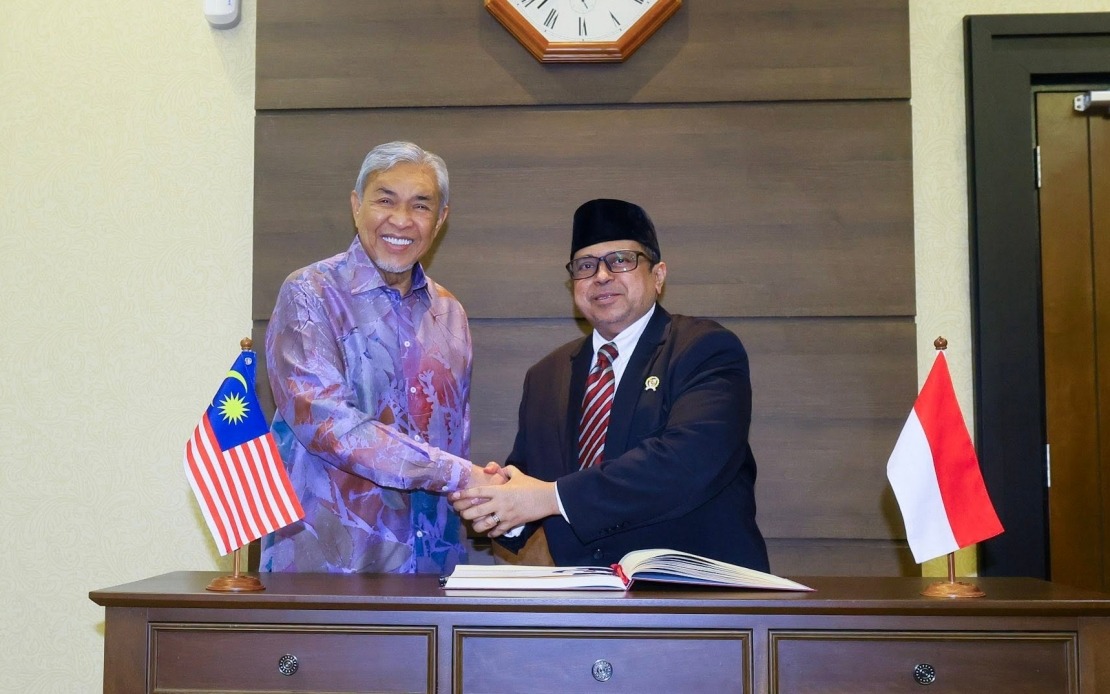
Malaysia and Indonesia have committed to deepening their strategic partnership across the halal sector, driven by discussions between Deputy Prime Minister Datuk Seri Dr Ahmad Zahid Hamidi and senior Indonesian officials on strengthening industrial development, trade flows, and human resource capacity. The engagement, which took place at the Parliament building, underscores both nations' determination to leverage their combined influence in one of the world's fastest-growing consumer markets.
During the courtesy visit from Indonesia's Ambassador to Malaysia, Raden Datuk Mohammad Iman Hascarya Kusumo, and Dr Ahmad Haikal Hassan, head of Indonesia's Halal Product Assurance Organising Body (BPJPH), the two countries outlined a roadmap for enhanced cooperation that extends beyond bilateral commerce. The conversation illuminated shared priorities including rural development initiatives and skills training programmes that position both economies to capitalise on the expanding demand for certified halal products across Asia-Pacific and beyond.
Central to this strategic vision is the proposed establishment of the Malaysia-Indonesia Halal Council (MIHC), a bilateral platform designed to facilitate greater alignment on halal certification standards, streamline cross-border commerce, and create a unified approach to market access. This institutional framework reflects growing recognition that harmonised standards remove friction from trade and enhance competitiveness when dealing with third countries and international buyers. For Malaysian businesses particularly, clearer alignment with Indonesian requirements reduces compliance costs and accelerates market entry into the region's second-largest economy.
Beyond the bilateral arrangement, Ahmad Zahid, who chairs the Malaysia Halal Industry Development Council, highlighted plans for an ASEAN Halal Council that would elevate cooperation to the entire Southeast Asian bloc. Such a regional mechanism would establish common benchmarks across the ten-member association, creating a unified ASEAN halal standard that carries greater weight in international negotiations and appeals to global consumers increasingly attuned to provenance and certification rigour. The World Halal Development Council, positioned as the capstone of this three-tier architecture, would anchor these frameworks within global governance structures and strengthen ASEAN's voice in setting international halal protocols.
The halal industry represents a significant economic pillar for both nations. Malaysia has cultivated a reputation as a global halal hub, hosting the Islamic Finance and Markets Department and various certification bodies, while Indonesia, as the world's largest Muslim-majority nation with a substantial domestic halal market, brings scale and authenticity. Together, they account for a disproportionate share of global halal commerce and possess the institutional depth to shape industry standards that others follow. For Malaysian manufacturers and service providers, Indonesian cooperation opens access to over 270 million consumers and positions Malaysian firms as preferred suppliers within ASEAN supply chains.
The emphasis on trade expansion and investment facilitation during these discussions reflects both governments' understanding that regulatory coherence directly translates into reduced costs and faster product circulation. When Malaysia-based halal processors can seamlessly export to Indonesia with minimal additional certification burdens, and vice versa, the entire ecosystem becomes more efficient. This efficiency gain flows through to smaller enterprises and rural producers who previously faced prohibitive compliance expenses, democratising access to larger markets and supporting inclusive economic growth across both nations.
Human capital development emerged as another pillar, reflecting the growing complexity of halal certification and the need for skilled auditors, laboratory technicians, and supply chain managers. By establishing joint training frameworks and knowledge-sharing initiatives, Malaysia and Indonesia can develop a skilled workforce equipped to manage halal assurance systems and advance innovation in product development. This investment in people also supports career mobility across borders and strengthens the professional networks that underpin effective regulatory cooperation.
The timing of this initiative carries particular significance as global interest in halal products continues accelerating. Western markets, including Europe and North America, have substantially expanded their halal product offerings in recent years, driven partly by Muslim diaspora communities but increasingly by mainstream consumers drawn to the implicit quality assurances embedded in halal certification. Malaysian and Indonesian producers, backed by robust institutional frameworks and enhanced bilateral coordination, are well-positioned to capture these opportunities far more effectively than competitors operating without equivalent regional support systems.
For Southeast Asia more broadly, this cooperation signals a shift toward deeper economic integration around high-value sectors with demonstrated global demand. Rather than competing destructively on price, Malaysia and Indonesia are constructing institutional frameworks that elevate the entire region's halal ecosystem, attracting investment and expertise while building barriers to entry for non-compliant producers. This approach has clear parallels with successful regional cooperation models in automotive manufacturing and electronics, where standards harmonisation amplified rather than diminished individual national advantages.
The implications extend into Malaysia's broader foreign policy calculus. Strengthening halal industry ties reinforces the bilateral relationship with Indonesia, Southeast Asia's largest economy and an indispensable regional partner on security, trade, and cultural matters. Economic cooperation in high-growth sectors like halal creates mutual prosperity incentives that transcend political cycles and builds resilience into the relationship. For Malaysian policymakers, ensuring that domestic halal producers benefit substantially from these new frameworks and platforms remains essential to justifying continued investment in coordinated standards and institutional development.

