The Prime Minister's Department (Religious Affairs) has initiated a structured programme designed to transform how Malaysia engages with contemporary Islamic scholarship and thought leadership. The Maal Hijrah Lecture Series represents a deliberate shift in strategy to ensure that intellectual contributions from recognised Islamic figures circulate throughout broader segments of the population rather than remaining confined to university lecture halls or specialist gatherings. By creating this institutional framework, the government signals its commitment to democratising access to Islamic scholarship and making these discourses relevant to Malaysians across educational, professional, and community divides.
Dr Zulkifli Hasan, who serves as Minister in the Prime Minister's Department (Religious Affairs), articulated the core rationale during the official launch in Putrajaya. He emphasised that allowing profound Islamic thought to remain siloed within exclusive academic or elite circles would represent a missed opportunity for national intellectual enrichment. The initiative reflects recognition that Islamic scholarship possesses intrinsic value not merely as academic discipline but as lived wisdom capable of informing public discourse, policy considerations, and everyday ethical deliberations. This positioning elevates the status of Islamic intellectual work from a specialised field to a matter of strategic national interest.
The scope of the initiative extends beyond domestic audiences. Dr Zulkifli articulated an ambitious vision wherein the intellectual contributions of Islamic scholars would resonate with both Muslim and non-Muslim populations across Malaysia. This multicultural framing represents a significant development in how Malaysia's religious affairs apparatus conceptualises Islamic scholarship—not as sectarian knowledge but as universal wisdom capable of contributing to broader societal understanding. For a multi-religious nation like Malaysia, such positioning potentially facilitates interfaith dialogue and mutual understanding by positioning Islamic thought as compatible with pluralistic engagement.
The institutional architecture supporting this initiative demonstrates substantial strategic backing. Both Universiti Sains Islam Malaysia (USIM) and International Islamic University Malaysia (IIUM) have already endorsed the programme, providing educational infrastructure and credibility. These partnerships are not merely symbolic; they position the lecture series within established academic frameworks that grant intellectual legitimacy while simultaneously leveraging university networks to reach students, faculty, and extended communities. The government's intention to expand collaborations beyond these initial partners suggests plans for systemically embedding the lecture series across Malaysia's tertiary education landscape.
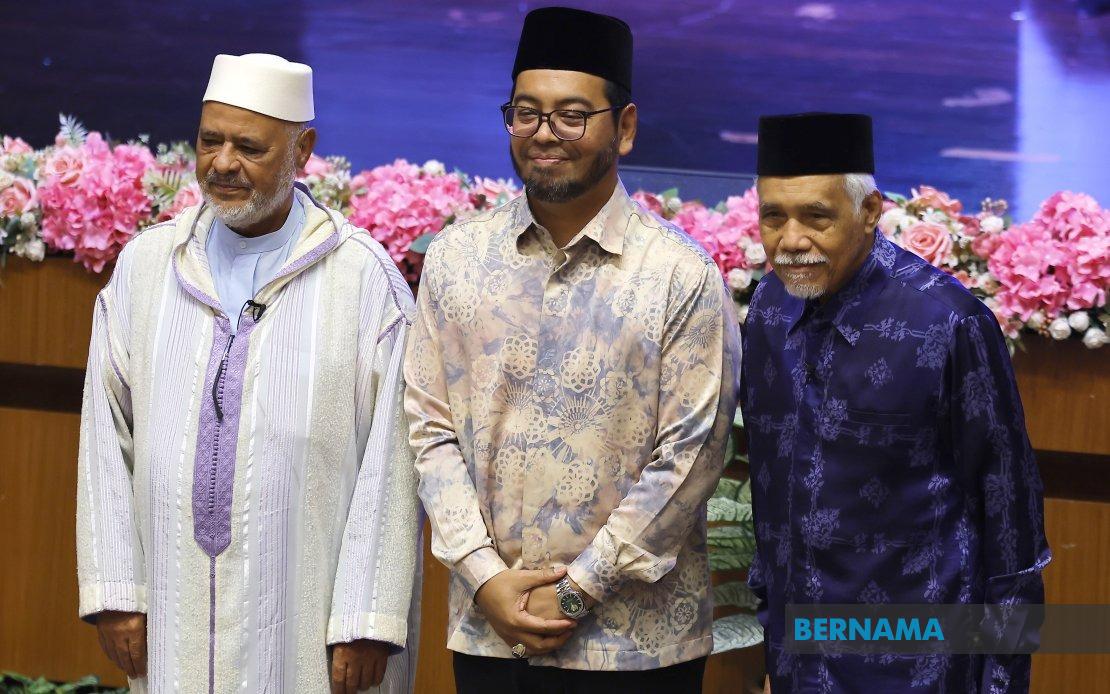
The inaugural event itself recognised two prominent Islamic intellectuals. Emeritus Professor Osman Bakar, who serves as rector of IIUM, received the national Maal Hijrah figure award, acknowledging his scholarly contributions within Malaysia's Islamic intellectual ecosystem. Professor Sheikh Dr Ahmad Al-Raysuni, an Islamic jurisprudence specialist based in Morocco, received the international award, reflecting Malaysia's engagement with global Islamic scholarly networks and its positioning within transnational Islamic intellectual currents. This dual recognition emphasises that Malaysian Islamic thought does not develop in isolation but participates in cosmopolitan scholarly exchanges.
The Sultan of Perak, Sultan Nazrin Shah, formalised these recognitions through the presentation of cash prizes, trophies, and certificates of appreciation. The involvement of constitutional royalty underscores that this initiative carries weight beyond administrative implementation. Royal patronage signals that the programme aligns with broader institutional values and that religious affairs represent matters of state significance. For both award recipients, such formal recognition enhances their standing and potentially amplifies the reach and receptiveness of their subsequent lecture contributions.
The Maal Hijrah 1448H/2026 chronology situates this initiative within the Islamic lunar calendar, marking the Islamic year corresponding to 2026 in the Gregorian system. This temporal framing grounds the programme within Islamic time-reckoning while simultaneously engaging Malaysian audiences who navigate both calendrical systems in daily life. The initiative thus becomes temporally anchored to specific Islamic historical consciousness while maintaining accessibility to secular timekeeping conventions.
From a Southeast Asian perspective, Malaysia's move to institutionalise Islamic scholarly dissemination carries regional implications. As the region navigates questions about Islam's role in modern governance, education, and public culture, Malaysia's approach—balancing systematic Islamic engagement with pluralistic inclusion—offers a distinctive model. Other Muslim-majority nations in Southeast Asia might observe how Malaysia manages the tension between deepening Islamic intellectual life and maintaining interfaith cohesion, potentially adopting comparable frameworks adapted to local contexts.
The lecture series concept itself represents innovation in knowledge dissemination architecture. Rather than relying on organic scholarly circulation through publications and conferences, the government deliberately structures platforms for Islamic intellectual engagement. This represents a particular vision of how states should facilitate knowledge work—not through laissez-faire approaches but through strategic institutional curation. The success or limitations of this approach will likely generate important lessons about state involvement in religious and intellectual life.
For Malaysia's Islamic education ecosystem, the initiative potentially reshapes intellectual authority hierarchies. By systematically elevating specific scholars and their contributions, the programme influences which voices gain prominence in public discourse. This curation function becomes particularly significant in Malaysia's religiously complex environment, where multiple Islamic interpretive traditions coexist and sometimes compete for influence. The lecture series effectively endorses particular scholarly approaches while implicitly deprioritising others, making visible the state's preferences regarding Islamic intellectual directions.
The expansion plans announced by Dr Zulkifli indicate that this represents an opening phase rather than a completed programme. Systematic engagement with additional universities and institutions suggests a vision of nationwide Islamic intellectual infrastructure development. Over time, such expansion could create sustained mechanisms for disseminating Islamic scholarship, potentially influencing how subsequent generations of Malaysians encounter and internalise Islamic thought and ethics.