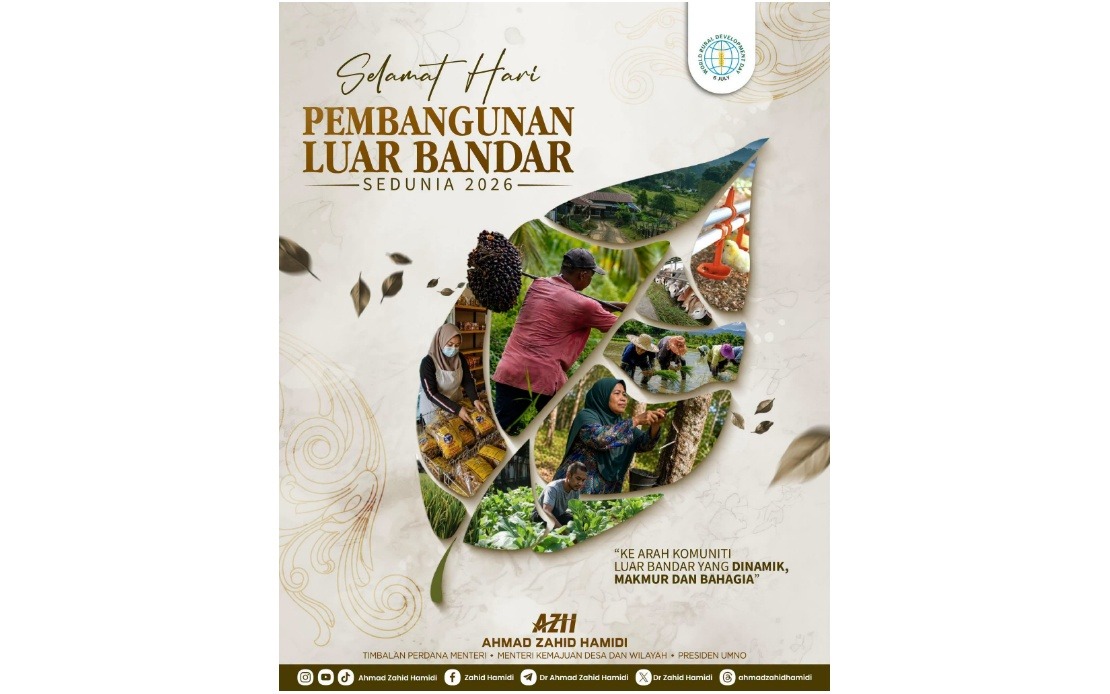
Malaysia has officially joined the global commemoration of World Rural Development Day (HPLBS) for the first time, with Deputy Prime Minister Datuk Seri Dr Ahmad Zahid Hamidi using the occasion to reaffirm the nation's dedication to uplifting rural communities. The inaugural celebration, held at Tun Abdul Razak Stadium in Jengka near Maran, Pahang, represents a significant acknowledgment of the critical role that village economies and agricultural societies play in Malaysia's broader development framework.
The establishment of July 6 as Malaysia's official rural development observance carries symbolic weight that extends beyond ceremonial recognition. Ahmad Zahid pointed out that the date coincides with the founding of the Centre on Integrated Rural Development for Asia and the Pacific (CIRDAP), an international institution that has shaped rural policy across the Asia-Pacific region for decades. This alignment suggests that Malaysia's rural development approach is being positioned within a wider regional context, potentially signalling greater integration with international best practices and cross-border knowledge exchange on agricultural and village economies.
As Minister of Rural and Regional Development in addition to his role as Deputy Prime Minister, Ahmad Zahid articulated a vision of rural transformation centred on expanding economic opportunities for villagers while simultaneously improving infrastructure and social amenities. The ministerial emphasis on ensuring rural communities benefit from "broader opportunities" and "stronger economy" reflects ongoing concerns about rural-urban disparities in Malaysia, where income levels, employment prospects, and access to services remain significantly uneven across regions. This messaging suggests that the government recognises the urgency of addressing structural inequalities that have long characterised Malaysia's development trajectory.
The inaugural HPLBS celebration operates around three interconnected pillars: community innovation, rural digitalisation, and rural entrepreneurship development. These thematic priorities reveal important assumptions about how rural Malaysia should evolve. Rather than proposing subsidy-dependent or charity-based approaches, the framework emphasises self-sufficiency, technological adoption, and business creation at the village level. This reflects broader global trends in development thinking that prioritise capacity-building and market-driven solutions over traditional government assistance programmes.
Rural digitalisation has emerged as a particularly critical focus area for Malaysian policy makers grappling with persistent connectivity gaps. Many village communities in Peninsular Malaysia, Sabah, and Sarawak lack adequate broadband infrastructure or digital literacy, creating structural barriers to participation in the modern economy. By making digitalisation a central pillar of rural development strategy, the government acknowledges that villages cannot thrive in isolation from the digital economy. However, the translation of this principle into concrete investment and infrastructure deployment remains a significant implementation challenge that extends beyond messaging.
The entrepreneurship development pillar addresses employment creation through self-initiated business ventures rather than reliance on traditional agricultural employment or government jobs. This orientation reflects recognition that population movements away from villages have historically been driven by limited livelihood options and perceived superior opportunities in urban centres. By fostering village-based entrepreneurship, the government hopes to create conditions that encourage rural residents, particularly young people, to remain in or return to their communities. The effectiveness of this approach depends heavily on sustained access to capital, markets, and technical support.
Community innovation, the third pillar, suggests that rural development should be driven not purely by top-down government programmes but by local problem-solving and creative initiatives rooted in community contexts. This approach empowers villagers as agents of their own development rather than passive recipients of policy interventions. It also recognises that rural communities possess distinctive knowledge, practices, and resources that can be leveraged for economic advancement when properly supported by enabling policy frameworks and strategic investments.
Ahmad Zahid's framing of HPLBS as an annual platform for recognising rural contributions to national progress attempts to elevate the status and visibility of agricultural and village economies within Malaysian political discourse. Rural development has often competed for attention and resources with urban and industrial priorities in Malaysia's development budgets. By institutionalising an annual day of recognition, the government signals that rural advancement is integral to national prosperity rather than a peripheral concern or charity case.
For Southeast Asian observers, Malaysia's establishment of HPLBS carries implications for regional cooperation on rural development challenges. Many Southeast Asian nations share similar rural-urban disparities, connectivity gaps, and agricultural transition pressures. A coordinated regional approach leveraging CIRDAP and other international platforms could facilitate exchange of successful rural development models, technical expertise, and policy innovations. Malaysia's inaugural celebration potentially opens pathways for deeper multilateral engagement on these shared challenges.
The celebration theme, "Toward Vibrant, Prosperous and Happy Rural Communities," frames rural development as encompassing not merely economic metrics but broader dimensions of wellbeing and community vitality. This holistic framing acknowledges that successful rural societies require balanced attention to income generation, cultural preservation, social cohesion, and quality of life indicators beyond GDP. Such a perspective aligns with growing global recognition that development measurement should extend beyond narrow economic indicators.
Implementation will ultimately determine whether HPLBS 2026 represents a genuine inflection point in Malaysian rural policy or merely symbolic acknowledgment. The Ministry of Rural and Regional Development must translate the three pillars into concrete budgetary allocations, programmatic initiatives, and measurable targets. Sustained commitment beyond the inaugural celebration will require political will, adequate resource mobilisation, and coordination with other government agencies responsible for infrastructure, education, and technological deployment. The test of sincerity will be whether rural communities perceive tangible improvements in their economic circumstances and quality of life in the years following this inaugural celebration.

