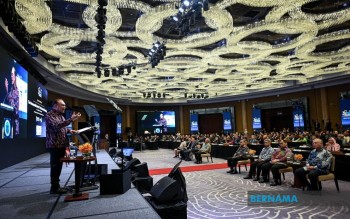
Prime Minister Datuk Seri Anwar Ibrahim has highlighted the urgent need for Malaysia to develop its own sovereign cloud infrastructure as the country navigates an increasingly complex digital landscape where foreign powers claim broad data access rights. Speaking at the 39th Asia-Pacific Roundtable in Kuala Lumpur, Anwar articulated a carefully balanced approach that seeks to protect Malaysia's strategic interests while avoiding isolationism that could deter crucial technology investment from global partners.
The Prime Minister's remarks directly address the implications of the US Cloud Act, legislation that grants American authorities sweeping powers to compel tech companies incorporated in the United States to hand over data regardless of where that information is physically stored or how it was originally collected. Anwar acknowledged this as an established legal reality in international relations, noting that the United States has explicitly asserted this prerogative under former President Donald Trump's administration. Rather than condemning this stance, the Malaysian leader pragmatically accepted it as a fait accompli while recognising that Malaysia cannot simply acquiesce to such arrangements without safeguarding its own sovereignty.
The sovereign cloud initiative represents Malaysia's strategic response to this geopolitical data challenge. By creating a dedicated cloud infrastructure controlled domestically, Malaysia would establish secure repositories for information deemed critical to national security and citizens' privacy, protected by firewalls and localised access controls. This approach would insulate sensitive data from automatic exposure to foreign government requests, giving Malaysia genuine agency over which information becomes accessible to external parties and under what circumstances such access occurs.
However, Anwar's vision demonstrates sophisticated understanding that absolute digital isolation is neither feasible nor desirable in the modern global economy. He emphasised that Malaysia must simultaneously remain attractive to technology investors and collaborative partners from the United States, China, Germany, and beyond. The sovereign cloud framework therefore functions as a middle path, protecting certain categories of data while maintaining the openness necessary for Malaysia to participate fully in the global digital economy. This distinction between protecting core strategic assets and remaining engaged internationally reflects Malaysia's broader positioning as a nation that seeks prosperity through connectivity rather than defensive withdrawal.
The challenges accompanying digital openness extend well beyond government surveillance and data sovereignty concerns. Anwar identified the proliferation of social media and digital platform misuse as an escalating threat requiring government intervention. These abuses manifest across multiple dimensions—political disinformation campaigns that undermine democratic processes, economic fraud that victimises consumers and investors, personal harassment targeting individuals, and sexual exploitation particularly affecting young people. The Prime Minister contended that Malaysia has legitimate grounds to establish safeguards addressing these harms, even within a framework committed to fundamental freedoms of expression and information access.
Young Malaysians face particular vulnerability to digital exploitation, a concern that resonates across Southeast Asia as the region experiences rapid internet penetration and social media adoption. Governments throughout the region grapple with how to protect young citizens from predatory behaviour, cyberbullying, and exposure to harmful content without implementing surveillance mechanisms that undermine democratic norms. Anwar's framing positions data protection and platform regulation as protective measures rather than restrictions on liberty, an important distinction that could influence how Malaysia's digital governance policies develop over coming years.
ANWAR's emphasis on ASEAN centrality adds a crucial regional dimension to Malaysia's digital sovereignty strategy. Rather than pursuing independent middle-power status through unilateral technological dominance, the Prime Minister stressed that Malaysia's strength derives from collective regional cooperation and the bloc's combined negotiating power. This perspective suggests Malaysia may champion coordinated Southeast Asian approaches to data governance, cloud infrastructure development, and platform regulation rather than pursuing isolated national solutions. Such regional coordination could enhance ASEAN's leverage in negotiations with major technology powers while establishing common standards that protect citizens across the bloc.
Malaysia's attractiveness to international investors depends partly on its reputation as a stable, predictable investment destination that respects both market principles and national sovereignty. By articulating a clear framework for data protection that does not arbitrarily restrict business operations, Anwar signals to multinational technology companies that Malaysia offers workable conditions for investment and operation. Companies seeking to establish regional hubs or data centres can understand exactly which information categories fall under sovereign protection and which remain subject to normal commercial and legal arrangements.
The sovereign cloud initiative also addresses growing regional anxiety about technological dependence on external powers. India's investments in data sovereignty, Vietnam's efforts to localise critical infrastructure, and Indonesia's digital policies all reflect Southeast Asian concern about vulnerability to digital disruption or data exploitation. Malaysia's public commitment to sovereign cloud development may encourage similar initiatives across the region, gradually shifting the balance of digital power and creating greater regional capacity for autonomous technological decision-making.
Implementing a functional sovereign cloud infrastructure presents substantial technical and organisational challenges that extend beyond political commitment. Malaysia must develop expertise in cloud engineering, cybersecurity, and data management at a scale comparable to major technology providers. The country will need to attract specialised talent, invest significantly in infrastructure, and establish governance frameworks ensuring reliable, secure operations. Partnerships with friendly nations and private sector technology companies may prove essential to developing capabilities within a reasonable timeframe.
The geopolitical context for Malaysia's sovereign cloud strategy has intensified amid broader tensions between the United States and China over technology dominance and data control. By establishing infrastructure positioned as serving Malaysian interests rather than aligned with any external power, Malaysia preserves strategic autonomy. This positioning allows the country to engage commercial and technical partnerships with various actors while maintaining genuine control over sensitive information and democratic processes.

