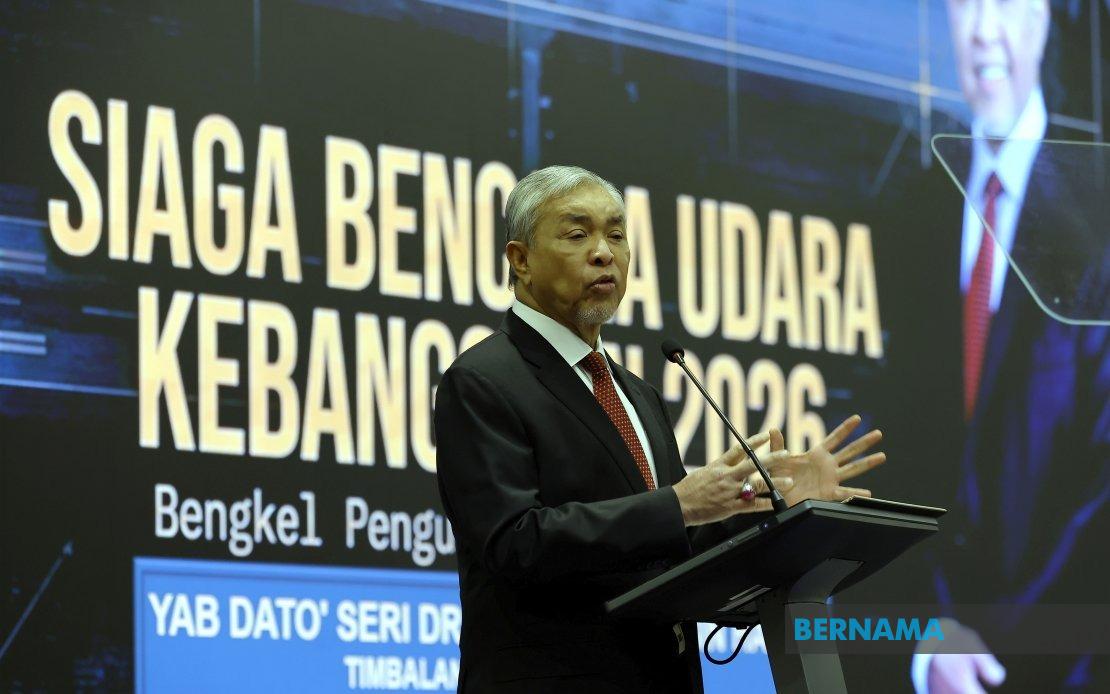
Malaysia requires a comprehensive, integrated air disaster management infrastructure that unites all emergency response agencies under a common operational framework, according to Deputy Prime Minister Datuk Seri Dr Ahmad Zahid Hamidi. Speaking at the launch of the National Air Disaster Preparedness 2026 workshop in Sepang, Ahmad Zahid stressed that the nation cannot afford fragmented responses during crises. The principle of "one system, one command, and one action" must form the foundation of Malaysia's approach to handling air emergencies, ensuring that the capabilities, skills, and authority of various agencies work harmoniously toward a singular goal of preserving lives and rapidly containing disasters.
Ahmad Zahid emphasized that disaster management readiness cannot be adequately tested only through theoretical exercises or paper-based reviews. Agencies must rehearse their coordination mechanisms, communication protocols, and decision-making processes before actual emergencies occur, ensuring clarity in directives and confirmation that all participating organizations can function seamlessly as a unified entity. The challenge lies not in possessing adequate resources or personnel, but in orchestrating those resources effectively under the pressure and chaos that accompany genuine catastrophes. The Deputy Prime Minister highlighted that truly effective systems demonstrate their worth when information flows rapidly, circumstances change unexpectedly, and high-stakes choices must be made within compressed timeframes.
The workshop itself serves as a critical venue for testing the country's current preparedness framework. Attended by more than 100 representatives from government departments, law enforcement agencies, rescue services, airlines, airport operators, and industry specialists, the two-day gathering provides an opportunity to evaluate existing procedures, stress-test communication networks, clarify the operational responsibilities of each participating organization, and gauge the overall capacity of Malaysia's air disaster response mechanisms. Such exercises reveal gaps and inefficiencies that might otherwise remain hidden until a real emergency unfolds.
Ahmad Zahid identified four strategic priorities to strengthen Malaysia's air disaster management capabilities. First, the nation must reinforce its chain of command and decision-making structures by carefully reviewing and refining existing procedures. Second, information sharing mechanisms and inter-agency communication systems require substantial enhancement to ensure that all parties access the same data and understand the operational landscape identically. Third, scenario-based training initiatives should expand beyond airport terminals to encompass remote locations and challenging terrain that may present obstacles during actual rescue operations. Fourth, disaster management systems must undergo rapid digitalization to enable quicker information processing and decision support during crises.
The government remains committed to backing these modernization efforts through policy development, improved coordination mechanisms, and systematic capacity-building investments. Aviation safety transcends mere technical or procedural concerns for Malaysia, representing instead a matter of strategic national consequence. The aviation sector functions as a crucial economic artery, facilitating international human movement, enabling international commerce, drawing foreign direct investment, and supporting the tourism industry upon which considerable economic activity depends.
The economic stakes underpinning aviation safety merit serious examination. Malaysia attracted 42.2 million international visitors during the previous year, generating RM110.6 billion in foreign tourism revenue alone. Concurrently, domestic tourism expenditure reached RM121.3 billion, demonstrating the sector's massive scale within the national economy. Any catastrophic aviation incident would not only claim precious lives but would also severely damage Malaysia's international reputation, potentially triggering sharp declines in visitor arrivals, investment flows, and trade activity. Consequently, investments directed toward strengthening disaster preparedness should be conceptualized as investments in safeguarding human lives, preserving Malaysia's credibility in global markets, and ensuring sustained economic contribution from the tourism and aviation sectors.
The workshop's expansion of scenario-based training to locations beyond airport perimeters reflects a sophisticated understanding of realistic disaster response challenges. Air disasters do not necessarily conclude within terminal buildings or runways. Wreckage, survivors, and rescue operations may extend across surrounding communities, agricultural areas, and difficult-to-access terrain. Training personnel to manage these scenarios in authentic environments, rather than controlled classroom settings, develops practical competencies that prove invaluable when actual events occur. The emphasis on "hard-to-access sites" particularly resonates for Malaysia, given the nation's substantial forest coverage and varied topography that could complicate rescue operations in certain regions.
Digitalization of disaster management systems represents another critical modernization pathway. Real-time information sharing platforms, decision-support tools, and integrated communication networks enable agencies to achieve that elusive common operational picture Ahmad Zahid emphasized. When rescue personnel in the field, hospital administrators, air traffic controllers, and senior government officials all access identical information through digital systems, coordination improves dramatically, reducing dangerous gaps in situational awareness and enabling more rapid, confident decision-making. The COVID-19 pandemic demonstrated that Malaysian agencies possess the technical capability to stand up sophisticated information-sharing systems under pressure, and those capabilities should extend to disaster management frameworks.
For Malaysia and the Southeast Asian region broadly, Ahmad Zahid's call for integrated disaster management systems carries broader implications. The region experiences regular aviation traffic across busy international routes, with aircraft from numerous nations frequently transiting Malaysian airspace or utilizing domestic airports. A sophisticated, well-coordinated Malaysian air disaster response capability enhances aviation safety across the region. Conversely, weak preparedness invites accident investigators from multiple nations to question Malaysia's emergency management competence, potentially affecting the nation's aviation standing and aircraft operations authorization within international oversight frameworks. Strong disaster preparedness thus represents both a national security matter and a critical dimension of Malaysia's international standing.
The timing of the National Air Disaster Preparedness 2026 initiative reflects forward-looking governance. Rather than awaiting a catastrophic incident to expose deficiencies, Malaysia is proactively examining its systems during peacetime, when adjustments can be made deliberately and comprehensively. This approach aligns with contemporary best practices in emergency management, where advanced industrialized nations regularly conduct tabletop exercises, full-scale drills, and after-action reviews to maintain preparedness without the tragedy that motivates reactive reforms. By establishing clear command structures, standardized procedures, and effective communication protocols now, Malaysia positions itself to respond with precision and effectiveness should disasters occur.

