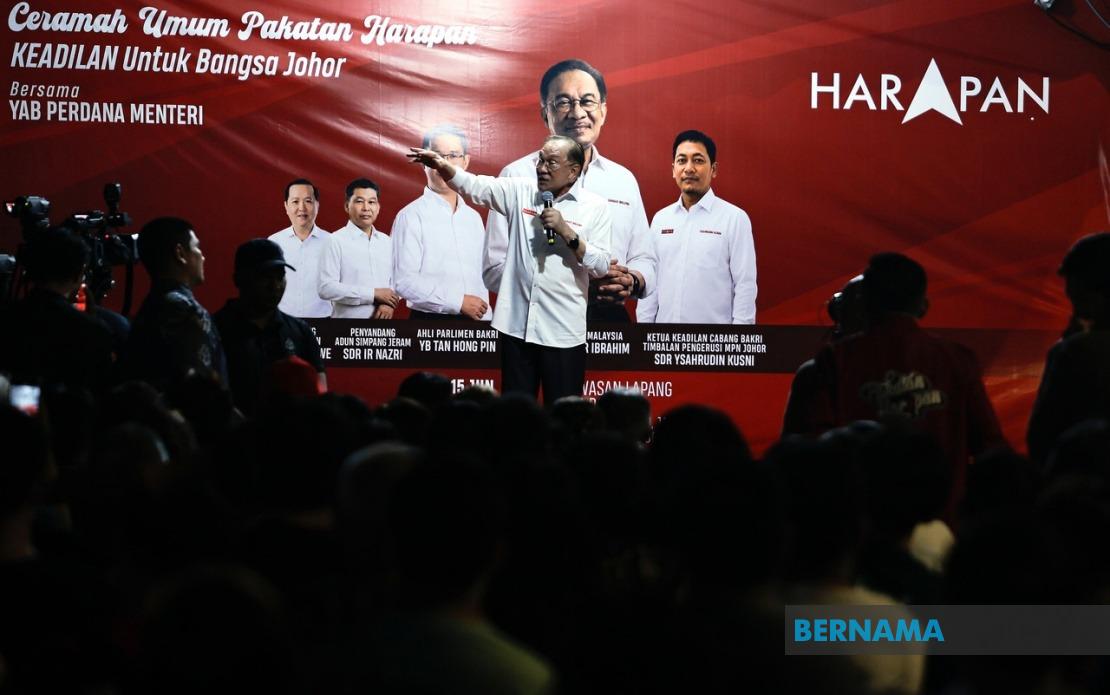
Prime Minister Datuk Seri Anwar Ibrahim has made a compelling case for Malaysia to redirect its political energy toward technological advancement, specifically artificial intelligence and quantum computing, rather than expending resources on divisive partisan conflicts. Speaking at a Pakatan Harapan rally in Muar, the Prime Minister articulated a vision where Malaysia's trajectory depends on embracing emerging technologies and global investment opportunities that will secure prosperity for future generations.
Anwar's remarks reflect a deliberate pivot in government messaging, emphasising that sustained economic competitiveness hinges on positioning Malaysia as a regional hub for AI infrastructure and quantum research. During recent diplomatic engagements in Japan, the government has actively explored quantum computing applications and pursued foreign direct investment specifically targeting data centres and AI-related operations. These initiatives represent a calculated strategy to diversify Malaysia's economic base beyond traditional sectors and establish the nation as a knowledge economy player in the increasingly technology-driven Asian landscape.
The Prime Minister's critique of perpetual political wrangling carries particular significance in the Malaysian context, where communal and religious sensitivities have historically dominated electoral discourse. By framing technological ambition as an alternative to identity politics, Anwar addresses a fundamental tension within the coalition he leads—the need to maintain diverse support across ethnic and religious communities whilst advancing a unifying national agenda. His exhortation that Malaysia's future rests on quantum capabilities rather than theological disputes suggests a deliberate attempt to elevate policy discussions beyond zero-sum cultural battles.
Anwar's assertion that international observers are watching Malaysia's development efforts with genuine interest speaks to the nation's restoration of credibility after several years of political turbulence. The comment that Malaysia no longer requires heavy promotional campaigns because investors are independently seeking opportunities reflects restored confidence in the country's governance and economic trajectory. This perception shift creates momentum for the government to capitalise on renewed international goodwill through concrete investments in technology infrastructure.
The exhortation for unity across Malaysia's multicultural fabric—directed at Malays, Chinese, and Indians alike—reflects an increasingly sophisticated understanding that technological advancement requires inclusive participation across all communities. By explicitly naming ethnic groups in his call for collaboration rather than division, Anwar acknowledges Malaysia's demographic complexity whilst reframing it as a strength for innovation rather than a source of conflict. This rhetorical approach suggests recognition that sustainable development requires harnessing talent and entrepreneurship regardless of communal background.
For Malaysian policymakers and business leaders, Anwar's emphasis on quantum computing represents positioning the country at the frontier of technological development rather than in follower industries. Quantum technology remains in developmental stages globally, meaning nations that invest early may capture disproportionate benefits and establish themselves as centres of expertise. Malaysia's geographic location, existing technology infrastructure, and relatively young workforce present tangible advantages for becoming a regional quantum research and application hub.
The criticism of political leaders who exploit divisive sentiments carries implicit acknowledgment that Malaysia's political environment has historically rewarded communal mobilisation. By framing such politics as fundamentally counterproductive to national development, Anwar attempts to establish new political incentives that reward pragmatic governance over identity-based campaigns. Whether this messaging resonates with voter bases accustomed to identity-centred politics remains an open question, particularly given upcoming electoral cycles where traditional divisions may reassert their prominence.
The presence of PKR Vice-President Datuk Seri Dr. Zaliha Mustafa and Johor PH Chairman Aminolhuda Hassan at this rally indicates strategic party positioning behind the Prime Minister's technological agenda. Coalition partners' public alignment with development-focused messaging suggests coordinated effort to establish shared ideological ground emphasising progress over traditional political divisions. This represents conscious attempt to differentiate Pakatan Harapan from opposition approaches that may emphasise communal grievances.
For Southeast Asia more broadly, Malaysia's pivot toward AI and quantum computing reflects regional patterns whereby governments recognise technological capability as essential for competing in next-generation economies. Countries including Singapore, Thailand, and Vietnam have similarly invested in digital infrastructure and AI initiatives. Malaysia's explicit commitment to these sectors positions it within this regional competition, though success will depend on translating rhetorical emphasis into sustained funding, human capital development, and institutional capacity.
The challenge for implementing Anwar's vision lies in translating broad political exhortations into specific policies, investment mechanisms, and educational frameworks that cultivate AI and quantum expertise. Malaysia requires not merely foreign investment in data centres but development of domestic research capacity and talent pipelines. This necessitates educational reforms, university partnerships with industry, and sustained commitment across multiple government budgets and economic cycles.
Anwar's implicit argument that political consensus around technological advancement can serve as unifying force for multiethnic Malaysia deserves serious consideration. If Malaysia can establish broad agreement that AI and quantum capabilities benefit all communities equitably, political energy currently directed toward identity disputes could theoretically redirect toward implementation of shared development priorities. However, this outcome remains contingent on government demonstrating tangible benefits are distributed inclusively rather than concentrated among particular groups.
Looking forward, the test of Anwar's technological vision will be whether Malaysia achieves meaningful advances in AI research, data centre development, and quantum applications, or whether ambitious rhetoric remains unaccompanied by institutional transformation and adequate resource allocation. The Prime Minister's emphasis on future generations signals recognition that technology investments represent long-term bets requiring patience and sustained commitment rather than electoral cycle-oriented quick wins. Malaysia's capacity to maintain focus on these priorities amidst ongoing political pressures will significantly determine whether the nation successfully transitions to technology-driven competitiveness.