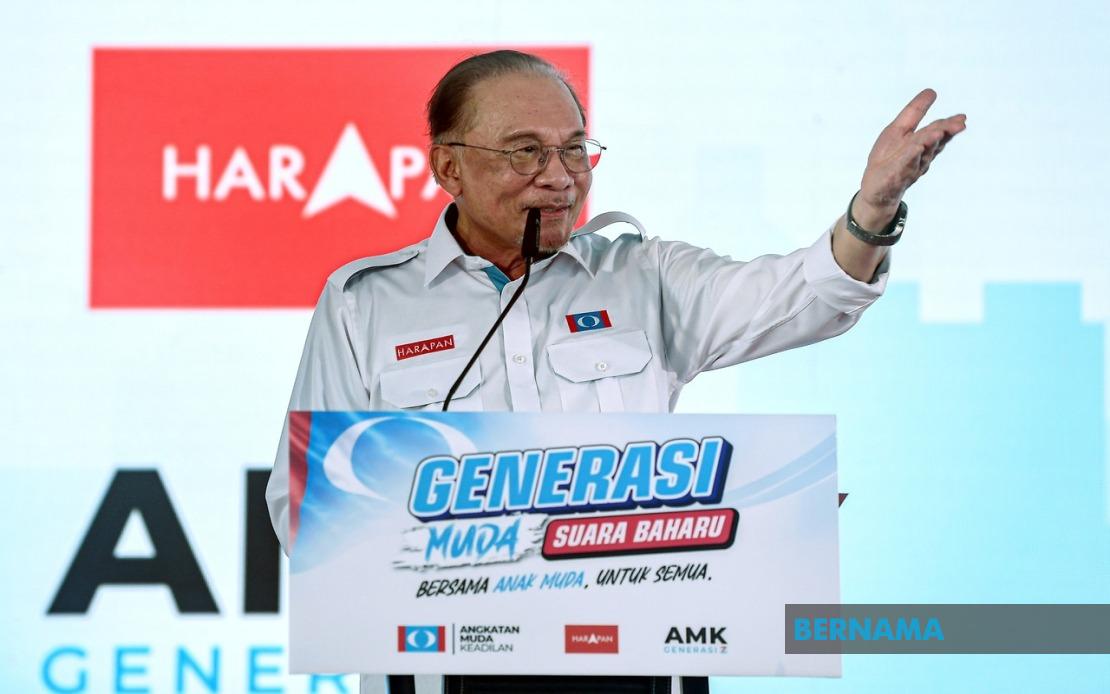
Prime Minister Datuk Seri Anwar Ibrahim has delivered a pointed message to Malaysian voters: the time has come to elect political leaders whose foremost commitment is bridging divides rather than exploiting them. Speaking at the 'Generasi Muda Suara Baharu' programme in Petaling Jaya on July 24, Anwar stressed that the selection of capable leaders represents far more than an administrative choice—it fundamentally shapes the trajectory of the nation's economic policies, educational systems, and social cohesion.
The Prime Minister's remarks reflect a broader concern about the tactics that have historically dominated Malaysian politics. He pointedly criticised the weaponisation of communal identity and fear, arguing that the narrative of pitting one ethnic group against another must become obsolete. In explicit terms, Anwar rejected what he characterised as the "old politics of fear, of race, of hatred," signalling a rejection of strategies that have long been deployed to mobilise constituencies along ethnic and religious lines. His articulation suggests a deliberate pivot away from zero-sum political competition based on group interests toward a paradigm centred on shared national objectives.
What makes Anwar's appeal particularly significant is its explicit targeting of Generation Z, whom he appears to view as agents capable of catalysing genuine political transformation. By positioning younger voters as the harbingers of this shift, Anwar is essentially arguing that the emerging electorate has the capacity and perhaps the moral obligation to break cycles of divisive politics that have constrained Malaysian political discourse. He expressed optimism that if this generation embraces and amplifies messages of unity and integrity, it could fundamentally alter the nation's political culture. This generational framing matters because it acknowledges demographic shifts while challenging young voters to translate values into electoral choices.
Crucially, Anwar's definition of suitable leadership encompasses more than mere rhetorical commitment to unity. He explicitly tied the corruption and moral integrity of leaders to their ability to govern effectively and protect national interests. The implication is stark: leaders must emerge from among those unblemished by corrupt conduct and untainted by associations with divisive rhetoric. This standard serves as a practical framework for evaluating candidates, moving the conversation beyond abstract ideals into concrete criteria that voters can apply when assessing political options. For Malaysian readers, this represents an attempt to recalibrate the basis upon which leadership decisions should be made.
The Prime Minister also articulated a nuanced perspective on the nature of meaningful change, distinguishing between superficial gestures and substantive reform. He cautioned against hollow activism or performative dissent that generates noise without producing tangible outcomes. Instead, Anwar advocated for thoughtful, deliberate approaches to transformation—change that is "wise" and rooted in realistic assessments of feasibility rather than passion-driven impulses. This distinction carries implications for how civil society and youth movements should conceptualise their engagement with the political system. It suggests that effectiveness matters as much as intention, and that the pursuit of reform must be grounded in strategic thinking.
Anwar's remarks also touched on what he characterised as existing evidence of successful inter-ethnic cooperation, particularly among younger Malaysians. His observations about Malays, Chinese, Indians, and communities in Sabah and Sarawak working cohesively was presented not as an aspiration but as an existing reality that deserves recognition and reinforcement. This framing is significant because it counters narratives of inevitable ethnic tension by highlighting instances where such cooperation already functions. For Malaysian audiences, these examples serve as proof points that alternative political models are achievable and not merely theoretical constructs.
The Communications Minister Datuk Seri Fahmi Fadzil's attendance at the event underscores the government's commitment to this messaging. The presence of a senior cabinet member alongside the Prime Minister signals that this is not an isolated personal position but a coordinated government narrative aimed at shaping public discourse around leadership selection and political values. This institutional backing suggests that the administration intends to pursue strategies that reinforce these themes across multiple platforms and forums.
A broader context animating Anwar's speech concerns Malaysia's ongoing political recalibration following turbulent years of coalition shifts, defections, and governance transitions. The nation's experience with unstable administrations and frequent leadership changes has created space for conversations about what qualities should define political leaders. Against this backdrop, Anwar's emphasis on unity and anti-corruption credentials represents an attempt to elevate certain benchmarks as non-negotiable in future leadership selection.
The planned expansion of the Suara Baharu Generasi Muda programme to every district nationwide indicates an ambition to systematically propagate these messages through grassroots engagement. Such a nationwide initiative suggests the government views youth mobilisation around these values as strategically important. For regional observers, this represents Malaysia's attempt to reshape its political culture through targeted youth outreach, an approach gaining traction across Southeast Asia as demographic shifts create opportunities for political realignment.
Underlying Anwar's message is an implicit acknowledgment that Malaysian politics has suffered from approaches that prioritise sectional interests and exploit communal anxieties. By calling for leaders who unite rather than divide, he is attempting to establish new expectations for acceptable political discourse and behaviour. Whether these messages resonate sufficiently to alter voting patterns remains to be seen, but they represent a clear articulation of the values the current administration believes should guide Malaysian political leadership.

