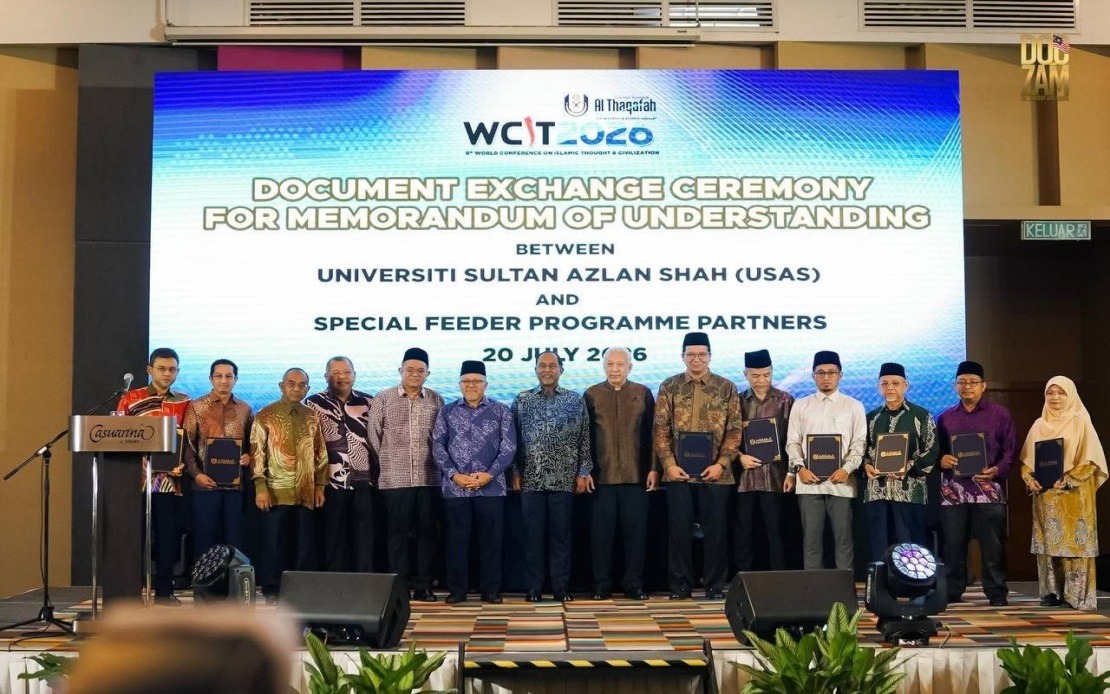
Malaysia is stepping into a strategic role as a facilitator of cross-cultural intellectual engagement and a champion of academic advancement in the Islamic world, according to Higher Education Minister Datuk Seri Dr Zambry Abdul Kadir. Speaking at an event marking the launch of the 8th World Conference on Islamic Thought and Civilisation (WCIT2026), Zambry articulated a vision for the nation that extends beyond its borders, positioning Malaysia as a destination for knowledge creation and a platform where diverse scholarly perspectives can converge productively.
The three-day conference, now underway, represents a significant gathering of intellectual firepower, drawing more than 180 delegates, scholars, researchers, and thought leaders from countries across the globe. The event, organised by Universiti Sultan Azlan Shah (USAS) in Ipoh, reflects an institutional commitment to fostering rigorous dialogue on contemporary issues affecting Islamic societies and the broader international community. By hosting this gathering, Malaysia demonstrates its capacity to serve as a neutral venue where competing ideas can be examined and synthesised into constructive frameworks for addressing shared challenges.
Zambry's remarks reveal a nuanced understanding of the challenges facing the contemporary Islamic world. Rather than dwelling on historical achievements or seeking to restore past glory, he contends that the future trajectory of Muslim societies must be anchored in demonstrable intellectual capacity, robust research infrastructure, and innovation ecosystems. This perspective shifts the conversation away from nostalgia toward actionable strategies centred on knowledge generation and competitive advantage through superior educational institutions. The emphasis reflects recognition that in an increasingly knowledge-driven global economy, nations that fail to invest in higher education and research will struggle to maintain relevance.
A particularly striking element of Zambry's address involves his invocation of historical calamities where centres of learning have been destroyed. By referencing the destruction of Baghdad, Granada, and Sarajevo, alongside the ongoing devastation in Palestine, he underscores a sobering reality: the loss of universities and libraries represents not merely physical destruction but the erasure of civilisational capacity. This metaphor carries weight for Malaysian policymakers and educators, suggesting that institutional strength in higher education is foundational to national resilience and cultural continuity. The implication is that investing in universities transcends narrow economic calculation and touches upon existential questions of civilisational survival.
Zambry's insistence that education must remain insulated from politics, conflict, and narrow technological determinism speaks to persistent tensions in the global knowledge ecosystem. This position acknowledges that knowledge is increasingly weaponised and compartmentalised along ideological lines, yet argues for a counter-narrative where intellectual exchange transcends such divisions. For Malaysia, a multi-ethnic, multi-religious nation navigating complex geopolitical currents, this commitment to knowledge as shared human heritage rather than national property holds particular resonance. It suggests a framework where intellectual collaboration can proceed even amid international tensions.
The conference's ambitions extend to generating actionable solutions with practical application for Muslim-majority societies and the wider global community. This pragmatic orientation distinguishes WCIT2026 from purely academic exercises. Rather than serving as a venue for abstract theoretical debate divorced from real-world impact, the gathering is explicitly designed to yield resolutions and policy recommendations that can shape institutional practice and governmental decision-making. For Malaysian universities and research institutions, participation in such a forum offers opportunities to contribute to global knowledge production while simultaneously elevating their own research profiles and international standing.
Malaysia's pivot toward this role as an intellectual bridge carries significant implications for regional higher education dynamics. By establishing itself as a convening power for Islamic thought and scholarly dialogue, Malaysia creates a gravitational pull that attracts researchers and academic talent from across the Islamic world and beyond. This is not merely a symbolic positioning but a concrete competitive advantage in an era where universities compete globally for enrolments, research partnerships, and intellectual prestige. Institutions like USAS benefit directly from hosting such events, gaining visibility and credibility within international academic networks.
The commitment outlined by Zambry also reflects broader Malaysian foreign policy objectives centred on positioning the nation as a responsible global actor with constructive contributions to international discourse. By hosting forums that bring together diverse perspectives on complex issues, Malaysia situates itself as a country capable of facilitating consensus-building and promoting understanding across ideological divides. This softpower dimension is increasingly important in an era characterised by polarisation, where nations that can convene and moderate dialogue enjoy disproportionate influence in shaping global narratives and policy directions.
Looking forward, the success of WCIT2026 will be measured not only by the calibre of discussions but by the tangible outcomes it generates. The conference's value to Malaysia and to the Islamic world more broadly will be determined by whether resolutions developed during the three days translate into concrete initiatives, funding streams, and collaborative research programmes. This requires follow-up mechanisms and institutional commitment from host universities and participating governments to implement recommendations and maintain momentum beyond the conference itself.
For Malaysian stakeholders in higher education, Zambry's vision presents both opportunity and responsibility. The opportunity lies in positioning Malaysian institutions as leading contributors to advancing Islamic thought and addressing contemporary challenges through rigorous scholarship. The responsibility involves ensuring that Malaysia's higher education system itself embodies the values of integrity-driven leadership, competitive excellence, and inclusive knowledge production that Zambry articulates. As the nation seeks to deepen its role as a knowledge bridge, its own universities must continue investing in research capacity, faculty development, and facilities that enable them to compete on the global stage.

