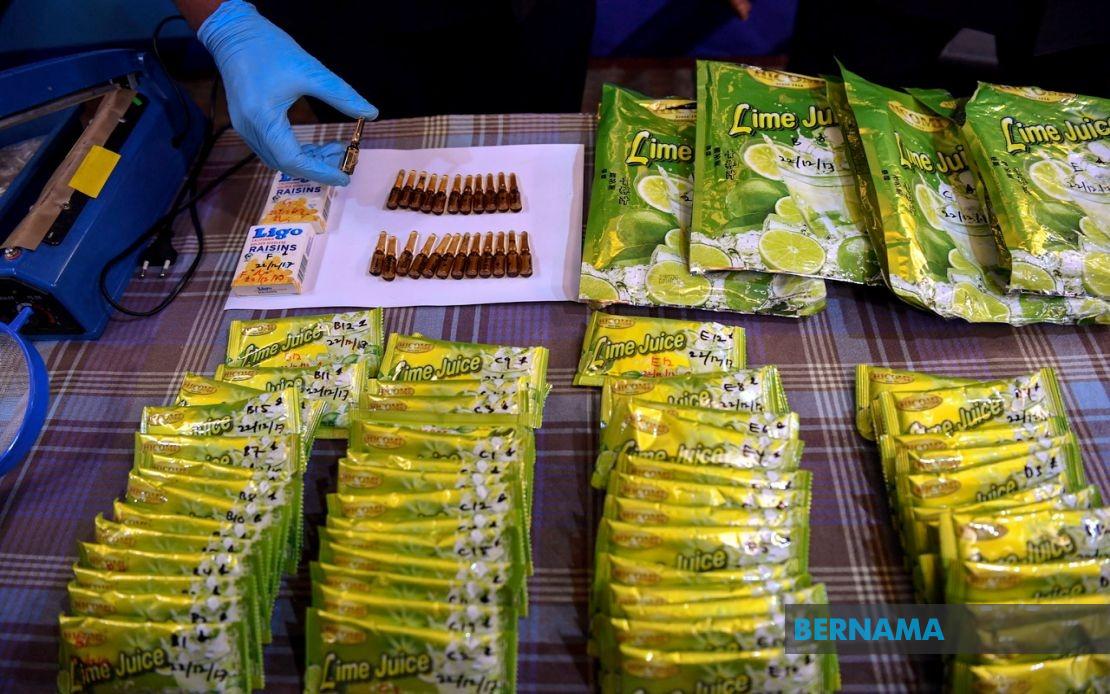
The Home Ministry is mounting an aggressive campaign to counter what it characterises as an escalating public health crisis driven by synthetic substances flooding Malaysian streets. Home Minister Datuk Seri Saifuddin Nasution Ismail has flagged the emergence of methamphetamine, psychoactive pills locally termed "piu-piu," and fentanyl as particularly worrying developments, citing their devastating potential for addiction, fatal overdoses, and cascading social harms including violence and organised crime.
The scale of the problem has become undeniable. Between 2023 and June 2026, the Royal Malaysia Police recorded 238,704 arrests nationwide connected to various synthetic drug offences, a figure that underscores both the pervasiveness of trafficking networks and enforcement activity. This volume of arrests represents a significant allocation of police resources and signals that drug-related criminality remains a persistent drain on law enforcement capacity across the country.
Responding to parliamentary questions about the threat in Sarawak, where remote geography complicates enforcement, Saifuddin Nasution outlined a multi-pronged operational strategy. The police have activated specialised operations designated Op Tapis and Op Tapis Khas, deploying teams across urban centres, provincial towns, and isolated rural communities. These initiatives operate in coordination with the National Anti-Drugs Agency and the Royal Malaysian Customs Department, reflecting an acknowledgment that tackling trafficking requires coordinated inter-agency action rather than isolated police efforts.
Technology has become integral to modern narcotics enforcement. The ministry has incorporated drones for aerial surveillance and monitoring, fixed camera systems for tracking known trafficking hotspots, and intelligence-gathering infrastructure to map supply chains before they reach street level. This technological investment represents a departure from traditional reactive policing toward predictive and preventive approaches, though questions remain about implementation capacity and consistent funding across all states.
Legal scaffolding underpins enforcement operations. The Dangerous Drugs Act 1952 continues as the primary statute, with authorities pursuing convictions under its established frameworks. However, the government recognises a fundamental challenge: synthetic drug chemistry evolves faster than legislation. New Psychoactive Substances—chemically engineered variants designed to circumvent existing drug schedules—routinely emerge before regulatory mechanisms can catch up. To address this, the ministry is actively considering amendments to expand the Act's schedules, bringing emerging compounds under legal prohibition rather than operating in grey zones that delay prosecution.
In Sarawak specifically, the law enforcement picture reveals both intensity and specificity. Between January and early June this year, authorities recorded 7,097 arrests: 342 traffickers, 1,314 individuals caught with drugs, and 5,441 users. Simultaneously, police seized 418.01 kilogrammes of narcotics valued at RM53.73 million, demonstrating that significant quantities continue transiting the state despite interdiction efforts. The confiscation of RM1.95 million in syndicate assets indicates that enforcement extends beyond individual apprehension to dismantling the financial infrastructure supporting trafficking organisations.
Prevention increasingly features alongside punishment in official strategy. Between 2023 and June 2026, authorities conducted 1,144 drug awareness and prevention programmes nationwide, representing a substantial community engagement effort. These initiatives aim to fortify resistance to drug use, particularly among youth, by building social and institutional defences before addiction takes hold. The community policing approach reflects international best practice, recognising that enforcement alone cannot solve demand-side drivers of substance abuse.
Forensic capability enhancement represents a crucial but often overlooked dimension of counter-narcotics work. The ministry has invested in upgrading laboratory infrastructure to rapidly identify and profile emerging synthetic compounds, particularly fentanyl analogues and novel synthetic opioids. This capacity enables faster confirmation of drug composition, speeding prosecution and allowing epidemiological tracking of which substances are circulating in which regions. Such intelligence feeds into tactical operations and helps authorities anticipate supply shifts.
The focus on synthetic drugs reflects a genuine evolution in trafficking patterns. Traditional plant-based narcotics like heroin remain problematic, but synthetic alternatives offer traffickers significant advantages: smaller shipment volumes, easier concealment, and rapidly changing formulations that keep ahead of law enforcement detection methods. Fentanyl, a pharmaceutical opioid thousands of times more potent than morphine, presents particular danger; even tiny quantities can prove lethal, making accidental overdose a realistic risk for users unaware of what they have consumed.
Sarawak's situation deserves contextual attention. The state's geography—vast territory with dispersed settlement patterns, lengthy borders, and river transportation networks—creates enforcement challenges distinct from peninsular Malaysia. Remote communities may lack easy access to treatment or counselling services, potentially driving higher reliance on law enforcement alone as the response mechanism. The parliamentary question from Mohamad Shafizan Kepli reflects legitimate concern that rural and indigenous populations could be disproportionately affected if drug prevention and treatment infrastructure remains concentrated in urban centres.
The detention of 13 individuals under the Dangerous Drugs (Special Preventive Measures) Act 1985, alongside action against 131 hardcore addicts under Section 39C of the 1952 Act, indicates that authorities are deploying rehabilitation-adjacent interventions alongside criminal prosecution. These provisions allow detention and mandatory treatment rather than incarceration alone, though their effectiveness in achieving lasting recovery and reintegration remains contested in academic literature.
The trajectory suggested by official statements points toward intensification rather than resolution. Synthetic drug availability appears entrenched; production and trafficking networks demonstrate adaptability; and demand persists, driven by addiction's neurochemical reality. Malaysia's response—combining enforcement rigour, technological investment, legal refinement, and community prevention—follows international precedent, though comparable jurisdictions report ongoing struggle against synthetic substances. Whether current escalation will achieve meaningful reduction in availability and harm remains an open question that subsequent years will test.

