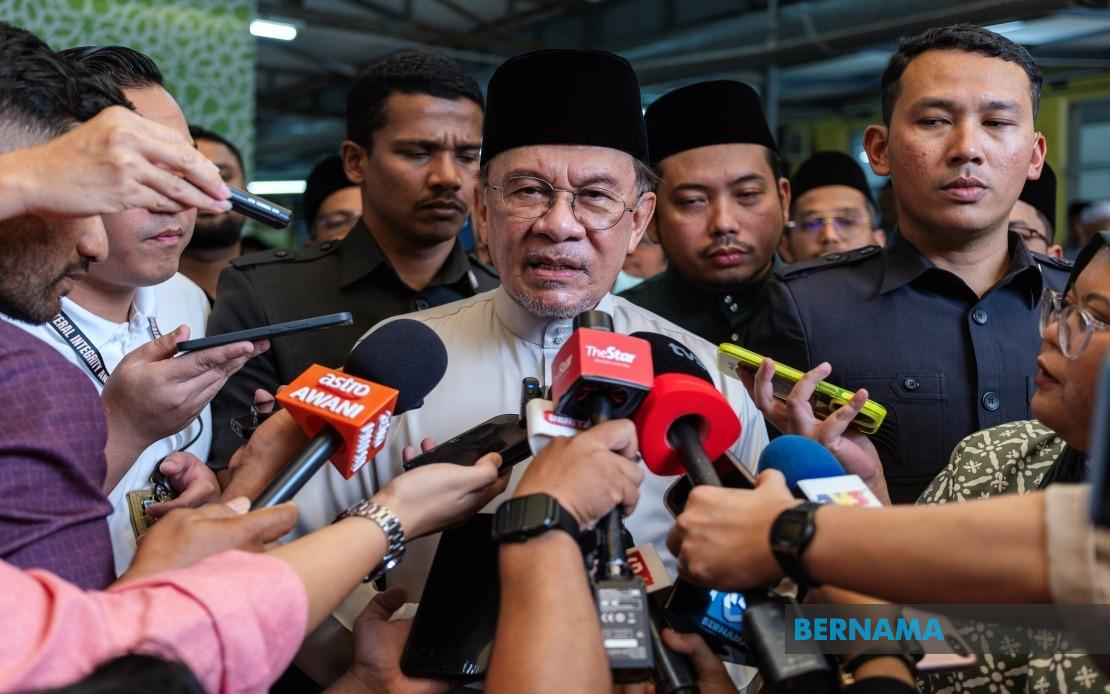
Malaysia will not alter its approach toward fugitive businessman Low Taek Jho, commonly known as Jho Low, even as international media outlets report that he may feature among approximately 250 individuals under consideration for a potential pardon by United States President Donald Trump, coinciding with America's 250th Independence Day celebrations. Prime Minister Datuk Seri Anwar Ibrahim made this declaration on Friday, speaking to journalists following congregational prayers at Masjid As-Sodiqin in Taman Kobena, Kuala Lumpur.
Anwar emphasised that any decision taken by Washington regarding Jho Low constitutes an internal matter for the United States and will not sway Malaysia's legal and diplomatic position. The Prime Minister stated emphatically that Malaysia's stance on the matter is grounded in principle and will remain unaffected by external developments. His comments reflect Malaysia's determination to preserve judicial independence and sovereignty in criminal matters that have long been central to the country's anti-corruption agenda.
The timing of these remarks is significant, as speculation about Trump's potential pardons has intensified ahead of the Independence Day celebrations on July 4. Jho Low, who remains accused of involvement in the massive 1Malaysia Development Berhad (1MDB) scandal that reverberated across global financial markets, has emerged as a test case for how Malaysia balances bilateral relations with the United States against its domestic legal commitments. The businessman has been a fugitive since authorities began investigating his alleged role in one of Asia's largest financial fraud schemes.
The 1MDB saga has cast long shadows over Malaysian politics and governance for nearly a decade. The scandal implicated numerous high-ranking officials and resulted in significant judicial proceedings domestically. Jho Low's alleged orchestration of massive fund diversions and money laundering operations through international financial channels prompted coordinated investigations across multiple jurisdictions, including the United States, Singapore, and the United Kingdom. Malaysia's pursuit of accountability in this matter has become emblematic of the nation's commitment to combat financial crimes and restore public trust in institutions.
Anwar's measured but firm response demonstrates Malaysia's careful navigation of a delicate diplomatic situation. While Malaysia maintains robust bilateral ties with the United States across trade, defence, and security domains, the government has consistently prioritised adherence to legal principles and rule of law as non-negotiable foundations of governance. Any US pardon of Jho Low would present Malaysia with complex questions about jurisdiction, extradition, and international cooperation in criminal justice matters.
The statement carries particular weight given Malaysia's recent anti-corruption initiatives and efforts to strengthen institutional credibility. The administration has sought to demonstrate that no individual, regardless of wealth, connections, or international mobility, stands above legal accountability. Allowing external pressures to influence domestic legal positions would undermine these carefully constructed narratives and potentially diminish public confidence in the country's commitment to justice.
Furthermore, Anwar's declaration addresses concerns among civil society organisations, legal advocates, and ordinary Malaysians who have closely monitored the 1MDB proceedings. The scandal destroyed billions in public wealth and triggered international investigations that exposed vulnerabilities in Malaysia's financial regulatory frameworks. A perceived capitulation on the matter of Jho Low's accountability could resurrect public doubts about whether powerful individuals might ultimately escape consequences through international legal maneuvering.
In separate remarks, the Prime Minister disclosed that Malaysia has received a proposed contribution of RM1 million from the United States designated for the restoration of Tugu Negara, the National Monument, in preparation for next year's National Day celebrations. Anwar indicated that this initiative will be evaluated during the upcoming Cabinet session, signalling that such cooperative ventures remain possible even as Malaysia maintains resolute positions on criminal justice matters. This distinction suggests Malaysia's approach involves compartmentalising bilateral engagement: pursuing collaborative opportunities where interests align while preserving principled stances on legal and governance issues.
The juxtaposition of these two developments illustrates the multifaceted nature of Malaysia's relationship with the United States. Cooperation on infrastructure, historical preservation, and cultural commemoration coexists alongside fundamental disagreements on matters affecting Malaysia's legal authority and national interests. For Malaysian observers, this reflects a pragmatic approach to international relations that neither allows ideological alignment nor economic linkages to compromise core institutional values.
Southeast Asian analysts have noted that Malaysia's position resonates beyond its borders, particularly among regional neighbours grappling with similar challenges related to transnational financial crimes and fugitives with international reach. Singapore, Indonesia, and Thailand have all experienced comparable cases where powerful individuals sought refuge abroad while facing domestic legal proceedings. Malaysia's refusal to subordinate its judicial determinations to external pressures establishes a regional standard for legal independence and institutional integrity.
The broader implications extend to questions about international legal cooperation and the enforcement of accountability across jurisdictional boundaries. As financial criminals increasingly exploit gaps between national legal systems, countries like Malaysia face mounting pressures to harmonise approaches with major powers, sometimes at the expense of domestic priorities. Anwar's stance indicates that Malaysia intends to participate in international legal frameworks as a partner of equal standing rather than as a subordinate entity.
Moving forward, Malaysia's position creates potential complications should the United States proceed with any pardon. Such a scenario would necessitate careful diplomatic management and public communication to prevent the perception that Malaysia has compromised its principles. The government may need to reinforce its commitment to pursuing accountability through alternative mechanisms or international cooperation frameworks that do not depend on the physical apprehension of fugitives already beyond national jurisdiction.

