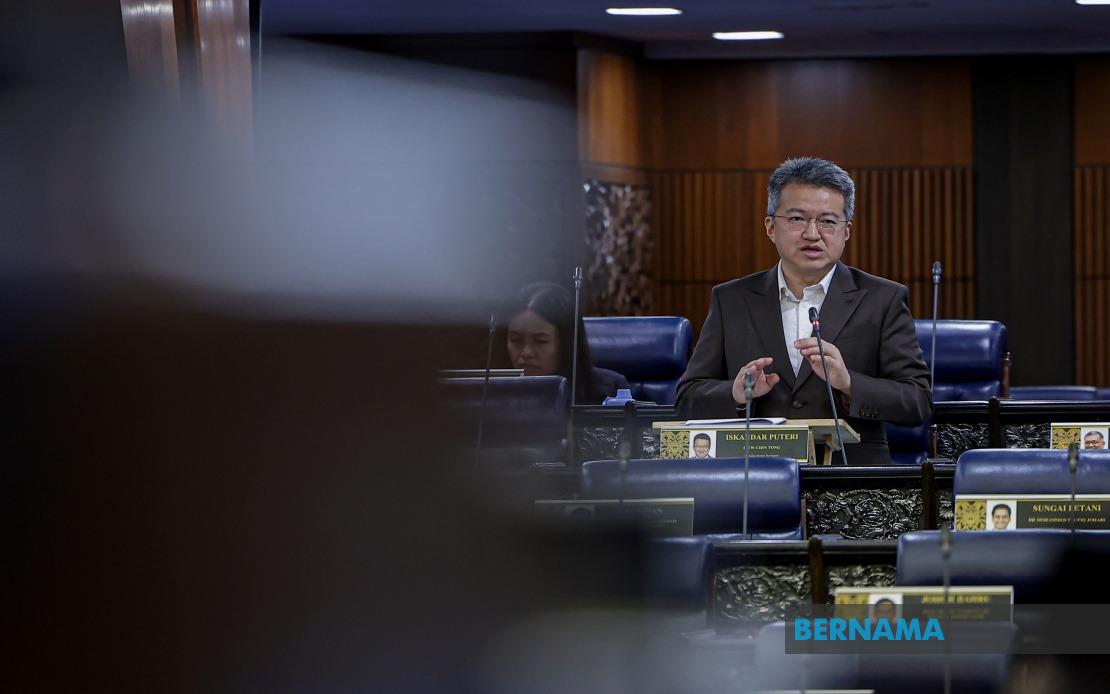
Deputy Finance Minister Liew Chin Tong has reaffirmed the MADANI Government's commitment to overhauling Malaysia's governance architecture and public administration systems in a deliberate effort to ensure that the catastrophic 1Malaysia Development Berhad debacle cannot be repeated. Speaking during parliamentary Question Time, Liew outlined how the administration under Prime Minister Datuk Seri Anwar Ibrahim has systematically introduced institutional reforms designed not only to tighten controls over public finances but also to rebuild the international credibility that Malaysia's economy forfeited following the 1MDB scandal.
The 1MDB crisis, which unfolded over nearly a decade before its exposure, resulted in an estimated USD4.5 billion in losses and triggered coordinated investigations across multiple jurisdictions including the United States, Singapore, and the United Arab Emirates. The fallout extended far beyond financial accounting—it fundamentally undermined global perceptions of Malaysia's institutional integrity and regulatory competence. For Malaysian businesses seeking to expand regionally and for foreign investors considering Malaysia as a destination, the scandal cast a long shadow over the reliability of government financial stewardship.
Among the most significant legislative responses has been the enactment of the Public Finance and Fiscal Responsibility Act 2023, which establishes binding constraints on government spending and borrowing while creating explicit prohibitions against the kind of opacity that enabled 1MDB's earlier proliferation. This legislation introduces measurable discipline into how Malaysia's public finances are managed at both federal and state levels, requiring transparent reporting mechanisms and establishing clear accountability frameworks for officials responsible for managing public money.
Parallel to this, the government has substantially expanded the investigative reach of the Auditor-General through amendments to the Audit Act. The new "follow the public money" approach grants Malaysia's audit authority unprecedented access to track government expenditures across multiple agencies and entities, enabling comprehensive audits that can traverse complex financial arrangements and identify irregular transactions before they metastasize into massive losses. This represents a fundamental shift from passive accounting to proactive financial surveillance.
Liew emphasised that the government is currently drafting a Government Procurement Bill intended to inject greater transparency and competitive rigour into how the state acquires goods and services. Procurement has historically been a vulnerability in Malaysian government operations, often opaque and susceptible to patronage arrangements. The new legislative framework aims to standardise procurement processes, require open bidding, and establish clear conflict-of-interest protocols.
Additionally, the government is undertaking a comprehensive legal and operational restructuring of state-owned enterprises, recognising that many SOEs have operated with insufficient oversight and disconnected from proper governance standards. This reform agenda specifically targets the governance gaps that allowed 1MDB to function as what was essentially a government entity with minimal parliamentary scrutiny and extraordinarily loose financial controls.
The reputational cost of 1MDB extended well beyond domestic politics. The scandal precipitated numerous negative international media narratives about Malaysia's governance capacity, triggered formal legal proceedings in multiple countries, and made Malaysia the subject of ongoing enforcement actions by foreign regulatory bodies. For years afterward, Malaysia's credit ratings faced downward pressure, and the country had to work substantially harder to attract foreign direct investment compared to regional peers that had not experienced similar shocks to institutional credibility.
Liew noted that the cumulative financial burden of addressing 1MDB's legacy remains substantial. Since 2017, the government has drawn RM18.7 billion from its operating and development budgets to service the scandal's financial consequences. When the MADANI Government assumed office in March 2023, it confronted an immediate obligation to allocate RM13 billion from its development budget specifically to redeem USD3 billion in government-guaranteed bonds that 1MDB had issued. This redemption consumed approximately 13.1 percent of the government's total development expenditure for the fiscal year, diverting resources that might otherwise have funded infrastructure, education, or healthcare initiatives.
The governance reforms now underway represent recognition that preventing future crises requires more than prosecuting those responsible for past misconduct; institutional architecture itself must be redesigned to make malfeasance substantially more difficult to conceal and perpetuate. By concentrating audit authority, establishing fiscal rules, standardising procurement, and subjecting SOEs to heightened oversight, the government is attempting to eliminate the institutional pathways that 1MDB exploited.
For Malaysian investors and businesses, these reforms carry tangible implications. Companies that export goods and services, or seek to attract overseas capital, benefit from restored confidence in Malaysia's institutional stability. For taxpayers, the reforms theoretically offer greater assurance that public funds are being deployed responsibly. Regionally, Malaysia's governance strengthening also sends a signal to other Southeast Asian economies about the importance of maintaining robust institutional checks.
However, the success of these reforms ultimately depends on consistent implementation, political will to enforce them even when inconvenient, and the development of a government culture in which adherence to governance standards is valued over expedience. The legislative framework is necessary but insufficient without corresponding shifts in administrative behaviour and institutional culture.
Liew's parliamentary remarks underscore the government's determination to position Malaysia as having learned serious lessons from the 1MDB episode. With Malaysia having recorded its highest-ever approved investments and demonstrated improved global competitiveness rankings according to official metrics, the government argues that its governance reforms are yielding measurable dividends in investor confidence and economic performance. Whether these improvements prove durable will largely depend on how rigorously these institutional safeguards are maintained over subsequent electoral cycles and whether future political actors demonstrate equivalent commitment to fiscal transparency and institutional integrity.

