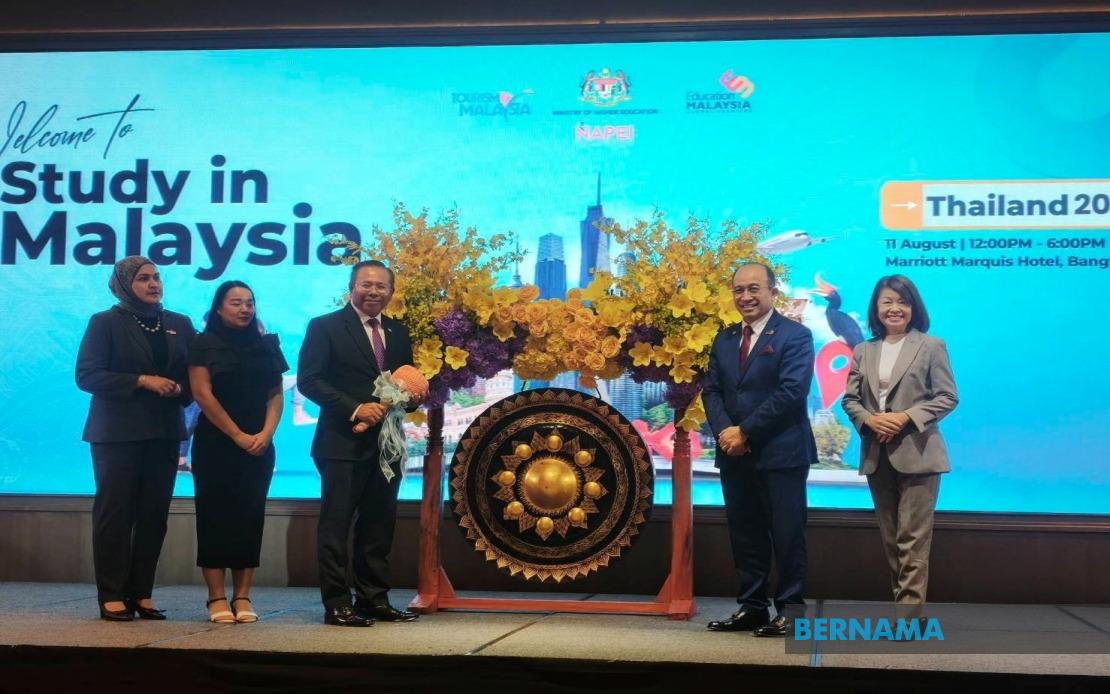
Malaysia is intensifying efforts to draw Thai students into its higher education sector, with authorities targeting an increase exceeding 20 per cent as the nation seeks to establish itself as a preferred study destination in Southeast Asia. The push reflects broader regional competition among universities and a recognition that neighbouring Thailand represents a significant untapped market given geographical and cultural proximity.
Education Malaysia Global Services (EMGS), the agency tasked with international student recruitment and visa processing, is spearheading the initiative through a carefully coordinated partnership with Thailand's professional education consultancy network. The organisation's chief executive officer Novie Tajuddin outlined the strategy during the launch of the Study in Malaysia Education Fair, held across multiple Thai cities including Chiang Mai, Bangkok and Hat Yai throughout August.
Current enrolment data reveals the modest starting point for this expansion. In 2025, approximately 634 Thai nationals were enrolled across Malaysian higher education institutions, representing growth from just 300 students in 2024. The 20 per cent increase target would translate to bringing these numbers to roughly 760 students, a substantial leap that would require coordinated marketing, institutional support and enhanced student pathways. The existing cohort demonstrates established demand, with more than 60 per cent pursuing undergraduate qualifications and the remainder engaged in postgraduate research and professional development programmes.
The collaborative framework underpinning this campaign involves EMGS working alongside Thailand's International Education Consultants Association (TIECA), a professional membership body representing 78 active education agents throughout Thailand. This institutional partnership provides crucial ground-level access to prospective students and their families, ensuring outreach extends beyond capital cities to regional centres where education agents maintain long-standing client relationships. Tourism Malaysia and the National Association of Private Educational Institutions (NAPEI) have also joined the initiative, broadening institutional backing and lending credibility to recruitment messaging.
Malaysia's competitive positioning rests on three interrelated strengths that regional authorities emphasise consistently. Geographic proximity eliminates lengthy travel logistics and reduces family separation concerns that deter some Thai students from considering distant destinations. Educational affordability, when benchmarked against competitor nations, provides genuine cost advantage particularly for families from provincial Thailand managing fixed budgets. Quality remains contested in global rankings yet Malaysian universities deliver recognised credentials accepted across professional sectors, attracting students with employment aspirations rather than purely academic prestige motivations.
A significant recent policy development strengthens Malaysia's appeal substantially. The Graduate Pass scheme permits international degree holders, including Thai nationals, to remain in Malaysia for one year following degree completion, enabling practical work experience within permitted economic sectors. This pathway addresses critical student concerns about employment prospects and real-world skill application, transforming Malaysia from a purely educational destination into a stepping-stone for career development and regional professional integration.
Government-level engagement reinforces the recruitment campaign's official status and institutional commitment. Datuk Wan Zaidi Wan Abdullah, Malaysia's Ambassador to Thailand, formally launched the education fair and subsequently proposed that Malaysian universities establish dedicated scholarship schemes exclusively for Thai students. Such schemes would substantially reduce financial barriers for merit-based candidates and demonstrate institutional investment in sustained Thai-Malaysian educational exchange, moving beyond casual recruitment into structured partnership frameworks.
The timing of this initiative reflects broader Southeast Asian trends in student mobility and regional competition for talent. Thailand, despite producing substantial numbers of tertiary students, has traditionally directed significant portions toward North American and European destinations where historical educational prestige and English-language advantages proved decisive. Malaysia's geographic proximity and increasingly sophisticated academic offerings now position it as a realistic alternative requiring substantially lower financial outlay while delivering regionally recognised qualifications.
EMGS has additionally strengthened formal coordination mechanisms with the Thai Embassy in Malaysia, establishing institutional pathways for ongoing engagement and troubleshooting student support needs. This diplomatic-educational partnership approach acknowledges that sustained enrolment growth depends on comprehensive support infrastructure beyond initial recruitment messaging, including visa facilitation, cultural orientation and ongoing academic advising throughout the student journey.
The expansion strategy carries implications extending beyond simple student numbers. Increased Thai enrolment strengthens bilateral educational and cultural ties, creating networks of Thai professionals with Malaysian university credentials who facilitate future business, diplomatic and academic collaboration between nations. For Malaysian institutions facing demographic pressures domestically and international competition globally, Thai recruitment addresses revenue diversification imperatives while positioning Malaysian universities as regional knowledge hubs rather than domestically focused institutions.
Institutional readiness remains partly uncertain despite official enthusiasm. Malaysian universities must demonstrate capacity to accommodate anticipated enrolment growth while maintaining educational quality standards. Language of instruction, ranging from English-medium programmes to Malay-language offerings, requires careful alignment with Thai student competencies and preferences. Accommodation availability, cultural support services and integration mechanisms merit concurrent development to ensure student satisfaction and retention throughout their academic tenure.
The 20 per cent growth target, while ambitious, remains achievable given demonstrated baseline interest reflected in current enrolment figures and absence of major barriers to cross-border educational mobility. Success depends substantially on sustained institutional commitment from universities, effective agent communication through TIECA networks and policy consistency regarding graduate employment pathways. Should this campaign succeed, Thailand could emerge as a primary regional recruitment source, fundamentally reshaping Malaysian higher education's international profile and contributing meaningfully to ASEAN educational cooperation frameworks.

