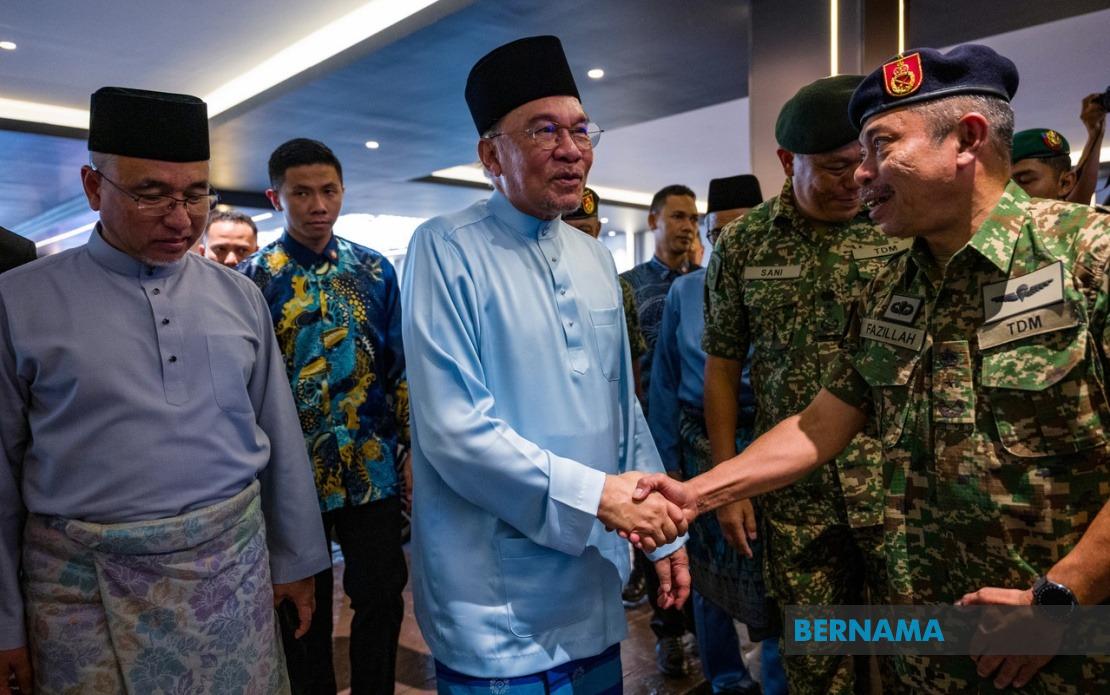
Prime Minister Datuk Seri Anwar Ibrahim has signalled the government's intention to lift defence spending in the 2027 budget cycle as part of a broader strategy to elevate the Malaysian Armed Forces into a more capable and integrated military institution. The announcement, made during a visit to Terendak Camp in Melaka, underscores Kuala Lumpur's recognition that sustained investment in defence infrastructure and human resources remains essential to maintaining regional security and operational effectiveness across Malaysia's vast maritime and terrestrial domains.
Chief of Defence Force General Tan Sri Malek Razak Sulaiman has publicly welcomed the budgetary initiative, characterising it as a concrete expression of governmental resolve to strengthen the armed forces across multiple fronts. His endorsement carries particular weight given the CDF's position at the apex of military hierarchy and his intimate knowledge of capability gaps and modernisation requirements across all three services. The backing from top brass suggests this budgetary move aligns with longstanding institutional priorities rather than representing merely a political gesture.
The enhanced allocation will target modernisation of military assets and equipment in alignment with the MAF's Future Force strategic development plan, a multi-year roadmap designed to reshape operational capacity and organisational structure. This connection to a formal strategic framework indicates that spending increases will follow a coherent vision rather than ad hoc acquisitions. The Future Force concept reflects international best practices in defence planning and positions Malaysia to address evolving security challenges in Southeast Asia, where technological advancement among competitor militaries has accelerated considerably in recent years.
Beyond hardware and systems, the government intends to direct increased resources toward the personnel dimension of military effectiveness. Housing quality improvements, construction of a new military hospital, and maintenance of essential utilities represent recognition that force readiness ultimately depends on the welfare and morale of servicemen and women. When soldiers and airmen contend with substandard accommodation or inadequate healthcare facilities, operational efficiency deteriorates regardless of equipment quality. Malaysia's competitor nations in the region have invested heavily in military personnel welfare as a retention and motivation strategy.
The welfare enhancements carry particular significance for a volunteer military force competing for talent against civilian employment opportunities. The new hospital facility addresses a long-standing gap in military healthcare infrastructure and signals commitment to comprehensive personnel care from recruitment through retirement. Housing improvements directly affect quality of life for personnel and their families, addressing one of the most visible sources of dissatisfaction within armed forces globally. When families lack adequate shelter or endure deteriorating living conditions, it undermines the stability needed for long deployments and operational focus.
As Finance Minister alongside his prime ministerial role, Anwar's personal involvement in defence budgeting decisions emphasises that military modernisation enjoys high-level governmental priority rather than serving as a peripheral policy concern. This dual-hat arrangement ensures that defence planners can access top-level financial decision-making authority, potentially expediting budget negotiations and allocations compared to arrangements where defence ministers operate separately from finance portfolios. The integration also signals to international defence partners that Malaysia remains committed to capability development.
The timing of the announcement during the Semarak Kenegaraan Programme at a military facility demonstrates symbolic as well as substantive commitment. Public ceremonies at military installations amplify the message within the armed forces community and signal to civil society that the government values defence and security institutions. Such visibility matters considerably for military morale and public confidence in defence spending, particularly important in democracies where public support for defence budgets fluctuates with changing security perceptions and economic conditions.
Another significant element of the announced package involves streamlining promotion procedures for military and police personnel, bringing these processes into alignment with broader civil service practices. Faster promotions can improve career satisfaction, enhance officer development, and create incentives for retaining experienced personnel who might otherwise transition to private sector roles. This procedural reform recognises that military effectiveness depends substantially on maintaining experienced cadres and enabling talented officers to advance based on merit and performance rather than seniority-driven timelines.
For the wider Southeast Asian region, Malaysia's defence spending increases reflect broader trends of military modernisation among ASEAN nations responding to geopolitical shifts, technological advancement, and maritime security challenges. Countries across the region from Vietnam to the Philippines to Indonesia have pursued significant defence acquisitions and capability development programmes. Malaysia's emphasis on integrated deterrence and strategic force development positions the nation to maintain credible military capacity amid these regional dynamics, particularly important given Malaysia's substantial coastline, maritime territorial interests, and commitment to upholding the UNCLOS-based regional order.
The Future Force framework underlying these spending plans represents a departure from purely procurement-focused approaches toward holistic force development encompassing doctrine, organisation, training, and personnel development alongside equipment. This integrated methodology reflects lessons learned globally from military modernisation efforts and acknowledges that modern defence challenges require more than technological solutions. Personnel welfare improvements, promotion reforms, and healthcare infrastructure constitute equally important components of building a truly modernised military institution capable of responding effectively to twenty-first century security demands.
Economic sustainability of increased defence spending will require careful balancing against other budgetary pressures facing Malaysia, from infrastructure development to social services to debt management. However, the government's framing emphasises that defence investment represents an investment in national security and strategic stability rather than mere expenditure. For Malaysian policymakers, the key challenge lies in demonstrating to taxpayers and international observers that these allocations generate proportionate security benefits and improved military effectiveness rather than simply expanding budgets without corresponding capability gains.
The announced initiatives suggest Malaysia's defence establishment and political leadership now operate from shared strategic assumptions regarding the necessity of sustained military modernisation. This convergence of views between civilian government and military command structures provides a stable foundation for long-term defence planning and should facilitate more coherent policy implementation than scenarios where civil-military perspectives diverge sharply. Whether the promised budgetary increases materialise and achieve intended modernisation goals will become apparent as Budget 2027 undergoes parliamentary scrutiny and implementation proceeds across subsequent financial cycles.

