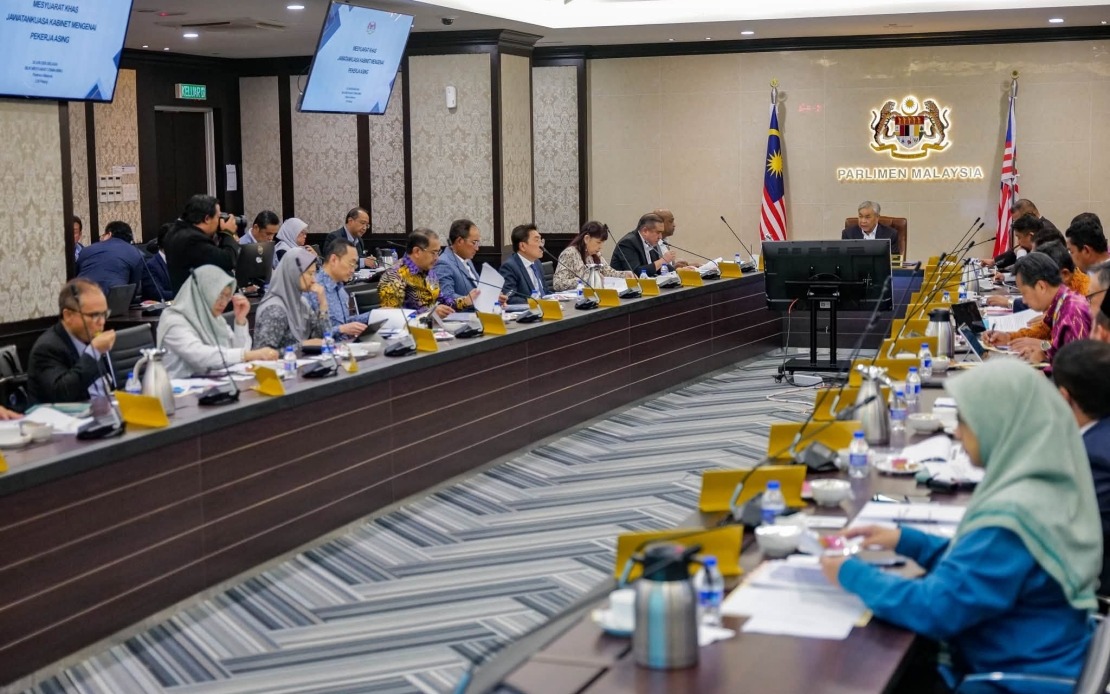
Malaysia's government is embarking on a comprehensive restructuring of how it manages the country's foreign workforce, Deputy Prime Minister Datuk Seri Dr Ahmad Zahid Hamidi announced following a special Cabinet Committee meeting on foreign workers held at Parliament. The overhaul aims to create a more cohesive and responsive system that can better serve both industry demands and national interests while maintaining rigorous oversight and security protocols.
The restructuring initiative emerged from decisions made during the Cabinet Committee meeting, which Ahmad Zahid chaired and which addressed fundamental questions about how the nation's foreign labour apparatus should be organized and operated. Among the substantive outcomes was a decision to reposition the One Stop Centre for Foreign Worker Management under the direct supervision of the Ministry of Human Resources, a move intended to streamline administrative processes and create clearer lines of accountability within government.
The deputy prime minister emphasized that efficiency and integrity form the twin pillars of the proposed new framework. Rather than viewing foreign worker management as purely a labour supply issue, the government is attempting to balance three competing objectives: meeting legitimate industry needs for workers in sectors where local talent remains unavailable, protecting Malaysia's national security interests, and preserving employment opportunities for Malaysian citizens who can and should fill available positions.
A key strategic element of the restructuring involves moving away from a reactive approach to labour importation toward a more deliberate, evidence-based system. Ahmad Zahid indicated that the government intends to conduct more rigorous assessments of actual foreign labour requirements across different industries and economic sectors. This represents a shift from historical patterns where foreign worker quotas were sometimes established without clear justification or regular review, potentially creating dependency relationships that discouraged local workforce development.
The Malaysian government simultaneously reaffirmed its commitment to reducing structural reliance on imported labour by pursuing parallel initiatives that strengthen the domestic workforce. These measures include accelerating skills development programmes for Malaysian workers, promoting automation in industries where labour shortages exist, and creating pathways for sector-wide productivity improvements that reduce headcount requirements. This dual-track approach recognises that while foreign workers will likely remain necessary for certain roles, the nation's long-term economic resilience depends on cultivating a more skilled, adaptable domestic labour force.
The timing of this restructuring reflects broader regional and global trends affecting labour migration patterns in Southeast Asia. Neighbouring countries including Singapore, Thailand, and Indonesia have similarly grappled with balancing labour market openness against concerns about labour market protection, wage suppression, and social cohesion. Malaysia's experience suggests that governments in the region are converging on the view that ad-hoc foreign worker policies create inefficiencies and governance challenges that eventually require comprehensive intervention.
For Malaysian employers, particularly in sectors heavily dependent on foreign labour such as manufacturing, construction, agriculture, and domestic services, the restructuring presents both opportunities and uncertainties. Streamlined administrative procedures through the One Stop Centre could reduce compliance burdens and processing delays. However, tighter scrutiny of labour requirements and preference for automation may constrain employers' ability to rapidly scale operations through labour importation, potentially requiring investment in productivity improvements and technology adoption.
The restructuring also addresses persistent concerns about worker exploitation, irregular employment, and the informal economy channels that have historically characterised Malaysia's foreign worker sector. By centralizing oversight under the Human Resources Ministry rather than distributing responsibility across multiple agencies, the government aims to enhance monitoring of working conditions, wage compliance, and worker protections. This consolidation could reduce opportunities for regulatory arbitrage where workers navigate between different government departments with inconsistent enforcement standards.
The Cabinet Committee's decisions on revising membership and terms of reference suggest that inter-agency coordination mechanisms will be reorganised to ensure that security, labour, immigration, and industry perspectives are properly integrated rather than siloed. This structural change acknowledges that foreign worker management is inherently multi-dimensional and requires input from agencies with different mandates and expertise. The previous fragmentation of responsibility across multiple ministries sometimes produced contradictory signals about policy direction and implementation priorities.
Ahmad Zahid's statement that all foreign worker management measures will be "guided by the interests of the nation and the people's wellbeing" reflects an attempt to position the restructuring as serving broader national objectives rather than narrow sectoral interests. This framing suggests the government views foreign labour policy as intimately connected to employment equity, social stability, wage protection, and economic resilience rather than simply as a mechanism for meeting business labour demands at the lowest cost.
For Southeast Asian observers, Malaysia's restructuring initiative demonstrates that even countries with long-established foreign worker programmes are finding those arrangements require periodic fundamental reassessment. As regional labour mobility patterns evolve, as technology disrupts traditional labour-intensive sectors, and as societies become more conscious of labour standards and migrant worker protections, governments recognize that yesterday's foreign worker management frameworks may prove inadequate for tomorrow's economic and social requirements.
The implications for Malaysian businesses will unfold over the coming months as the Ministry of Human Resources establishes the operational details of the restructured One Stop Centre and implements more stringent labour requirement assessments. Industries will need to prepare transition plans that account for potentially tighter constraints on foreign worker recruitment while simultaneously enhancing domestic workforce development and pursuing automation investments.

