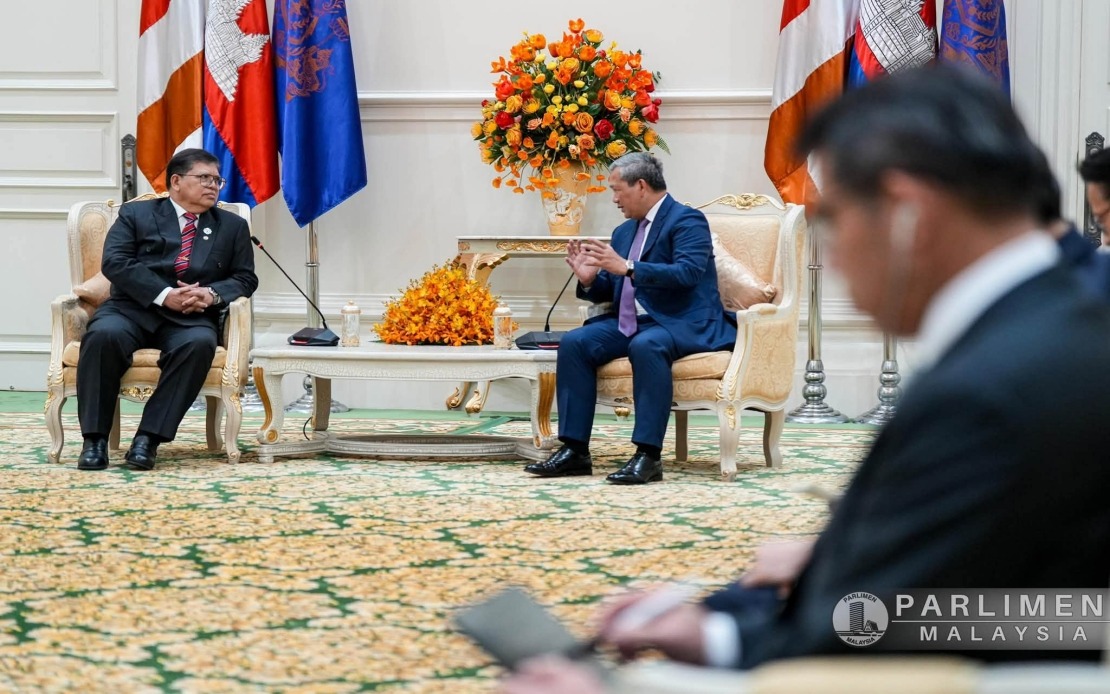
Malaysia's parliament speaker has renewed calls for diplomatic channels to remain open in resolving the ongoing border tensions between Cambodia and Thailand, warning that unresolved conflicts could undermine the cohesion that the Association of Southeast Asian Nations relies upon for its effectiveness. Tan Sri Johari Abdul made the remarks during his participation in the Second Inter-Parliamentary Speakers' Conference in Phnom Penh, where he held discussions with Cambodian Prime Minister Hun Manet about the escalating situation along their shared frontier.
For Malaysia, which has long positioned itself as a neutral mediator within ASEAN, the Cambodia-Thailand border dispute represents a test of the bloc's capacity to manage intra-regional conflicts without external intervention. Johari's emphasis on constructive dialogue reflects Malaysia's broader commitment to the ASEAN Way, a diplomatic framework that prioritises non-interference and peaceful settlement of disputes over confrontation. The speaker underscored that bilateral disagreements, particularly those involving border demarcation and security concerns, must not be allowed to fracture the broader platform of trust that ASEAN members have built over decades.
The significance of Johari's intervention lies in Malaysia's standing within the regional grouping. As a founding member and current holder of the Dewan Rakyat speaker's position, Malaysia carries considerable soft power in advocating for consensus-based approaches to regional challenges. The conference itself, jointly hosted by Cambodia's National Assembly and Senate from August 26 to 28, provided an ideal setting for this intervention, allowing Malaysia to address the issue at the inter-parliamentary level rather than solely through official government channels. This dual-track approach strengthens the message by engaging both legislative and executive branches across the region.
During his meeting with Hun Manet, Johari acknowledged Cambodia's legitimate concerns regarding the border situation and its effects on civilian populations living in affected areas. This recognition of Cambodia's perspective is strategically important, as it demonstrates Malaysia's sensitivity to all parties' grievances rather than adopting a stance perceived as favouring one side. By validating Cambodia's concerns while simultaneously advocating for negotiated solutions, Malaysia attempts to position itself as an honest broker capable of understanding multiple viewpoints without compromising its commitment to peace.
The broader context of the Cambodia-Thailand border dispute involves complex historical claims, competing territorial interpretations, and periodic military tensions that have escalated in recent years. The dispute centres on several contested areas, including maritime boundaries and overlapping continental shelf claims, compounded by legacy issues from the Khmer Rouge period and subsequent border demarcation efforts. Malaysia's intervention recognises that unmanaged escalation could trigger a wider regional security crisis, drawing in other ASEAN members and potentially creating space for external powers to exploit.
Beyond the immediate border issue, Johari's visit underscored Malaysia's commitment to deepening bilateral cooperation with Cambodia across multiple dimensions. The discussions encompassed parliamentary cooperation, economic engagement, human capital development and youth empowerment initiatives. These conversations signal that despite regional tensions, Malaysia views Cambodia as a strategic partner worthy of expanded institutional ties and collaborative frameworks. The emphasis on youth exchange programmes and technical education reflects a long-term investment in building people-to-people connections that can transcend periodic political tensions.
The mention of Technical and Vocational Education and Training (TVET) cooperation carries particular weight for Southeast Asian readers concerned about regional economic development. Skills training and institutional exchanges represent practical avenues through which Malaysia and Cambodia can address common workforce challenges while building mutual understanding. As both nations grapple with preparing younger generations for rapidly evolving labour markets, collaborative TVET initiatives create win-win scenarios that extend beyond traditional diplomatic gestures.
Johari's appreciation for Cambodia's facilitation of Malaysian business investments highlights the economic interdependencies that underpin ASEAN relationships. Malaysian companies operate across Cambodia's manufacturing, tourism, agriculture and services sectors, and a deterioration in bilateral relations could disrupt these commercial networks. By acknowledging Cambodia's business-friendly environment, Johari reinforces the notion that regional stability directly enables prosperity, creating material incentives for all parties to prioritise peaceful resolution of disputes.
Malaysia's position on the Cambodia-Thailand issue reflects a broader regional anxiety about conflict escalation during a period when ASEAN faces external pressures and internal divisions. The bloc's collective credibility depends on its ability to resolve member disputes without fragmentation. By emphasising dialogue and diplomacy, Malaysia appeals to the institutional interests that bind ASEAN together, suggesting that compromising on peaceful settlement mechanisms would ultimately weaken everyone's capacity to manage future challenges.
The timing of these diplomatic interventions also matters. As regional geopolitical competition intensifies, with major powers expanding their influence across Southeast Asia, ASEAN's internal cohesion becomes increasingly valuable. Malaysia's advocacy for sustained negotiation implicitly warns against allowing border disputes to become proxies for broader strategic rivalries. This message carries particular resonance given that Cambodia and Thailand have different security partnerships and strategic orientations, meaning their dispute could become entangled with wider great power competition.
Moving forward, Malaysia's commitment to supporting efforts to return parties to negotiating tables will likely manifest through quiet diplomacy, regional forums and multilateral mechanisms. The Inter-Parliamentary Speakers' Conference demonstrates how legislative bodies can complement formal diplomatic channels, creating additional platforms for dialogue. As ASEAN grapples with this challenge, the collective success of Malaysia and other mediating members in maintaining pressure for peaceful resolution will significantly influence the bloc's trajectory and relevance in an increasingly contested regional environment.

