When fatty plaque hardens into calcium deposits within the coronary arteries, it creates one of cardiology's most stubborn clinical challenges. Malaysian cardiologists are now pioneering a novel treatment approach that could fundamentally change how physicians manage these life-threatening blockages. The condition, known as severe coronary artery calcification, has long frustrated interventional specialists because the hardened deposits resist conventional treatment methods and significantly elevate the risk of heart attack and stroke.
Coronary artery disease develops when a complex mixture of fat, cholesterol, calcium, cellular debris and a clotting protein called fibrin gradually accumulates on artery walls. Over time, this accumulation progressively narrows blood vessels, restricting the fresh blood supply essential for heart function. When these deposits become severely calcified, they transform into a rock-like substance that standard balloon angioplasty cannot effectively compress. This calcification problem affects a substantial proportion of patients undergoing coronary interventions, yet remains notoriously difficult to treat, often requiring multiple interventional strategies or alternative surgical approaches.
Traditional approaches to opening blocked arteries include percutaneous coronary intervention, coronary artery bypass grafting, and angioplasty, each with varying effectiveness depending on plaque composition. When soft plaque predominates, physicians can insert a balloon catheter, expand it to crush the material, and deploy a stent to maintain the expanded vessel opening. However, when calcium dominance makes the plaque rock-hard, this straightforward approach fails. Consultant cardiologist Datuk Dr Tamil Selvan Muthusamy explains the fundamental problem: conventional balloons simply cannot generate sufficient force to fracture heavily calcified deposits, leaving physicians with limited options and often disappointing results.
Intravascular lithotripsy represented a significant breakthrough for managing severely calcified lesions. This minimally invasive procedure delivers sonic pressure waves through a specialised catheter directly to calcium deposits, essentially cracking them like geological formations. The ultrasound energy creates intense mechanical stress that fractures the hardened material, allowing subsequent stent placement and restoration of blood flow. Despite its promise, however, conventional IVL systems possess meaningful limitations that constrain clinical effectiveness. The devices operate within rigid parameters: if a system generates eight sonic pulses, physicians must completely fracture the calcium within that exact pulse budget. Newer iterations provide twelve pulses, but the fundamental constraint remains unchanged.
The mechanical design of conventional IVL systems also creates practical obstacles for interventional cardiologists. The catheter bulkiness makes insertion into already-narrowed coronary arteries extraordinarily challenging, particularly when significant calcification has substantially reduced the vessel lumen. Additionally, these devices typically come in a single standardised size, creating a measurement mismatch problem when treating coronary vessels that taper unpredictably from the proximal to distal segments. A vessel might measure 3.5 millimetres proximally but narrow to just 2 millimetres distally, yet the balloon remains fixed at a single diameter, forcing physicians to choose between inadequate lesion coverage or vessel trauma.
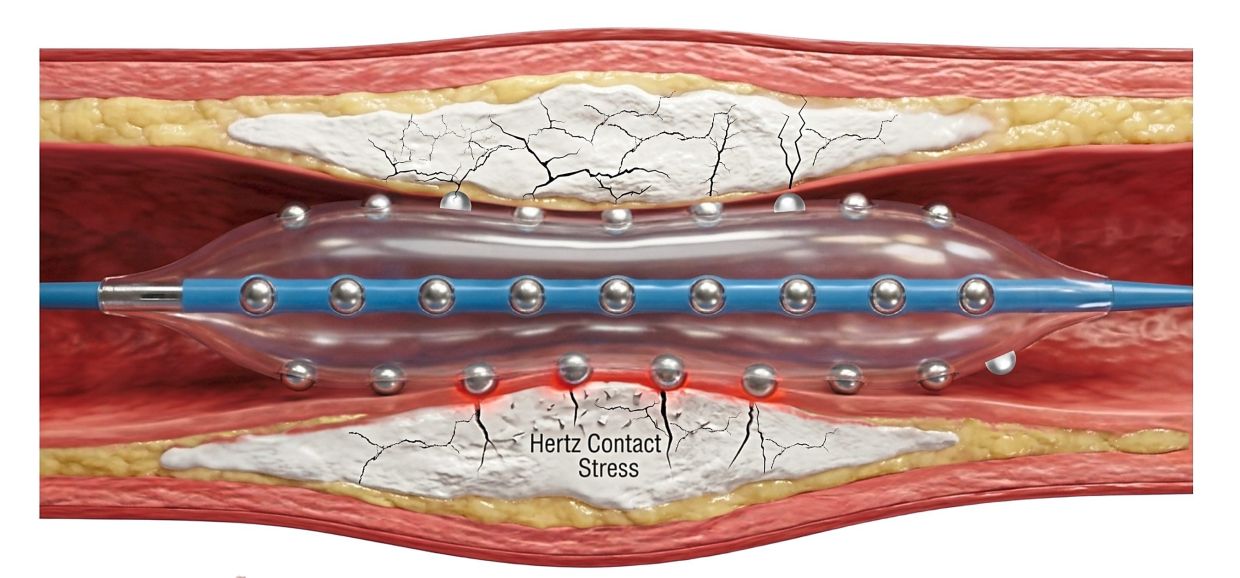
Recognising these limitations, Dr Tamil Selvan and his cardiology colleagues initiated a comprehensive research programme in 2025 investigating an advanced iteration called the Hertz Contact-IVL System. This innovative device fundamentally reimagines lithotripsy mechanics by replacing external energy generation with an integrated mechanical approach. Rather than relying on ultrasound pulses emanating from an external generator, the HC-IVL system features a specialised balloon embedded with tiny metallic hemispheres. When the balloon contacts hardened plaque and physicians apply pressure, the hemisphere geometry multiplies and amplifies that pressure, concentrating it with remarkable intensity precisely where calcium deposits require fracturing.
The physics underlying this mechanical amplification provides substantial advantages over energy-based predecessors. By eliminating dependence on external sonic generators, the HC-IVL system sidesteps the pulse-limitation problem entirely. More critically, the device creates deep, wide fractures throughout the calcified plaque while preserving surrounding arterial tissue from collateral damage. This selectivity permits optimal arterial expansion, enabling interventional cardiologists to deploy stents with far greater reliability and effectiveness. Dr Tamil Selvan emphasises that the system represents a purely mechanical breakthrough: "We are still breaking the calcium, but we do not have an external source." The integrated hemispheres transform mechanical pressure into focused stress amplification, fundamentally improving how deeply the device can fracture even the densest calcifications.
Deliverability represents perhaps the most clinically meaningful improvement the HC-IVL system offers. Unlike its predecessors, which often require multiple catheters when treating longer lesions or multiple blockages, the Contact-IVL system navigates through the entire vessel length with substantially greater ease. This superior trackability means interventional cardiologists can employ a single balloon for extending lesions or even multiple vessel segments, reducing procedural complexity, fluoroscopy exposure, and overall intervention time. For patients, this translates to reduced radiation dose and shorter procedure duration, directly improving immediate clinical outcomes and patient safety profiles.
Before enthusiastically adopting this promising new technology throughout Malaysian cardiology practices, Dr Tamil Selvan and his research team recognised the critical importance of rigorous local validation. While the device manufacturer had conducted preliminary studies across multiple American centres, those investigations remained relatively limited in scope and patient numbers. Understanding that Malaysian patient populations and clinical practice patterns might differ meaningfully from Western cohorts, the research team designed a comprehensive local study to thoroughly evaluate the HC-IVL system's safety profile, efficacy metrics, and practical utility within the Malaysian healthcare context.
This Malaysian-led research initiative reflects broader trends within Southeast Asian cardiology toward developing indigenous research capacity and validating international technologies within regional patient populations. Rather than passively accepting foreign research conclusions, Dr Tamil Selvan's team is systematically establishing local evidence that will ultimately inform clinical practice guidelines across Malaysia and potentially throughout the region. The study's focus on safety profiling, procedural success rates, and long-term outcomes will provide Malaysian interventional cardiologists with confidence that the technology performs reliably within local clinical settings.
The implications of successful HC-IVL adoption extend significantly beyond technical cardiology. Severe coronary artery calcification disproportionately affects ageing populations, particularly those with chronic kidney disease, where calcium-phosphate metabolism becomes dysregulated. Malaysia's rapidly ageing population, combined with rising prevalence of lifestyle-related cardiovascular risk factors, means coronary calcification presents an increasingly prevalent clinical challenge. Better tools for managing severely calcified lesions directly improve patient outcomes, reduce the need for emergency bypass surgery, and expand treatment options for patients previously considered unsuitable candidates for interventional procedures.
Looking forward, the successful development and validation of advanced calcification-treatment technologies in Malaysia positions the nation as a meaningful contributor to regional cardiology innovation. As the HC-IVL system undergoes rigorous local evaluation, Malaysian cardiologists gain opportunities to refine interventional techniques, train subsequent generations of specialists, and establish Malaysia as a centre of excellence for complex coronary intervention. This research trajectory ultimately strengthens the entire regional cardiology infrastructure while directly benefiting patients across Southeast Asia who suffer from this challenging, potentially life-threatening coronary condition.

