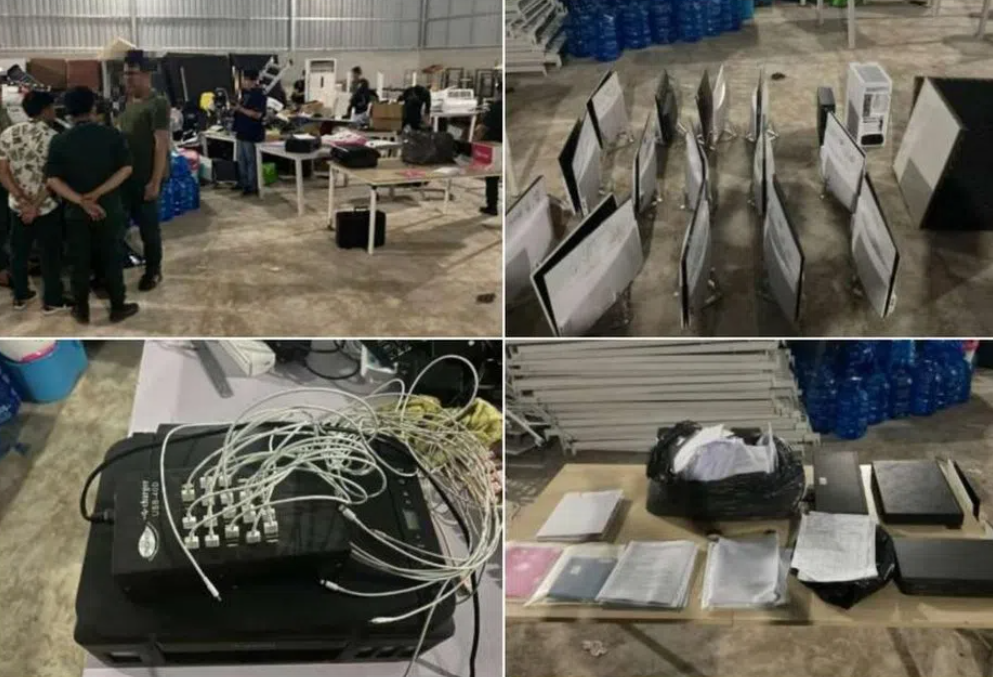
A Malaysian man has been sentenced to 16 months and two weeks' imprisonment for his involvement with a Cambodia-based organised crime syndicate that operated a sprawling scam operation targeting Singaporeans throughout 2024 and 2025. Yip Chee Ming, 30, pleaded guilty to membership in the criminal organisation on Friday, June 26, marking the conclusion of a case that underscores the transnational nature of modern fraud networks and their ability to recruit operatives across Southeast Asia.
Yip's venture into organised crime proved remarkably short-lived. Introduced to the opportunity by a friend named Jason in October 2024, he was persuaded to join what was presented as a lucrative overseas employment arrangement. The two men were subsequently contacted by Tang Soon Wah, identified as a senior leader within the syndicate, who extended an invitation to view the operation's physical headquarters located in Phnom Penh. Both Malaysians travelled to Cambodia on November 21, 2024, after returning home to deliberate the offer, seemingly convinced of the legitimacy of their prospective employer.
The compound itself was designed to impress potential recruits. The five-storey building functioned as a fully operational scam centre, complete with security personnel stationed at entry points and a hierarchical management structure that distinguished between leadership, supervisors, trainers, and frontline callers. The syndicate offered Yip a monthly salary of US$1,800 in cryptocurrency alongside a one per cent commission on each successful victim, compensation that would have appealed to someone seeking income in the Cambodian informal economy.
Beginning on November 22, 2024, Yip was tasked with impersonating bank officials during calls to unsuspecting Singaporean victims. The syndicate provided trained scripts and coaching on conversational techniques, including instruction on adopting a Singaporean accent to enhance credibility. However, Yip's performance was disastrous. Despite adhering to the prepared dialogue, he failed to persuade a single victim to fall for the deception on his first day. His second attempt on November 23 yielded identical results. Recognising his complete unsuitability for the role, Tang summarily terminated Yip's employment, deleting their communication records before severing ties entirely.
The broader criminal enterprise to which Yip briefly belonged operated with remarkable scale and sophistication. Between September 3, 2024, and September 5, 2025, law enforcement documented at least 528 reported scam incidents attributable to the syndicate, resulting in cumulative losses exceeding S$52.5 million for victims across Singapore. The operation maintained distinct functional units, with dedicated personnel managing victim contact, script development, training, cryptocurrency conversion, and money laundering. Court records indicate the syndicate numbered at least 78 suspected members, though the actual roster may have been considerably larger given the structure's apparent sprawl and complexity.
The syndicate's method of operation exploited psychological vulnerabilities and trust in institutional authority. By impersonating government and financial sector officials, callers manufactured urgency and legitimacy around fraudulent requests. The emphasis on accent coaching and scripting reveals an organised approach to social engineering that moved beyond amateur deception. Money launderers within the network converted stolen funds into cryptocurrency, a mechanism that provided distance from conventional financial tracking and facilitated the movement of illicit proceeds across borders.
Yip's arrest occurred in Singapore on September 9, 2025, following a coordinated enforcement operation undertaken jointly by Singapore Police Force and the Cambodian National Police. He was among 12 individuals charged as alleged syndicate members. Of this cohort, nine are Singapore citizens: Deon Tan Ke Yuan, 25; Lester Ng Jing Hai, 29; Christy Neo Wei En, 29; Heiqal Lee, 30; Tay Jun Xiang, 32; Ng Wei Kang, 33; Zachary Lee Jia An, 35; Melvin Tan Wenzheng, 35; and Lau Haoxiang, 39. Two additional defendants represent Malaysia and the Philippines respectively: Muhamad Asyraf Anuar, 29, and Filipina De Villar Rizalyn Panganiban, 34. The multinational composition of the accused reflects how these criminal networks transcend territorial boundaries and recruit operatives from multiple countries, often leveraging economic disparities and personal networks.
While Singapore experienced an overall decrease in reported scam cases during 2025, a concerning trend has emerged within a specific fraud subcategory. Government official impersonation scams more than doubled year-on-year, increasing from 1,504 documented cases in 2024 to 3,363 in 2025. This category has become the fifth most prevalent scam type in Singapore, reflecting both the effectiveness of such schemes and their attractiveness to criminal syndicates. The dramatic escalation suggests that perpetrators have refined their techniques and expanded recruitment, taking advantage of vulnerabilities in public trust and official communication channels.
Under Singapore law, membership in an organised crime group carries substantial penalties. Offenders face potential fines reaching S$100,000, imprisonment terms up to five years, or both. Yip's sentence of 16 months and two weeks represents a moderate application of these provisions, likely reflecting his minimal participation and complete operational failure. An additional charge of cheating was taken into consideration during sentencing, indicating prosecutors could have pursued more severe consequences had the case proceeded to trial. The leniency of the outcome relative to maximum possible penalties illustrates how negligible actual harm caused can influence judicial discretion, even within organised crime contexts.
The case carries implications for Malaysian authorities and residents. The syndicate's ability to recruit Malaysian operatives suggests that employment vulnerability and economic motivation remain potent recruitment tools in the region. Malaysia shares porous borders and extensive informal economic ties with Cambodia, creating conditions where such recruitment networks operate with relative impunity. The transnational prosecution and sentencing also demonstrates increasing cooperation between Singapore and Cambodia on cross-border crime, a framework that may expand to include Malaysian law enforcement in future operations targeting similar schemes.
For potential victims across Southeast Asia, the proliferation of government impersonation scams underscores the necessity of institutional verification protocols. Financial institutions and government agencies throughout the region have amplified public awareness campaigns, yet the doubling of cases suggests that educational initiatives have failed to sufficiently reduce susceptibility. The sophisticated nature of these operations, complete with accent coaching and psychological preparation, indicates that casual vigilance offers inadequate protection against determined perpetrators operating from fortified compounds with professional infrastructure.

