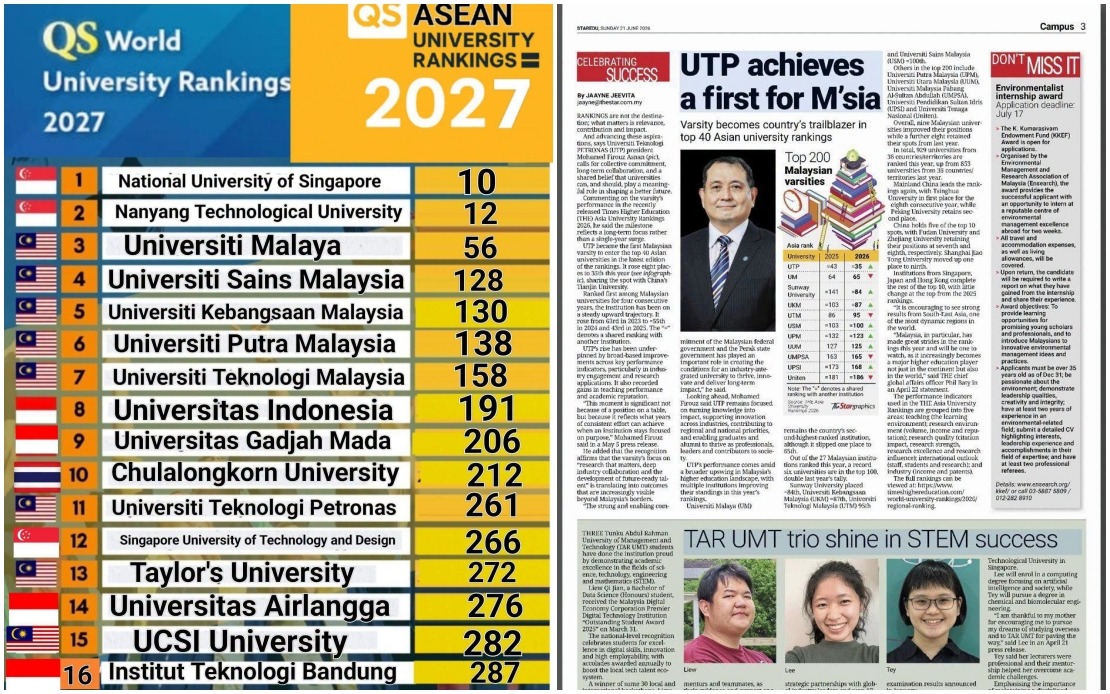
Malaysia's higher education sector is consolidating its standing as a regional powerhouse, driven by a wave of strong performances in the latest Times Higher Education Asia University Rankings 2026. The achievements, anchored by Universiti Teknologi Petronas (UTP) securing 35th place in the prestigious index—up from 43rd last year—signal mounting international recognition of local academic rigour and research output. Higher Education Minister Datuk Seri Dr Zambry Abd Kadir has characterised these gains as validation of the nation's capacity to compete on the global stage, positioning Malaysia as an increasingly attractive destination for scholars and researchers seeking world-class education.
The significance of UTP's breakthrough cannot be overstated. By becoming the first Malaysian university to crack Asia's top 40 institutions, the energy-focused research university has set a new benchmark for homegrown excellence. This advancement reflects years of investment in cutting-edge facilities, industry partnerships, and faculty recruitment that have bolstered the institution's research profile and international visibility. For Malaysian higher education more broadly, UTP's achievement demonstrates that local universities can rival established competitors from China, Singapore, South Korea, and Japan—regions that have historically dominated regional rankings.
The overall expansion of Malaysia's footprint in this year's THE Asia rankings extends well beyond a single institution's success. A total of 27 Malaysian universities secured positions within the comprehensive listing, a testament to the sector's breadth and distributed excellence. More tellingly, six domestic institutions now occupy slots within Asia's top 100—a record for the country. This clustering of high-performing universities suggests systemic improvements in research funding, infrastructure development, and international collaboration across the Malaysian higher education landscape.
Eminent universities including Universiti Malaya (UM), the country's oldest and most research-intensive institution, continue to anchor Malaysia's academic reputation. Alongside UM, institutions such as Universiti Kebangsaan Malaysia (UKM), Universiti Teknologi Malaysia (UTM), and Universiti Sains Malaysia (USM) have each strengthened their competitive positions. The inclusion of private-sector alternatives like Sunway University in the top-tier cohort underscores the dynamism of Malaysia's diversified higher education ecosystem, where both public and private providers are elevating standards and contributing to the nation's educational export value.
Minister Zambry's emphasis that rankings, while not the ultimate measure of university quality, serve as vital proxies for institutional competitiveness reflects a balanced perspective often absent from public discourse. Rankings capture tangible dimensions—research output, citation impact, international faculty recruitment, and reputation among peers—that correlate with meaningful educational outcomes and labour market readiness. For Malaysia, where global talent competition intensifies annually, these metrics carry real consequences for student recruitment, research funding attraction, and positioning within regional innovation ecosystems.
The collaborative effort underpinning these achievements extends across multiple constituencies. Academic staff, research teams, administrative personnel, and increasingly, industrial and corporate partners have collectively invested in elevating institutional profiles. University collaborations with multinational corporations, particularly in technology and energy sectors, have amplified research visibility and generated intellectual property that elevates international standing. Student quality and alumni success further reinforce reputational gains—when graduates establish themselves in leadership roles across Asia-Pacific economies, they become ambassadors for their alma maters.
For Malaysia's strategic positioning, these ranking improvements carry broader economic and geopolitical significance. As Southeast Asia consolidates its role in the global knowledge economy, education exports constitute a substantial revenue stream and soft power instrument. Neighbouring countries like Singapore and Thailand have weaponised education sector excellence to attract regional talent and secure outsized influence in international academic hierarchies. Malaysia's ascending universities represent institutional capital that can be leveraged to retain domestic talent while capturing regional market share from students across ASEAN seeking affordable yet credible English-language education.
The placement of eleven Malaysian universities within Asia's top 200 suggests a robust second tier of capable institutions capable of contributing meaningfully to national development and regional knowledge production. Universiti Putra Malaysia (UPM), Universiti Utara Malaysia (UUM), Universiti Malaysia Pahang Al-Sultan Abdullah (UMPSA), Universiti Pendidikan Sultan Idris (UPSI), and Universiti Tenaga Nasional (UNITEN) collectively provide specialised expertise spanning agriculture, education, energy, and business disciplines—sectors critical to ASEAN's economic diversification.
However, ranking improvements must be contextualised within Malaysia's broader educational challenges. Quality disparities persist between urban and rural institutions, English language proficiency remains inconsistent, and research productivity in humanities and social sciences lags behind STEM disciplines. The concentration of excellence among flagship institutions—UM, UTM, UKM, USM—suggests that while Malaysia's apex is sharpening, the distribution of competitive advantage remains unequal. Sustained advancement requires systematic investment in under-resourced universities, capacity building in emerging research fields, and strategies to reverse brain drain among top-tier researchers.
The momentum evident in the 2026 rankings also reflects Malaysia's recovery trajectory post-pandemic, when university operations and research output temporarily contracted. International collaborations have rebounded, student mobility has normalised, and research funding has resumed growth patterns. This cyclical upswing, if sustained through continued policy support and investment, could propel Malaysia toward a future state where top-quartile ranking positions become routine rather than exceptional.
Looking forward, the challenge for Malaysian higher education lies in transforming ranking gains into tangible contributions to national innovation capacity, graduate employability, and regional thought leadership. Ranking points should catalyse rather than conclude systemic improvements. The government's recognition of these achievements, coupled with Zambry's call for momentum to persist, signals political commitment to the sector. Whether this translates into sustained funding, regulatory reform, and strategic resource allocation will ultimately determine whether Malaysia's 2026 ranking surge initiates a generational leap in educational excellence or remains a cyclical fluctuation.

