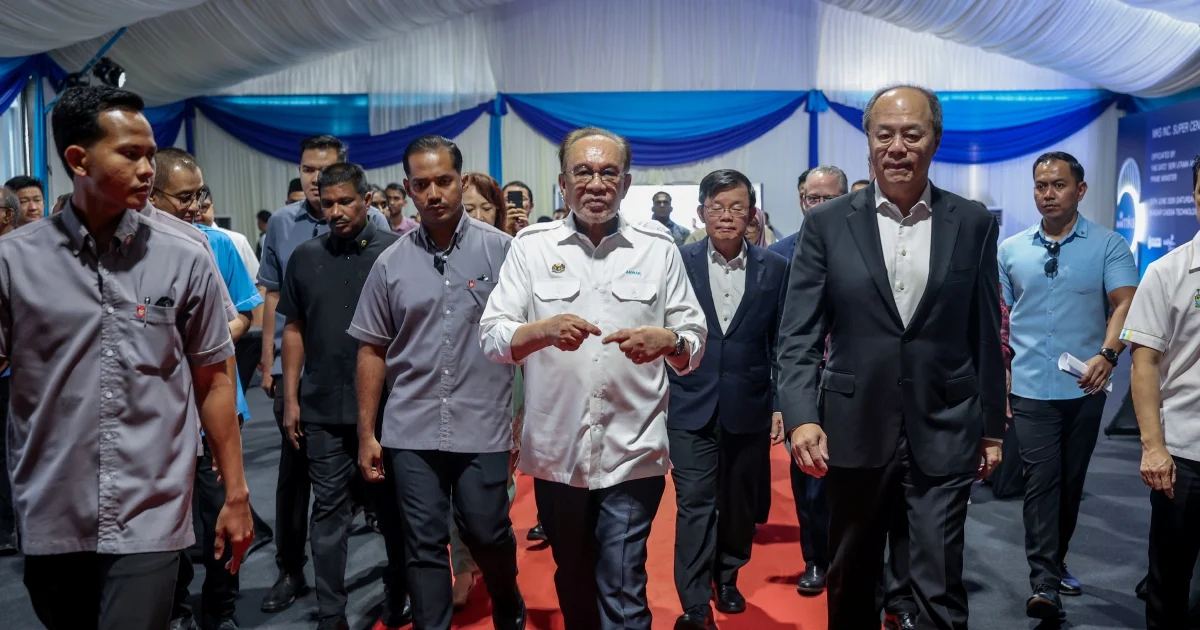
Prime Minister Datuk Seri Anwar Ibrahim has articulated Malaysia's strategic positioning as a cornerstone advantage for attracting foreign capital, arguing that the nation's commitment to non-alignment and diplomatic outreach to all powers creates a stable environment for business expansion. Speaking in Batu Kawan, the Prime Minister framed Malaysia's independent foreign policy approach as a competitive asset in a region experiencing intensified geopolitical competition, where multinational enterprises increasingly seek jurisdictions that avoid entanglement in great-power disputes.
The emphasis on maintaining autonomy in international relations reflects a deliberate Malaysian strategy developed over decades of statecraft. Unlike some Southeast Asian economies that have gravitated toward closer alignment with specific powers, Malaysia has historically preserved flexibility in its foreign partnerships, allowing the government to pursue economic cooperation with both Western and Asian markets without sacrificing diplomatic credibility. This positioning has proven particularly valuable as supply chain diversification accelerates globally, with companies seeking manufacturing and operations bases that do not face geopolitical sanctions or access restrictions.
Anwar's articulation of this policy signifies an explicit recognition that contemporary capital flows increasingly factor in political stability and diplomatic risk. Institutional investors, particularly those managing sovereign wealth and pension funds, conduct extensive due diligence on the geopolitical environment surrounding potential host countries. Malaysia's reputation as a neutral ground where competition among major powers does not translate into local political instability makes it an attractive alternative to jurisdictions perceived as proxy battlegrounds or closely aligned with contested international positions.
The Prime Minister's remarks arrive as Malaysia contends with significant economic headwinds, including weakening regional growth, persistent inflationary pressures, and competition from other Southeast Asian economies for foreign direct investment. Vietnam and Indonesia have captured substantial manufacturing relocations from China, while Thailand and the Philippines have positioned themselves as alternatives within the region's investment hierarchy. By reemphasizing Malaysia's diplomatic independence and stability, Anwar seeks to differentiate the country and reinvigorate investor appetite for Malaysian assets and greenfield projects.
Engagement with all powers, as Anwar frames it, extends beyond ceremonial diplomacy into substantive economic relationships. Malaysia maintains active trade arrangements with the United States, China, the European Union, Japan, and India, reducing dependence on any single economic partner. This diversification insulates Malaysia from targeted tariff regimes or supply chain restrictions that might affect countries perceived as aligned with competing blocs. For multinational corporations balancing exposure across regions and managing regulatory complexity, Malaysia presents an operational platform that minimizes geopolitical risk.
The neutrality doctrine also resonates within Malaysia's domestic context, where multiethnic and multireligious composition mirrors regional complexity. A foreign policy perceived as even-handed and inclusive of diverse international perspectives strengthens social cohesion by avoiding polarization around international alignments. Investors recognize that political stability underpins long-term return profiles, and Malaysia's ability to navigate regional tensions without internal fragmentation along geopolitical lines constitutes an underappreciated advantage in competitiveness calculations.
However, maintaining genuine neutrality amid intensifying strategic competition requires consistent messaging and careful navigation of emerging fault lines. The United States and China, the primary drivers of regional geopolitical dynamics, both increasingly expect Southeast Asian partners to exhibit clearer positioning on critical issues ranging from the South China Sea to technological standards and supply chain security. Malaysia's commitment to engaging all sides simultaneously faces mounting pressure, as both powers implement policies that implicitly demand alignment. The Prime Minister's public reaffirmation of non-alignment appears designed to preemptively signal Malaysia's intentions to stakeholders concerned about potential future shifts.
For the investment community, the credibility of Malaysia's neutrality pledge depends partly on implementation consistency. Previous Malaysian governments have occasionally tilted in response to domestic political pressures or personal relationships with individual leaders, creating perception of inconsistency in foreign engagement. Anwar's administration has sought to rebuild confidence in institutional continuity and rules-based decision-making, essential for investors who require predictability in the regulatory and diplomatic environment spanning their operational timelines.
The economic implications of this positioning extend beyond traditional foreign direct investment into emerging sectors where geopolitical considerations weigh heavily. Technology transfer, semiconductor manufacturing, and digital infrastructure development increasingly reflect strategic considerations alongside commercial logic. Malaysia's attractiveness as a location for advanced industrial facilities depends partly on demonstrating that operations will not face disruption due to geopolitical realignments or great-power sanctions regimes. The Prime Minister's emphasis on engagement with all nations communicates assurance on this crucial dimension.
Regional leadership within ASEAN also amplifies Malaysia's diplomatic balancing act. As a middle-power voice in the association, Malaysia frequently mediates between members with varying strategic orientations and between the organization and external powers. A reputation for principled non-alignment strengthens Malaysia's capacity to broker consensus among diverse ASEAN members and maintain the bloc's relevance as an independent forum rather than a proxy mechanism for competing external interests.
Anwar's framing of neutrality as an investor magnet represents continuity with Malaysia's postcolonial strategic tradition, adapted to contemporary competition for capital and technological capacity. The argument deserves scrutiny regarding implementation, particularly as geopolitical pressures intensify. Nevertheless, as Southeast Asian economies jostle for position within a restructuring global system, Malaysia's deliberate cultivation of a neutral, engagement-oriented profile offers genuine differentiation in the competition for sophisticated investors requiring operational freedom from great-power constraint.

