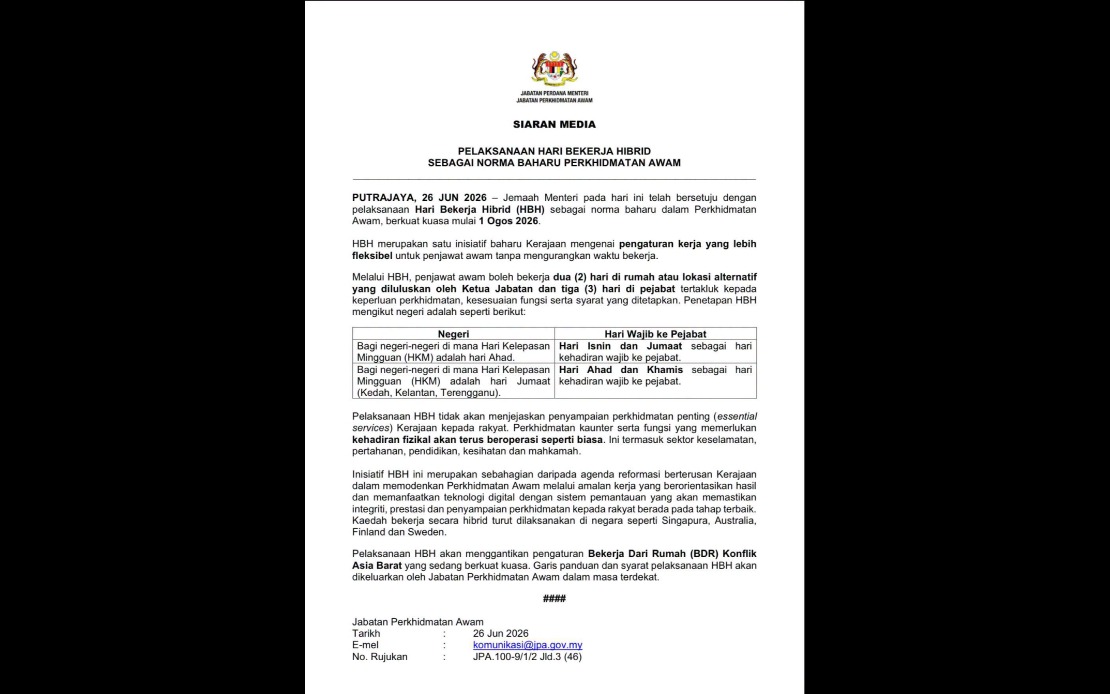
Malaysia's government has formally endorsed a shift toward hybrid working arrangements across the civil service, with the Public Service Department announcing that the new Hybrid Work Day framework will take effect on August 1. The decision, approved by the Cabinet in late June, represents a significant restructuring of how the country's approximately 1.6 million public sector employees will conduct their daily operations, marking a transition away from the more flexible work-from-home policies that emerged during the pandemic era.
The hybrid model establishes a standardised framework whereby civil servants will spend two days working remotely—either from home or at an alternative location designated by their departmental head—while maintaining a three-day physical presence at their offices. This arrangement replaces the previous Work From Home system entirely, though officials have stressed that the transition maintains the same total weekly working hours. The structure balances government objectives to modernise work practices with operational requirements for in-person service delivery across critical government functions.
The implementation recognises Malaysia's geographic and religious diversity by accommodating different weekly rest day schedules across states. For the majority of states observing Saturday and Sunday as the weekend, Monday and Friday have been designated as mandatory office attendance days, creating a consistent structure for interdepartmental coordination and public-facing services. However, Kedah, Kelantan and Terengganu—states that observe Friday as their weekly rest day—will instead require civil servants to work in-office on Sunday and Thursday, ensuring that each state's administrative calendar aligns with local observance patterns.
The Public Service Department has provided explicit assurances that the introduction of hybrid arrangements will not compromise the delivery of essential public services, a concern that has animated debates about remote working in government sectors worldwide. Counter services and functions requiring direct physical interaction with citizens will continue operating under existing schedules, while sectors including security and defence, education, healthcare and the judiciary will maintain their operational protocols. This sectoral approach recognises that not all government functions can be performed remotely and that public safety and citizen access to critical services remain paramount considerations.
Official statements characterise the hybrid framework as part of a broader modernisation strategy within Malaysia's public service sector. The initiative aligns with the government's intention to adopt results-oriented work methodologies rather than time-based evaluations, simultaneously encouraging greater integration of digital technologies into administrative processes. By permitting flexibility in work location, policymakers argue the arrangement can enhance employee satisfaction and retention while maintaining accountability through performance metrics rather than physical presence surveillance.
To ensure the transition succeeds without diminishing service standards, the Public Service Department plans to introduce comprehensive monitoring mechanisms designed to track integrity, performance levels and service delivery outcomes. These oversight structures will serve a dual purpose: demonstrating to the public that government efficiency remains uncompromised while providing management with concrete data on whether the hybrid model improves or hinders operational effectiveness. The department has indicated that detailed implementation guidelines and specific conditions governing the arrangement will be released in subsequent announcements.
The Malaysian government has cited international precedent to justify the policy direction, noting that comparable hybrid or flexible working models have been successfully implemented in developed nations including Singapore, Australia, Finland and Sweden. These references suggest officials view the arrangement not as experimental but rather as an adaptation of proven practices from countries with comparable or superior governance standards. However, Malaysia's approach differs from some international models by establishing mandatory office days rather than allowing complete flexibility, reflecting distinct administrative and cultural considerations specific to the Southeast Asian context.
For Malaysian businesses and organisations competing for talent, the civil service shift toward hybrid working may influence private sector practices. If government employees enjoy arrangement flexibility while maintaining job security and benefits, private companies may face pressure to adopt comparable policies to retain skilled workers. Conversely, the demonstration effect could legitimise hybrid models more broadly across the economy, potentially accelerating workplace flexibility trends that have remained inconsistent in Malaysia compared to Western markets.
The timing of implementation—August 1—allows government departments approximately five weeks to prepare operational adjustments, revise office scheduling systems, and communicate changes to affected staff. This transition period enables departments to test their monitoring mechanisms and address teething problems before the arrangement becomes operational. Larger departments managing diverse functions across multiple locations face more complex implementation challenges than smaller agencies, suggesting that the standardised August 1 date may require flexible interpretation depending on departmental circumstances.
For Malaysian workers within the civil service, the arrangement offers tangible lifestyle benefits through reduced commuting time and costs, particularly significant in congested urban areas where many government offices are located. However, the requirement for mandatory three-day office attendance may disappoint some employees who had enjoyed greater flexibility under pandemic-era work-from-home arrangements. The balancing act reflects government acknowledgment that contemporary workforce expectations have shifted while institutional needs for in-person coordination and public service delivery remain non-negotiable.
The policy's success will ultimately depend on implementation quality and departmental leadership commitment. Without robust monitoring systems and managerial support for the underlying results-based philosophy, hybrid arrangements can devolve into informal arrangements that undermine both flexibility benefits and accountability structures. Conversely, overly rigid implementation that penalises remote work days despite official approval could create cynicism about government modernisation commitments. The coming months will reveal whether Malaysia's civil service genuinely embraces this hybrid model as part of sustainable public sector transformation or whether it becomes another policy announcement that struggles with inconsistent execution across diverse government agencies and geographic regions.

