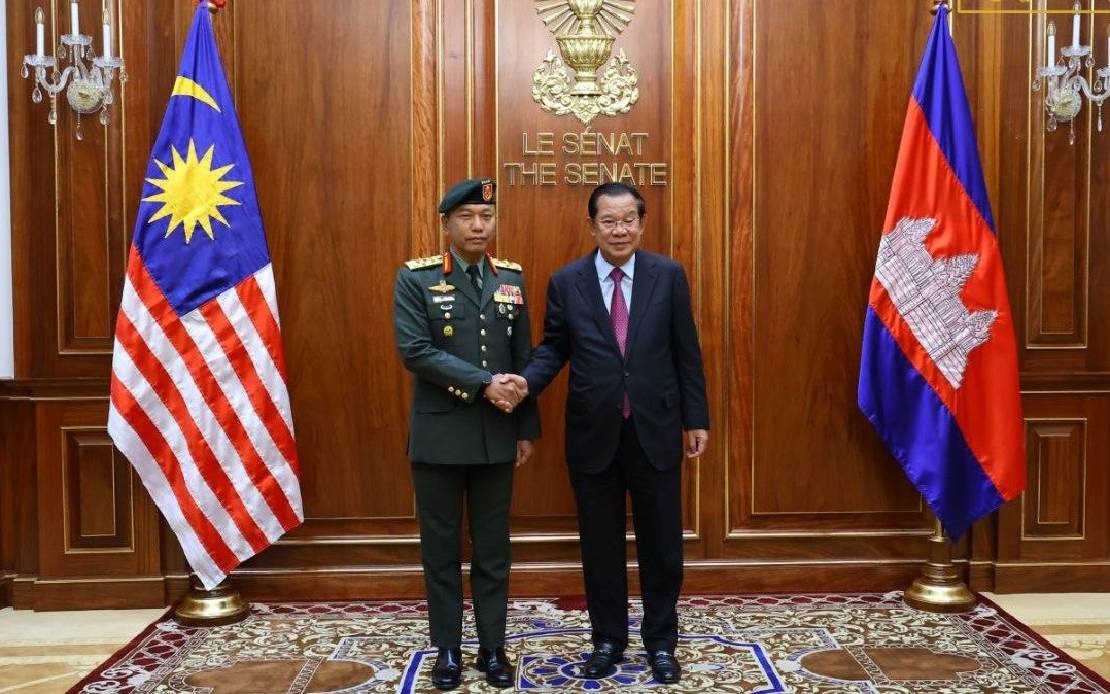
General Tan Sri Malek Razak Sulaiman, Malaysia's Chief of Defence Force, concluded a four-day official visit to Cambodia aimed at broadening and deepening the military relationship between Kuala Lumpur and Phnom Penh. The visit, which ran from July 8 to 11, was conducted at the invitation of General Vong Pisen, Commander-in-Chief of the Royal Cambodian Armed Forces, and demonstrated Malaysia's strategic commitment to strengthening ties with a neighbouring ASEAN partner amid evolving regional security dynamics.
During his time in Cambodia, Malek Razak engaged in substantive discussions with senior Cambodian military and civilian leadership, signalling the high-level nature of the engagement. Beyond the capital, he travelled to Banteay Meanchey province along the Cambodia–Thailand border to gain firsthand understanding of the security environment in that frontier region. This move underscores Malaysia's interest in understanding broader regional security challenges that extend beyond bilateral concerns, positioning the visit as part of a wider effort to comprehend shared stability priorities across mainland Southeast Asia.
In bilateral talks with General Vong Pisen on July 9 and subsequently with Deputy Prime Minister and National Defence Minister Tea Seiha on Friday, both delegations identified concrete areas for expanding military cooperation. The discussions went beyond symbolic exchanges to address practical mechanisms for implementation, including the activation of existing bilateral defence frameworks that may have remained dormant or underutilised. Malaysian officials emphasised the value of increased military-to-military contact as a foundation for mutual understanding and confidence-building in an era of rising strategic competition.
A critical component of the collaboration centres on professional military development and capacity-building initiatives. Malaysia and Cambodia agreed to broaden opportunities for military personnel exchange, joint training exercises, and educational programmes. Such initiatives, when sustained over time, create personal relationships among defence professionals from both nations and facilitate knowledge transfer on contemporary military challenges ranging from counterterrorism operations to maritime security and disaster relief coordination. These people-to-people connections often prove as durable as formal government agreements.
In a statement published on social media, Malek Razak articulated the shared vision animating the visit. Both Malaysia and Cambodia, as members of the Association of Southeast Asian Nations, share an overarching commitment to building a peaceful, secure, and economically vibrant region. This framing places the bilateral defence relationship within the broader context of ASEAN's foundational principles of non-interference, respect for sovereignty, and peaceful settlement of disputes—principles increasingly tested by great power competition and transnational security threats in Southeast Asia.
The defence chief stressed that Malaysia and Cambodia would prioritise mutual understanding and institutional collaboration as pillars of their partnership. In practical terms, this means establishing regular dialogue mechanisms, joint planning exercises, and coordinated responses to emergencies or crises that could affect both nations. The emphasis on institutional frameworks rather than ad-hoc engagement reflects a maturation in how bilateral defence relationships are managed in Southeast Asia, moving beyond protocol-driven visits to sustained strategic planning.
Particularly noteworthy is the emphasis both sides placed on leveraging ASEAN-led defence platforms to address collective security challenges. Regional mechanisms such as the ASEAN Regional Forum, the East Asia Summit, and the ASEAN Defence Ministers' Meetings provide multilateral spaces where Malaysia and Cambodia can work in concert with other regional and external powers to manage emerging threats. By reinforcing bilateral foundations, Malaysia strengthens its ability to contribute meaningfully to these multilateral forums and to advocate for solutions aligned with ASEAN's collective interests.
For Malaysia, strengthening military ties with Cambodia carries particular strategic significance. Cambodia occupies a position on the mainland Southeast Asian mainland, and its stability influences the broader security environment affecting countries throughout the region. A stronger defence relationship with Phnom Penh allows Malaysia to expand its security horizon beyond maritime concerns in the Straits of Malacca to encompass understanding of land-based threats and challenges that could indirectly affect regional stability and Malaysian interests. This reflects a more comprehensive regional security perspective.
The timing of the visit also merits consideration within the broader geopolitical context facing Southeast Asia. As major powers compete for influence in the region and as non-traditional security threats—including transnational crime, cyber warfare, and extremism—become increasingly complex, bilateral military partnerships take on heightened importance. They serve as stabilising mechanisms that build resilience against external pressure and create frameworks for addressing shared challenges that transcend borders. Malaysia's active engagement with Cambodia through defence diplomacy signals to the region that it remains committed to fostering stable, cooperative relationships with all ASEAN neighbours.
Moving forward, the success of this visit will be measured not by the cordial statements exchanged but by the concrete implementation of agreed frameworks. Malaysian and Cambodian defence establishments will need to translate high-level political commitment into operational reality through scheduled exchanges, joint exercises, and regular strategic consultations. The frequency and quality of follow-up engagements will determine whether this visit represents a momentary diplomatic gesture or the beginning of a sustained, deepening defence partnership that contributes meaningfully to regional stability and mutual prosperity.

