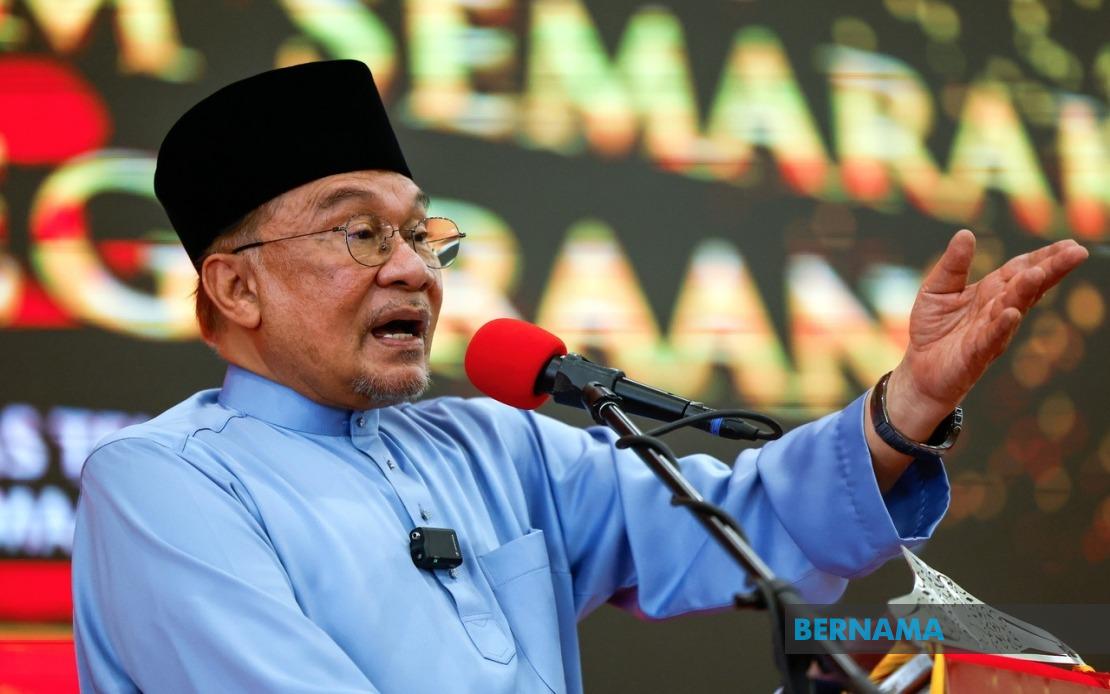
Prime Minister Datuk Seri Anwar Ibrahim has announced that a Malaysian Petronas vessel has successfully obtained permission to navigate the Red Sea and is scheduled to reach Melaka port in early August, marking a significant diplomatic achievement in resolving a critical logistics challenge. The news was conveyed to Anwar by Petronas President and Group Chief Executive Tan Sri Tengku Muhammad Taufik Tengku Aziz, who informed him that the tanker departed from Yanbu, Saudi Arabia, with full clearance to proceed through the contested waterway. The Prime Minister shared this development while addressing the Semarak Kenegaraan programme at the Basic Training Centre of the Malaysian Army (PUSASDA) in Port Dickson, underscoring Malaysia's capacity to navigate complex international waters through strategic diplomacy.
The successful passage represents a tangible outcome of Malaysia's carefully balanced foreign policy approach, which emphasises maintaining constructive relationships across multiple geopolitical alignments rather than adhering to rigid bloc politics. According to Anwar, this capability has proven instrumental in resolving shipping crises and addressing critical maritime security issues that have plagued regional commerce in recent months. The achievement gains particular significance given the treacherous conditions that have made the Red Sea one of the world's most hazardous shipping corridors, forcing many international carriers to reroute their vessels through longer, costlier alternative paths around Africa.
The Red Sea's transformation into a high-risk zone stems directly from repeated attacks on commercial vessels by the Houthi movement, a Yemen-based group backed by Iran. These militant operations have disrupted global shipping patterns and raised insurance premiums substantially, creating genuine hardship for trading nations dependent on efficient maritime commerce. The Houthis recently escalated their campaign by announcing a formal blockade targeting vessels associated with Saudi Arabia, a move that followed renewed tensions with the Kingdom, which has engaged in an extended military conflict with the group spanning more than a decade. This intensifying threat landscape has created urgent pressure on governments to find diplomatic solutions that can restore safe passage for their national shipping interests.
Anwar articulated how Malaysia's cultivation of diplomatic channels with Tehran proved decisive in securing clearance for the Petronas vessel. He disclosed that when a previous Petronas tanker faced obstruction months earlier, his direct communication with Iran's presidential leadership enabled swift resolution of the impasse. The Prime Minister explained that his ability to personally appeal to Iran's government, coupled with the goodwill built through consistent bilateral engagement, resulted in the Ocean Thunder becoming among the earliest vessels granted passage through the Strait of Hormuz. That tanker subsequently arrived safely at Pengerang Terminal in Johor on April 17, demonstrating the tangible returns on Malaysia's diplomatic investment in maintaining productive channels with Tehran.
The Strait of Hormuz itself represents one of the world's most strategically vital chokepoints, with approximately 20 per cent of global crude oil and liquefied natural gas flowing through its narrow passage annually. The waterway's strategic importance means that any disruption carries severe consequences for energy security worldwide, affecting prices and supply chains across multiple continents. The corridor experienced major disruptions following escalating military tensions between the United States and Iran, particularly after February 28 when American and Israeli operations against Iranian territory and facilities commenced. These confrontations prompted Iran to impose restrictions on shipping passage, effectively weaponising control of the Strait as a response to external military pressure.
Subsequent diplomatic efforts yielded a memorandum of understanding between Washington and Tehran aimed at de-escalating tensions, with both parties committing to finalise a comprehensive peace agreement within 60 days of signing. However, the framework proved fragile, as the United States resumed military operations against Iranian targets within days of the accord's announcement, while Tehran retaliated by striking what it claimed were American military installations and facilities across multiple West Asian locations. This cycle of attack and counter-attack has created profound uncertainty regarding the sustainability of any diplomatic settlement, with maritime commerce caught in the crossfire of great power rivalry.
Anwar emphasised that Malaysia's strategic approach of maintaining cordial relations with all major powers—the United States, China, the Gulf states, and Iran—has enabled the nation to advance its national interests without sacrificing its principled positions on contentious international issues. He addressed prevailing criticisms that Malaysia's engagement with powerful nations, particularly China and America, constitutes a compromise of values or strategic autonomy. The Prime Minister countered that selective relationship-building with different powers represents pragmatic statecraft rather than capitulation, allowing Malaysia to preserve its agency while securing tangible benefits. He highlighted that Malaysia can simultaneously maintain productive ties with Washington and Beijing while refusing to abstain from condemning Israeli military operations in Gaza or American military interventions against Iran.
This nuanced diplomatic positioning reflects the MADANI Government's broader philosophical framework, which rejects the false binary of choosing between Western alignment and non-aligned status. Instead, Malaysia has positioned itself as a nation capable of engaging productively with multiple power centres while articulating independent moral positions on contentious geopolitical questions. Anwar underscored that this approach is not merely rhetorical but translates into concrete policy outcomes, evidenced by Malaysia's swift convening of special parliamentary sessions to formally condemn Israeli military operations in Gaza and American military strikes against Iran. Such positions carry political weight precisely because Malaysia demonstrates that it maintains substantive relationships across the dividing lines of global geopolitical competition.
The successful navigation of the Red Sea passage carries implications extending well beyond Petronas and Malaysia's energy sector. The achievement suggests a potential pathway through which other nations might negotiate safe conduct for their commercial vessels, provided they possess comparable diplomatic resources and political relationships with key regional actors. For Southeast Asia more broadly, Malaysia's diplomatic success demonstrates the continued relevance of non-aligned principles adapted to contemporary conditions of multipolar competition and interconnected global markets. The precedent potentially offers a template for other ASEAN nations seeking to protect their maritime commerce while avoiding entanglement in great power conflicts that do not directly threaten their core interests.
Looking forward, the early August arrival of the Petronas vessel in Melaka will serve as a practical validation of Malaysia's diplomatic approach, providing the government with tangible proof of its capacity to deliver results for the national economy. The vessel's successful transit through contested waters will likely feature prominently in the MADANI Government's narrative regarding the efficacy of balanced foreign policy and strategic relationship management. However, the fragility of the broader geopolitical situation—underscored by continued military tensions between the United States and Iran—suggests that future shipments cannot be taken for granted. Sustained diplomatic engagement and careful management of Malaysia's relationships across competing power blocs will remain essential preconditions for maintaining maritime security and protecting the nation's economic interests in an increasingly volatile global environment.

