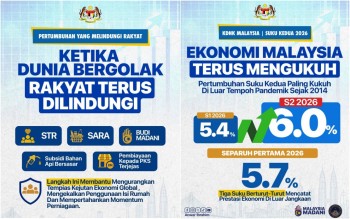
Malaysia's economy has demonstrated remarkable resilience by posting a six per cent growth rate in the second quarter of 2026, a figure that has surpassed analyst forecasts and represents the nation's most robust second-quarter expansion in over a decade when pandemic-era anomalies are excluded. Prime Minister Datuk Seri Anwar Ibrahim highlighted the achievement as a testament to government economic stewardship during a period when most global economies face significant headwinds from international supply disruptions and regional instability in West Asia.
The timing of this announcement carries particular significance for Malaysia's economic narrative. The global economy has been experiencing deceleration driven by persistent supply chain vulnerabilities and geopolitical tensions that have reverberated across multiple sectors. Despite these unfavourable external conditions, Malaysia's six per cent expansion demonstrates that domestic policy frameworks and structural economic strengths can partially insulate the nation from worldwide economic pessimism. This growth trajectory places Malaysia ahead of many regional peers facing similar international pressures, suggesting that the country's economic management during this challenging period has yielded tangible results.
Anwar attributed the strong performance to the MADANI Government's deliberate interventions designed to shield ordinary Malaysians from the worst effects of global inflation. The Prime Minister specifically referenced targeted assistance programmes including BUDI MADANI, Sumbangan Tunai Rahmah (STR), and Sumbangan Asas Rahmah (SARA) as key components of the protective social safety net. These direct cash transfers and subsidies have helped maintain consumer purchasing power and domestic demand, which remain crucial drivers of economic expansion in Southeast Asia's third-largest economy.
Beyond the visible cash assistance programmes, Anwar noted that the government has undertaken substantial behind-the-scenes efforts to stabilise prices across essential goods and maintain adequate supply throughout the country. Price controls and supply-chain coordination have been instrumental in preventing the inflationary spiral that has afflicted many developed and developing economies. By maintaining relative price stability in critical sectors such as food and energy, the government has effectively preserved real incomes for lower and middle-income households, thereby sustaining consumer confidence and economic activity.
The six per cent growth figure assumes greater importance when contextualised within the post-pandemic economic landscape. Prior to 2020, Malaysia's second-quarter growth rates had generally hovered between three and five per cent in non-crisis periods. The 2026 performance therefore represents a genuine acceleration beyond the pre-pandemic trend, suggesting that structural economic reforms and policy adjustments have contributed to improved productivity and expansion capacity. This is particularly notable given that the growth occurred against the backdrop of cautious global sentiment and reduced international trade volumes that characterise the current period.
However, Anwar was careful to temper optimism with pragmatism regarding the challenges that remain. The Prime Minister acknowledged that sustaining this growth momentum will require continued policy implementation and structural improvements beyond the current quarter. He emphasised that economic growth alone is insufficient if it does not translate into meaningful improvements in citizens' living standards. The fundamental objective, according to Anwar, must be to ensure that economic expansion generates genuine opportunities for wealth creation across society rather than concentrating benefits among existing elites.
The government's policy agenda moving forward centres on three interconnected priorities: maintaining sustainable growth rates, ensuring equitable distribution of economic gains, and creating quality employment opportunities that provide dignified incomes. These objectives reflect a shift in emphasis from pure growth metrics to growth quality, recognising that economic expansion measured in GDP percentage points must ultimately manifest as improved wages, job security, and purchasing power for working Malaysians. This approach aligns with the MADANI framework's broader commitment to inclusive development and human-centric economic policymaking.
Vulnerable populations remain a particular focus of government attention, with Anwar indicating that targeted assistance for low-income groups will continue alongside broader economic reforms. The acknowledgement that certain segments of the population require sustained support reflects the government's recognition that market-driven growth does not automatically benefit all citizens equally. Programmatic interventions will therefore complement structural economic policies to ensure that the benefits of Malaysia's stronger growth trajectory reach those facing the greatest financial pressures.
The MADANI Government's framing of this economic performance emphasises continuity with its reform agenda. Rather than presenting the six per cent growth as a culmination of successful policy, Anwar positioned it as validation of the reform trajectory and justification for deepening structural changes. This forward-looking perspective suggests that the government views the positive quarterly result as a foundation upon which to build longer-term economic competitiveness and social cohesion. The implicit message is that Malaysia's economic resilience depends on sustained commitment to reform rather than complacency about recent achievements.

