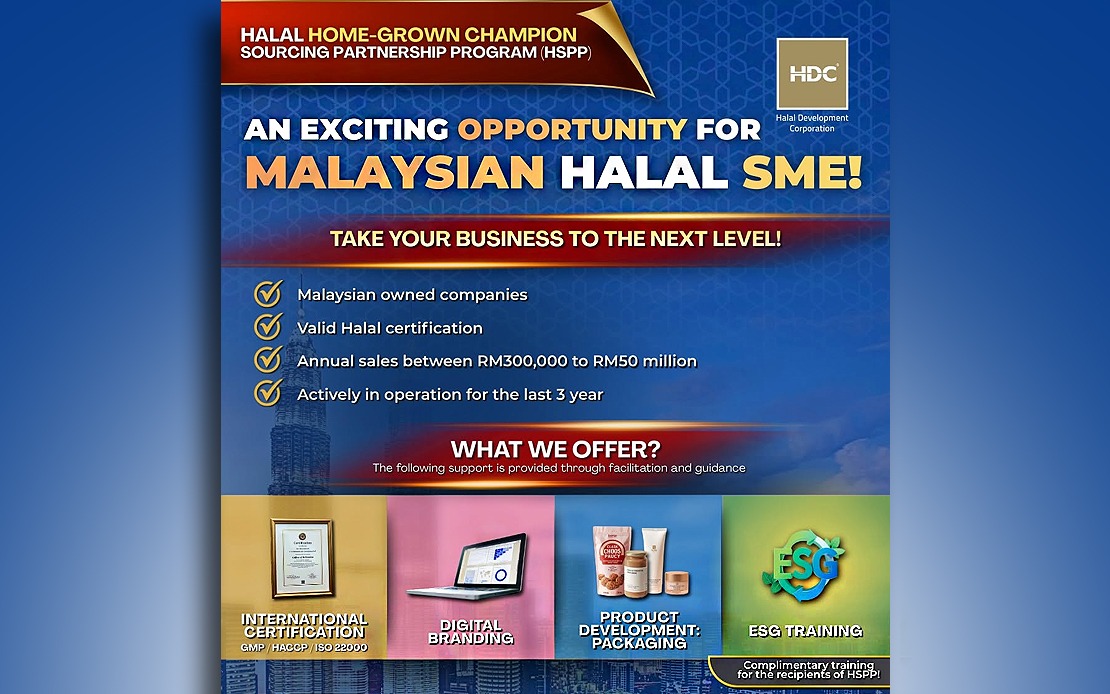
Malaysia is accelerating efforts to consolidate its position as the world's leading halal hub through a targeted support programme that has already generated substantial commercial momentum for domestic enterprises. The Halal Home Grown Champion – Sourcing Partnership 2.0 initiative, operating through 2026, has channelled support to 313 halal-certified companies and created pathways to RM187.91 million in potential sales revenue over the three-year period. The breadth of beneficiaries reflects a deliberate focus on inclusive growth: 158 participating firms are Bumiputera-owned, whilst 52 are led by women entrepreneurs, addressing structural inequalities within Malaysia's MSME ecosystem.
The Ministry of Investment, Trade and Industry (MITI) designed the scheme as a precision intervention addressing a critical bottleneck facing local halal producers. Most Malaysian halal MSMEs operate in isolation, lacking direct market access, supply chain integration, or visibility to institutional and corporate buyers. By coupling financial and technical support with active sourcing partnerships, the programme bridges the distance between suppliers and purchasers, accelerating commercialisation timelines. This approach recognises that halal certification alone—whilst a valuable differentiator—does not guarantee market penetration without complementary business development infrastructure.
The significance of this initiative extends beyond immediate sales figures. Malaysia's halal sector represents one of the nation's most promising growth vectors, with global halal markets expanding at double-digit rates annually. Islamic finance, cosmetics, pharmaceuticals, and food products represent expanding frontiers, yet local firms frequently lose market share to competitors in Turkey, Indonesia, and the United Arab Emirates. By systematically building export capacity among domestic MSMEs, Malaysia addresses both economic diversification and the strategic imperative to capture value within high-growth segments before international competitors consolidate advantage.
The government's announcement of Malaysia International Halal Showcase (MIHAS) 2026 signals confidence in this trajectory and represents a deliberate infrastructure investment in sectoral visibility. Scheduled for September 23-26, 2026, at the Malaysia International Trade and Exhibition Centre (MITEC) in Kuala Lumpur, the event will provide 2,400 exhibition booths and is projected to attract over 1,000 local MSMEs. As the world's largest dedicated halal trade platform, MIHAS functions as both showcase and marketplace, enabling direct buyer-seller encounters that circumvent traditional intermediaries and compress transaction costs. The scale anticipated—thousands of booth spaces and over a thousand participating firms—reflects institutional confidence that buyer demand justifies such investment.
For Malaysian MSMEs, participation in MIHAS 2026 presents a pivotal commercialisation opportunity. Historically, Southeast Asian halal producers have struggled to achieve critical mass in international distribution channels, constrained by limited access to trade finance, regulatory complexity across destination markets, and opacity regarding buyer specifications. By concentrating supply-side outreach within a single platform, MIHAS reduces search friction for international importers, wholesalers, and institutional procurement teams. Buyers seeking halal-certified ingredients, finished goods, or components can execute efficient sourcing comparisons, conduct product trials, and establish long-term supply relationships—activities that would otherwise require prohibitively expensive international travel and intermediary commissions.
The Halal Home Grown Champion programme's emphasis on value-added production signals recognition that Malaysia cannot compete on commodity pricing alone. The nation's higher labour costs and stringent regulatory standards necessitate differentiation through innovation, quality premiums, and brand development. By coupling market access with capability-building support, MITI positions participating firms to move beyond basic production toward sophisticated offerings: organic halal beverages, specialised nutraceuticals, artisanal food products, or technology-enabled supply chain solutions. This transition from volume to value addresses a longstanding structural challenge facing Malaysian manufacturing and represents a plausible pathway to sustained competitiveness.
The programme's composition—313 halal companies, with specific representation for Bumiputera and women-led enterprises—reflects deliberate structural inclusion. Historically, Bumiputera firms have experienced disadvantages in accessing formal credit, market information, and international networks relative to larger, established exporters. Women entrepreneurs face compounded barriers within predominantly male-dominated trade networks. By ringfencing a portion of programme resources and ensuring targeted promotion, MITI addresses both equity concerns and untapped productive capacity. These demographics often operate lean businesses with profound knowledge of local input availability, consumer preferences, and culturally-rooted production practices—advantages that become pronounced when integrated into structured value chains.
Malaysia's broader halal sector position rests on accumulated institutional capacity that extends beyond any single programme. The nation's halal certification bodies, international recognition through the Halal Malaysia logo, and regulatory frameworks establish comparative advantage that competitors cannot readily replicate. Indonesia and Thailand possess larger Muslim populations and lower labour costs, yet lack Malaysia's globalised halal governance infrastructure. The United Arab Emirates, despite vast capital resources, operates at different scale and sector focus. Malaysia's differentiation lies in consistency, transparency, and buyer confidence—intangible assets that translate into premium pricing and market loyalty. The Halal Home Grown Champion initiative leverages these foundations by amplifying their commercial utility.
For regional observers, Malaysia's coordinated sectoral strategy offers instructive lessons in targeted industrial policy. Rather than attempting broad-based manufacturing incentives, the government has identified a specific high-growth market niche where existing capabilities provide genuine advantage, and then systematically removed barriers to supply-side participation. This focus reduces fiscal burden, aligns incentives with market realities, and enables concentrated promotion. Countries across Southeast Asia confronting manufacturing transitions might examine whether similar models—halal production, digital services, renewable energy components—could address local MSME constraints whilst building genuine export capacity.
The RM187.91 million in potential sales projected across 2024–2026 represents a baseline, not a ceiling. Actual performance will depend on international market conditions, execution quality of participating firms, and effectiveness of downstream distribution channels. However, the figure itself—approximately RM62.6 million annually—demonstrates that even modest-scale MSMEs, when aggregated and professionally supported, can achieve material commercial significance. For a nation with over one million registered MSMEs, the lesson is that concentrated support to viable clusters can generate meaningful economic impact without requiring the capital intensity of traditional industrial development.
Looking forward, Malaysia's halal sector strategy positions the nation to capture disproportionate share of expanding Islamic consumption worldwide. Population growth in Muslim-majority regions, rising incomes driving demand for certified products, and increasing regulatory requirements for halal compliance in non-Muslim-majority countries all expand addressable markets. The Halal Home Grown Champion programme and MIHAS 2026 represent institutional recognition that Malaysia possesses the capacity to lead this transition, provided domestic firms are equipped and connected to global buyers. For Malaysian policymakers and businesses, this represents both opportunity and strategic imperative: failure to capture these opportunities would cede market share to competitors and represent a significant missed development pathway.

