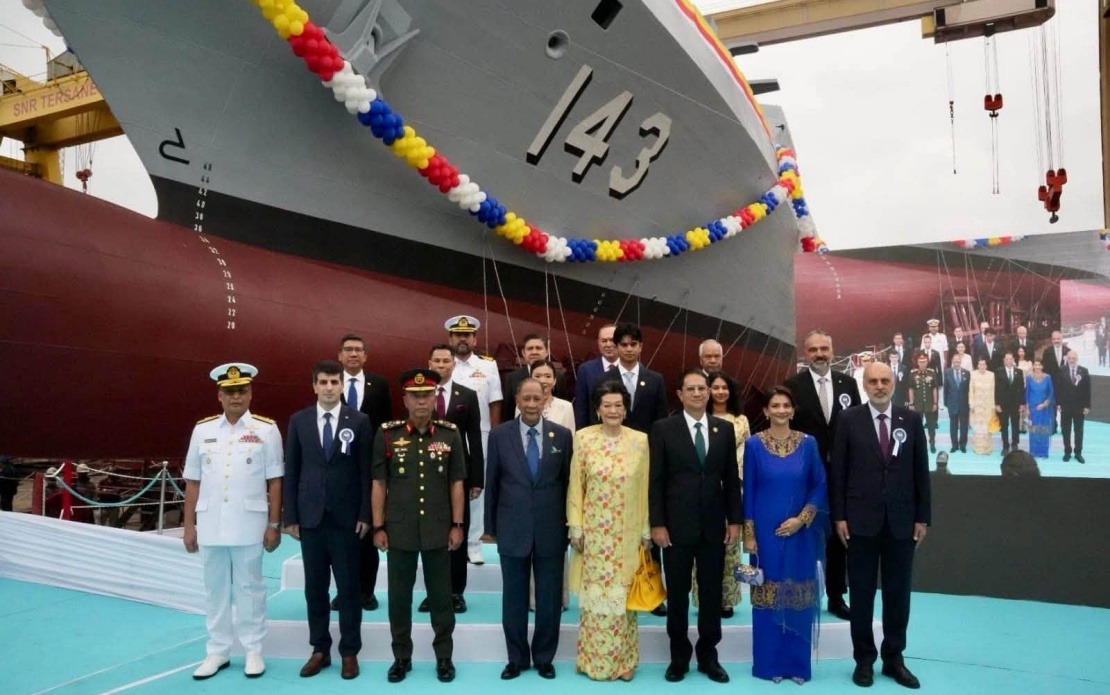
The Royal Malaysian Navy requires a continuous upgrade of its operational assets to navigate an increasingly sophisticated maritime security landscape, according to Defence Minister Datuk Seri Mohamed Khaled Nordin. His remarks came during the formal launch of the third Littoral Mission Ship Batch 2 (LMSB2) vessel, an event that marks a significant milestone in Malaysia's naval modernisation programme and signals the government's commitment to strengthening the country's ability to protect its territorial waters and maritime economic interests.
The named vessel, Tunku Osman Jewa, honours the legacy of the Kedah royal household and commemorates the late General Tan Sri Tunku Osman Tunku Mohammad Jewa, a distinguished military leader who formerly served as the nation's Armed Forces chief. The ship's christening ceremony drew attendance from the Sultan of Kedah, Al Aminul Karim Sultan Sallehuddin Sultan Badlishah, and the Sultanah of Kedah, Sultanah Maliha Tengku Ariff, underlining the ceremonial and national significance of the occasion. This convergence of military modernisation with royal patronage reflects how defence acquisition remains a matter of broader national importance in Malaysia.
The completion of the Tunku Osman Jewa represents the final unit in the construction phase of three LMSB2 vessels, consolidating what is now recognised as Malaysia's inaugural Government-to-Government defence procurement collaboration with Turkiye. This partnership breaks new ground for regional naval cooperation and demonstrates how Southeast Asian nations are increasingly looking beyond traditional Western suppliers to diversify their defence industrial relationships. The decision to partner with Turkiye, a NATO member with growing defence manufacturing capabilities, suggests Malaysia's pragmatic approach to equipping its armed forces with cost-effective alternatives whilst maintaining strategic flexibility.
Delivery of all three LMSB2 ships is projected to be completed by the end of 2027, with each unit expected to substantially enhance the RMN's operational reach and endurance. These littoral mission vessels are designed for extended patrol operations, interception duties, and maritime enforcement across Malaysia's extensive exclusive economic zone and territorial waters. Their introduction into service will materially strengthen the navy's capacity to conduct anti-piracy operations, counter illegal fishing, respond to maritime emergencies, and maintain presence across critical waterways including the Strait of Malacca, where approximately one-third of global maritime trade transits annually.
The LMSB2 acquisition forms a critical component of what defence officials describe as the 15-to-5 Transformation Plan, a comprehensive strategy aimed at modernising the RMN fleet and operational capabilities. This initiative recognises that Malaysia's maritime domain encompasses one of Southeast Asia's most strategically important regions, where multiple nations maintain overlapping territorial claims and where non-traditional security threats including trafficking, piracy, and environmental crime remain persistent concerns. The transformation plan represents an acknowledgment that legacy platforms increasingly struggle to address contemporary maritime challenges effectively.
Malaysia's maritime security environment has grown measurably more complex over the past decade. Rising tensions in the South China Sea, increased naval activity from major powers, the proliferation of sophisticated maritime surveillance technologies, and the emergence of advanced unmanned systems have collectively raised the operational demands on regional navies. The RMN, as guardian of Malaysian waters spanning approximately 330,000 square kilometres, must maintain credible deterrence whilst demonstrating effective enforcement of maritime law. The introduction of modern vessels with enhanced sensor suites, improved endurance, and better habitability represents a tangible response to these evolving pressures.
The Malaysian government's sustained commitment to naval modernisation reflects broader strategic calculations about regional security architecture. As smaller Southeast Asian nations navigate great power competition and shifting geopolitical alignments, maintaining credible indigenous maritime capabilities becomes essential for protecting national interests and upholding principles of freedom of navigation. The investment in LMSB2 vessels, whilst significant, remains modest relative to major naval powers but sufficient to upgrade critical capability gaps and extend operational presence in strategically vital waters.
Turkiye's role as a defence partner introduces interesting dynamics to Malaysia's security partnerships. The Turkish defence industry has expanded significantly and now competes effectively in international markets, particularly for smaller warships and littoral platforms. This relationship potentially opens avenues for future co-production or technology transfer agreements, particularly in areas where Turkey possesses specific expertise. For Malaysia, diversifying supplier relationships reduces strategic vulnerability whilst potentially accessing more competitive pricing and responsive support arrangements compared to traditional sources.
The maritime security imperative extends beyond naval considerations into broader economic and regional stability concerns. Malaysia's fishing industry, offshore energy infrastructure, and shipping lanes form the backbone of national prosperity, making their protection a fundamental governmental responsibility. Piracy incidents, though less frequent than historical peaks, continue sporadically. Illegal unreported fishing by foreign vessels remains endemic, representing both an economic loss and a sovereignty challenge. These practical considerations underscore why continuous investment in naval modernisation remains non-negotiable rather than discretionary.
Looking forward, the introduction of LMSB2 vessels will enable the RMN to retire ageing platforms and consolidate operations around more capable, fuel-efficient, and modern ships. Enhanced sensor systems aboard the new vessels will significantly improve maritime domain awareness, enabling better coordination with regional partners through established information-sharing arrangements. The improved crew accommodation aboard modern platforms also addresses retention challenges, as better shipboard conditions contribute to improved morale and personnel stability within the naval service.
The defence minister's emphasis on continuous modernisation acknowledges that maritime security is not a static challenge but a dynamic environment requiring perpetual technological and operational evolution. The LMSB2 programme, whilst impressive, represents merely one element within a broader naval development roadmap that will likely encompass submarine acquisition, maritime patrol aircraft upgrades, and enhanced integrated command systems in coming years. For Malaysia and Southeast Asian observers generally, this progression demonstrates how even moderate-sized nations can progressively enhance their maritime capabilities through sustained investment and strategic partnerships.

