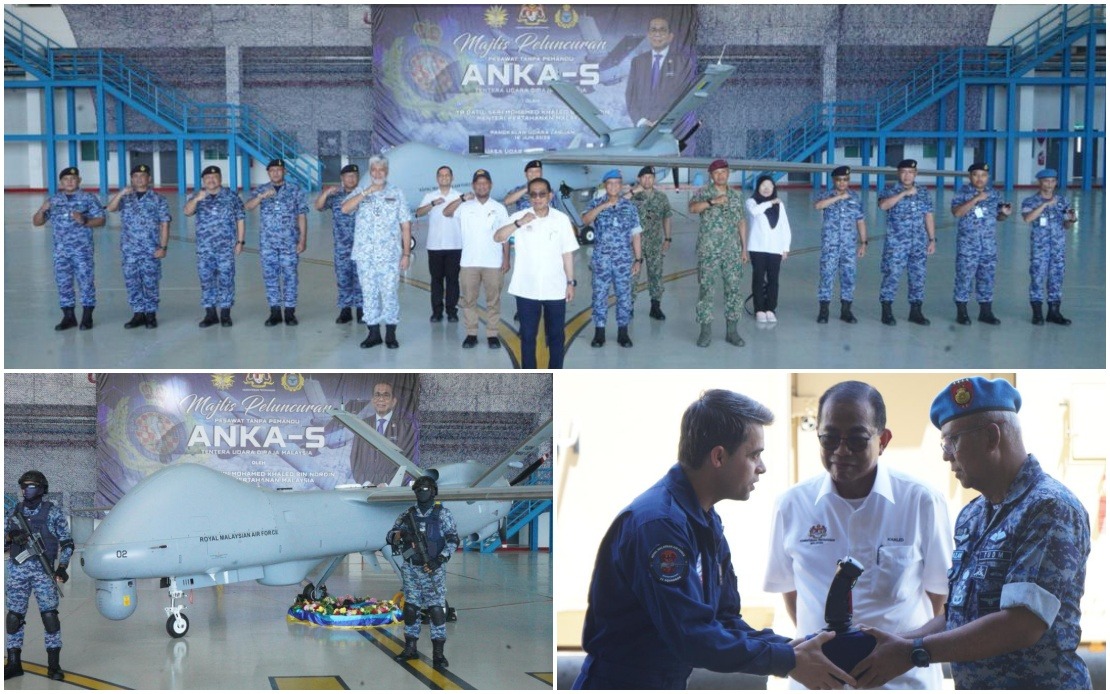
Malaysia has taken a significant step in modernising its maritime defence infrastructure with the operational deployment of the ANKA-S Unmanned Aircraft System at the Royal Malaysian Air Force base in Labuan. Defence Minister Datuk Seri Mohamed Khaled Nordin characterised the launch as a watershed moment for the nation's ability to monitor and protect its interests in one of the world's most strategically important and contested bodies of water. The initiative reflects a broader recognition among Southeast Asian nations that unmanned aerial platforms have become indispensable tools for safeguarding sovereignty in an era of increasing maritime competition and complexity.
The three ANKA-S Medium Altitude Long Endurance aircraft represent an investment of RM423.8 million, encompassing not only the aircraft themselves but also ground control infrastructure and two years of comprehensive personnel training. This substantial financial commitment underscores the Malaysian government's determination to acquire capabilities that would have been unthinkable for the nation just a decade ago. The decision to establish the fleet at Labuan Air Base positions it strategically for operations across Malaysian waters, with particular emphasis on the South China Sea—a region where Malaysia's maritime claims overlap with those of China, Vietnam, the Philippines, and other claimants.
Capability-wise, the ANKA-S platform operates at altitudes exceeding 30,000 feet and can remain airborne for periods surpassing 24 hours, characteristics that fundamentally alter how Malaysia approaches maritime domain awareness. These specifications represent a qualitative leap from relying primarily on surface vessels and conventional manned aircraft for surveillance missions. The extended endurance translates into the ability to maintain persistent observation over vast stretches of ocean, capturing intelligence that would require multiple sorties using traditional platforms. For a nation with extensive maritime responsibilities across the Straits of Malacca and beyond, such persistent surveillance capacity addresses long-standing operational challenges.
The technological sophistication of the ANKA-S includes advanced sensors capable of accurately identifying and tracking vessel profiles at considerable distances. This feature has profound implications for Malaysia's response capabilities to maritime incursions or anomalous activity. Rather than deploying assets reactively across broad patrol areas, the RMAF can now direct resources with surgical precision to verified locations of interest, substantially improving operational efficiency. The intelligence generated by these platforms enables more informed decision-making at the strategic and tactical levels, providing Malaysian planners with the situational awareness necessary to formulate coherent maritime security policies.
Beyond the intelligence advantages, the economic rationale for the ANKA-S acquisition deserves emphasis. Maintaining continuous surveillance through conventional means—whether expensive fighter aircraft or large maritime patrol vessels—represents a significant drain on defence budgets, particularly for nations with limited resources. Unmanned systems offer a more cost-effective alternative for sustained monitoring operations, freeing conventional assets for other tasking. This efficiency gain is particularly relevant for Malaysia, which must balance defence investments against competing fiscal priorities in healthcare, education, and infrastructure development across a geographically dispersed nation.
A notable dimension of Malaysia's deployment strategy involves the deliberate decision not to arm these aircraft with weapons systems. Defence Minister Mohamed Khaled explicitly framed this choice as a statement of defensive intent, designed to signal to the international community that Malaysia's modernisation efforts are calibrated to protect national sovereignty rather than threaten regional stability. This approach carries diplomatic weight in a region already characterised by strategic suspicion and great-power competition. By maintaining an unarmed posture, Malaysia positions itself as acting responsibly within established international norms, even as it substantially enhances its surveillance and situational awareness capabilities.
The implications for regional security dynamics merit careful consideration. Malaysia's acquisition of advanced unmanned systems follows similar investments by neighbouring countries and reflects a broader Southeast Asian trend toward technological modernisation of defence forces. Vietnam, Indonesia, and the Philippines have undertaken their own drone programmes, creating an emerging ecosystem of unmanned aerial capabilities across the region. This distributed capability development could theoretically enhance overall regional maritime domain awareness, though it also introduces complexities around data sharing, coordination protocols, and the potential for miscalculation in increasingly crowded airspace.
The government has indicated plans to acquire three additional ANKA-S aircraft under a second phase of the programme, contingent on approval through the national development planning framework. This phased approach suggests a measured, fiscally conscious strategy to gradually expand capabilities rather than attempting transformative change all at once. Should the second tranche proceed, Malaysia would possess a fleet of six aircraft, substantially amplifying the nation's capacity to maintain continuous coverage across multiple operational areas simultaneously. This expansion would represent a significant enhancement of maritime domain awareness across Malaysian waters and the surrounding region.
The launch ceremony, attended by senior defence and military officials including the Chief of Navy Admiral Tan Sri Dr Zulhelmy Ithnain and Chief of Air Force Gen Tan Sri Muhamad Norazlan Aris, underscored the institutional importance assigned to this capability by Malaysia's defence establishment. The presence of these senior leaders reflected recognition that the ANKA-S programme represents more than a procurement decision—it embodies a strategic reorientation toward technologically enabled defence operations. The Data Exploitation Centre established to process intelligence from the platform indicates systematic planning to extract maximum value from the surveillance data generated, transforming raw sensor information into actionable intelligence for decision-makers.
For Malaysian observers and regional analysts, the ANKA-S deployment illustrates broader patterns in contemporary defence modernisation. Rather than seeking expensive platforms with multiple capabilities, increasingly sophisticated nations are adopting specialised systems designed to excel in specific domains. The ANKA-S focus on persistent surveillance reflects this trend toward functional specialisation. As maritime security challenges intensify across Southeast Asia—from piracy to illegal fishing, from transnational smuggling to territorial disputes—the capacity to see vast ocean areas continuously becomes increasingly valuable. Malaysia's investment signals recognition that technological advantage in information gathering constitutes a core element of contemporary national security strategy in maritime domains.
The strategic timing of this deployment deserves note as well. The South China Sea remains contested territory, with multiple nations asserting overlapping claims while great powers manoeuvre for influence and position. Malaysia's decision to establish its unmanned surveillance capabilities in Labuan, proximate to disputed waters, constitutes a physical assertion of its commitment to monitoring its own maritime interests. The message implicit in this positioning is that Malaysia intends to possess independent visibility into activities within its claimed waters, reducing reliance on intelligence derived from other powers and enhancing its capacity for autonomous decision-making regarding maritime security matters.