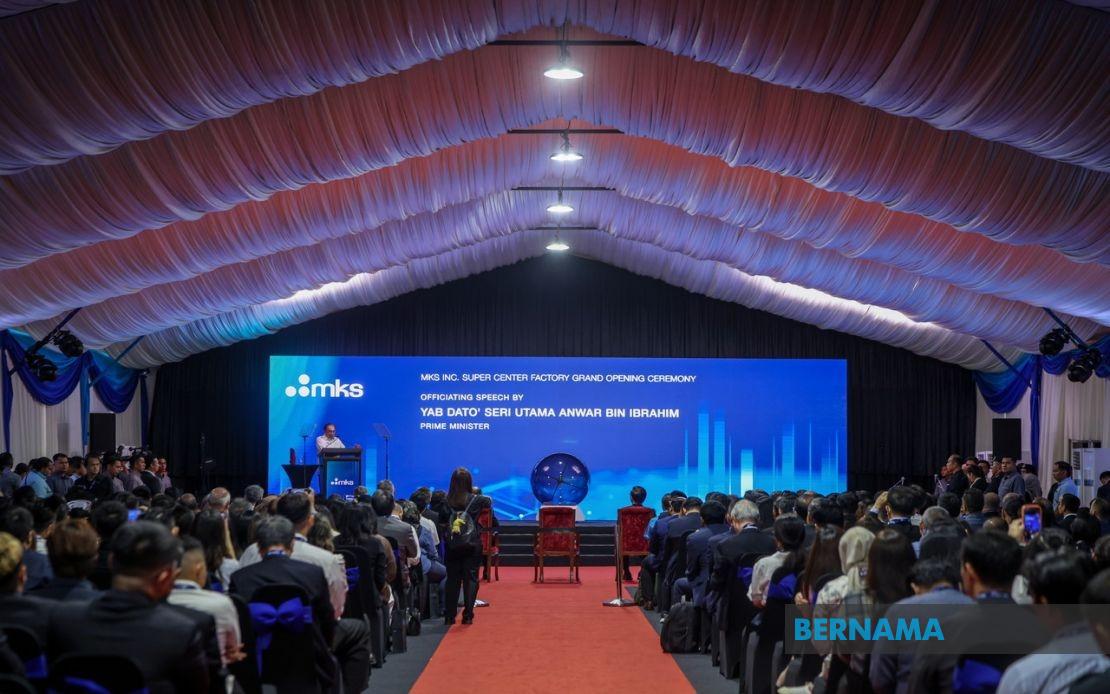
Prime Minister Datuk Seri Anwar Ibrahim has underscored Malaysia's strategic advantage in maintaining a balanced, non-aligned approach to international relations, describing it as a foundation for deepening economic cooperation across competing global power blocs. Speaking at the MKS Super Centre factory opening in Bandar Cassia Technology Park in Batu Kawan, the Prime Minister argued that this carefully calibrated neutrality has not merely preserved Malaysia's diplomatic flexibility but actively generated fresh commercial opportunities that benefit the nation's economic interests.
The Prime Minister cited Malaysia's recent diplomatic engagement with the United States, China, India, and Russia as evidence of the country's ability to sustain productive relationships regardless of broader geopolitical tensions. He emphasised that this multiplicity of partnerships has translated into concrete economic wins, with Petronas's latest agreement in Turkmenistan serving as a tangible illustration of how Malaysia's willingness to engage constructively with all nations yields commercial dividends. The strategic positioning allows Malaysia to participate meaningfully in economic initiatives spanning different regions and ideological camps without being perceived as aligned to any particular bloc.
Anwar's framing of Malaysia's approach reflects a deliberate recalibration of how Southeast Asian nations can navigate the complex interplay between major power competition. Rather than viewing neutrality as passive disengagement, the Prime Minister characterised it as active positioning that enhances Malaysia's bargaining power and attractiveness as a partner. By refusing to adopt exclusionary positions on contentious global issues, Malaysia preserves its ability to work with diverse partners on sectoral cooperation, infrastructure development, and resource extraction ventures. This pragmatic balancing act has become increasingly valuable as Western and Chinese interests compete for influence across the region.
The Trump administration's visit to Malaysia last year was highlighted as a significant milestone in strengthening bilateral ties with the United States, while simultaneous cultivation of relationships with Beijing and New Delhi demonstrates Malaysia's commitment to compartmentalising different partnerships rather than allowing geopolitical rivalry to disrupt economic engagement. This approach mirrors strategies adopted by other ASEAN nations seeking to maximise their strategic autonomy in an era of intensifying great power competition. Malaysia's explicit articulation of its positions on contested issues—whether related to regional security, trade, or governance—coupled with its openness to all nations maintains credibility without sacrificing access or opportunity.
The Petronas agreement in Turkmenistan exemplifies how Malaysia's energy security interests align with its broader diplomatic strategy. Central Asian resource partnerships require sustained diplomatic engagement and credibility with diverse actors, conditions that Malaysia's non-aligned posture facilitates more effectively than more ideologically committed stances would. The hydrocarbon sector has historically served as a channel through which Malaysia builds deeper state-to-state relationships, and Petronas's international footprint remains contingent on Malaysia's reputation as a reliable, non-adversarial partner across geopolitical boundaries. This commercial success thus validates the Prime Minister's broader strategic thesis.
The presence of Penang Chief Minister Chow Kon Yeow and Deputy Minister of Investment, Trade and Industry Sim Tze Tzin at the factory opening signals coordination across federal and state levels in promoting Malaysia's investment-friendly positioning. The attendance of MKS president and chief executive officer John T.C. Lee emphasised the private sector's role in operationalising Malaysia's openness to international capital and partnerships. Factory openings and industrial expansion announcements serve as practical demonstrations of how Malaysia's diplomatic stance translates into job creation and manufacturing capacity that attract both local and foreign investors.
For Malaysian policymakers, the strategic utility of neutrality extends beyond attracting major power investment into the realm of influencing regional outcomes. By maintaining channels with all significant actors, Malaysia amplifies its voice within ASEAN and participates more effectively in regional security discussions, trade negotiations, and development initiatives. A nation perceived as beholden to a single external power inevitably commands less respect and influence among neighbours and external partners seeking to engage Southeast Asia as a whole. Malaysia's demonstrated independence thus enhances its capacity to shape outcomes that serve national interests.
The economic implications of this strategy carry particular weight given Malaysia's reliance on international trade, foreign direct investment, and access to global value chains. Manufacturing sectors like those represented by MKS require stability, predictability, and access to multiple source markets and distribution networks. A Malaysia branded as neutral and welcoming to all partners becomes an attractive location for companies seeking to hedge their geopolitical exposure while maintaining production capacity that can serve customers across different blocs. This creates a durable competitive advantage against nations perceived as more ideologically committed.
Anwar's articulation of Malaysia's position also addresses audiences beyond the immediate economic sphere. By publicly affirming Malaysia's commitment to engaging all countries while maintaining independence, the Prime Minister signals to domestic constituents that Malaysia will not be pressured into alignments that contradict national interests, a message with particular resonance in a society historically conscious of external interference. Simultaneously, this reaffirmation reassures foreign investors and governments that Malaysia remains a predictable, non-aligned partner unlikely to suddenly reverse course due to domestic political shifts or external pressure.
Looking forward, Malaysia's maintenance of this balanced approach will require sustained diplomatic skill and resistance to pressure from major powers seeking greater commitment. The emergence of new technologies, the reshaping of supply chains, and evolving security challenges will all test Malaysia's ability to remain genuinely non-aligned rather than gradually drifting toward any particular bloc. The success of Petronas ventures, manufacturing expansion, and broader economic cooperation across diverse partners will ultimately determine whether this strategy's promise translates into durable prosperity.

