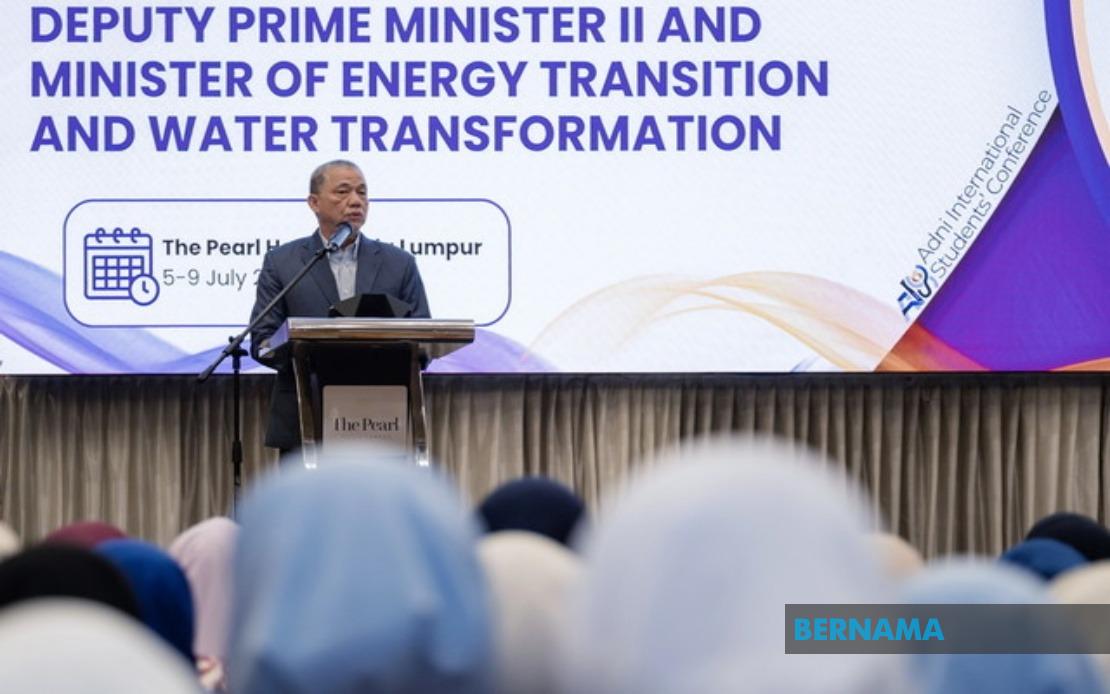
Malaysia's trajectory towards sustained prosperity will ultimately rest not on financial performance or cutting-edge technology, but on cultivating a workforce equipped with advanced cognitive abilities and moral grounding, according to Deputy Prime Minister Datuk Seri Fadillah Yusof. Speaking at the opening of the ADNI International Students' Conference (AISC) 2026 in Kuala Lumpur on July 6, Fadillah articulated a vision that extends beyond conventional development paradigms, positioning human capital as the cornerstone upon which national resilience is constructed.
The deputy premier identified the specific competencies that ought to define Malaysia's workforce for the coming decades. Beyond technical proficiency, he stressed the imperative for individuals capable of engaging in rigorous analytical reasoning, articulating ideas with precision, and navigating structural transformations within a globalised ecosystem. This framework acknowledges that countries functioning within an increasingly interconnected landscape face a fundamentally altered competitive landscape where traditional advantages have diminished in relevance.
Fadillah framed contemporary development challenges as inherently transnational phenomena that demand sophisticated, multisectoral responses. Climate disruption, pandemic preparedness, technological integration and systemic inequality represent obstacles that transcend national boundaries and defy resolution through unilateral government action. Instead, he advocated for an ecosystem approach wherein governmental authorities collaborate with academic institutions, corporate entities, grassroots organisations and emerging generations to devise and implement coordinated solutions. This integrated perspective reflects a departure from siloed policymaking and represents an acknowledgment that sustainable progress requires institutional coordination at unprecedented scales.
The MADANI Government's strategic positioning of human capital advancement as a foundational component of national development doctrine draws upon historical precedent established by Malaysia's third Prime Minister, Tun Hussein Onn. Fadillah invoked this lineage to underscore a philosophical continuity: national strength emerges from the collective character and organisational cohesion of the population rather than from geographic resources or industrial capacity. By anchoring contemporary policy within this historical narrative, the deputy premier sought to imbue human capital investment with the gravitas of proven governance wisdom.
In articulating the relationship between technological infrastructure and social coherence, Fadillah presented a nuanced distinction that carries particular relevance for Southeast Asia's digital advancement trajectory. While technological systems facilitate instantaneous communication across vast distances, such connectivity does not automatically generate the trust, reciprocal respect and shared ethical frameworks necessary for stable societies. This observation proved prescient given the region's experience with digital platforms simultaneously enabling connection and amplifying polarisation. By foregrounding values-based integration alongside technological deployment, Fadillah outlined a development model that avoids the pitfalls of technocratic determinism.
The deputy premier expanded his conception of development beyond conventional metrics to encompass multiple dimensions of human flourishing. Education systems, physical and mental wellbeing initiatives, ethical formation, innovation capacity, environmental stewardship and interpersonal solidarity all received incorporation into his developmental framework. This holistic approach diverges from narrower formulations that prioritise GDP expansion or sectoral output, instead proposing that genuine national advancement encompasses improved quality of existence across multiple domains simultaneously.
Fadillah positioned the AISC 2026 gathering as a microcosm of the collaborative, values-driven, SDG-aligned approach he advocated. The conference's focus on nurturing young people cognisant of quality education's transformative potential, inclusive institutional design, robust governance architecture and strategic partnership mechanisms reflected alignment with United Nations Sustainable Development Goals. By hosting such gatherings, Malaysia demonstrated commitment to producing citizens whose worldview transcends parochial horizons and whose ethical commitments extend to collective human welfare.
The symposium's emphasis on intellectual engagement across cultural boundaries addressed another crucial dimension of contemporary human capital development. Cross-cultural discourse cultivates the cognitive flexibility and empathetic imagination requisite for navigating plural societies and international cooperation. Young people who have participated in sustained dialogue with peers from diverse backgrounds develop more sophisticated understanding of alternative perspectives and enhanced capacity for collaborative problem-solving in heterogeneous environments. For Southeast Asia, where nations remain engaged in capacity-building for regional integration, such interpersonal competency represents strategic infrastructure.
Fadillah's concluding observations regarding artificial intelligence and human wisdom encapsulated a broader philosophical position about technology's appropriate role within human societies. As computational systems exhibit accelerating capability across cognitive domains, the distinctive human contributions—embodied understanding, intuitive judgment, compassionate response to suffering—assume heightened importance rather than obsolescence. This framing resists both techno-optimism that imagines automation solving human problems and technological pessimism that views innovation as inevitably corrosive to human values. Instead, it proposes a complementary vision wherein technological and human capacities constitute distinct but interdependent contributions to collective flourishing.
The AISC 2026's assembly of approximately 150 participants from Malaysia, Thailand, the Philippines and Indonesia represented the regionalisation of human capital development discourse within Southeast Asia. The conference's thematic orientation toward diversity, educational quality and wellness alongside digital integration reflected shared concerns across the region's developmental agendas. By convening students as active participants in defining approaches to collective challenges, the gathering embodied the collaborative governance model Fadillah articulated, positioning emerging generations as architects of their societies' futures rather than passive recipients of inherited institutional arrangements.
For Malaysia specifically, Fadillah's emphases carry implications for ongoing policy formulation across education, healthcare, employment and social sectors. The articulation of human capital development as paramount suggests potential reorientation of resource allocation toward programmes that cultivate critical reasoning, adaptive capacity and ethical formation. Similarly, the invocation of collaborative governance indicates receptivity to public-private partnerships and civil society engagement in delivering human development services. Within Southeast Asia's competitive landscape, sustained investment in human capital quality may constitute the most defensible source of comparative advantage across coming decades.

