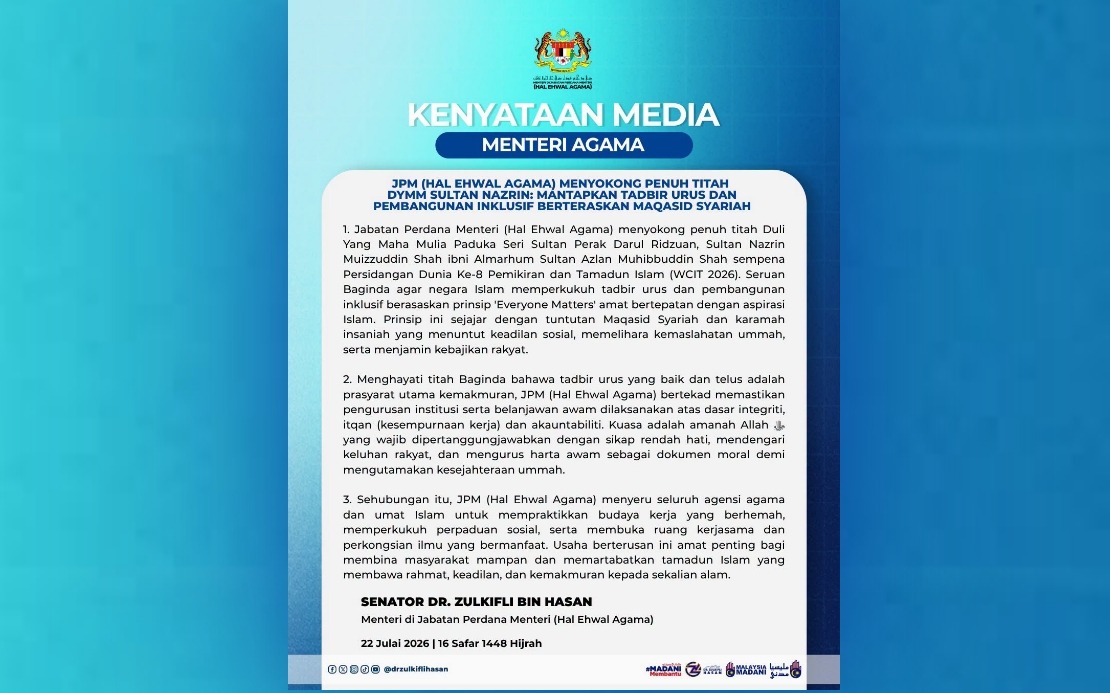
The Prime Minister's Department (Religious Affairs) has committed to advancing the governance of Malaysia's religious institutions through a framework centred on integrity, accountability, and the collective well-being of society. This institutional direction directly reflects the vision articulated by Sultan Nazrin Shah, whose call for Muslim-majority nations to embrace good governance and inclusive development has become a touchstone for policy reform across the region. The alignment represents a significant moment in how Malaysia's religious establishment approaches its mandate, moving beyond conventional administrative practices towards a model that emphasises universal inclusion and transparent stewardship of public resources.
Dr Zulkifli Hasan, the Minister in the Prime Minister's Department (Religious Affairs), has articulated how Sultan Nazrin's foundational principle of "Everyone Matters" transcends mere political rhetoric to embed itself within Islamic jurisprudential frameworks. The minister explained that this concept resonates fundamentally with Maqasid Syariah, the overarching objectives of Islamic law that prioritise the preservation of faith, life, intellect, lineage and wealth across society. Equally, the principle engages with karamah insaniah, the Islamic concept of inherent human dignity that demands respect for every individual regardless of circumstance. This theoretical grounding suggests that the religious affairs ministry is not adopting a secular governance model but rather recovering and reaffirming values embedded within Islamic tradition itself.
Sultan Nazrin Shah delivered his foundational address at the 8th World Conference on Islamic Thought and Civilisation, where he contended that a truly representative public service must extend its benefits equitably across all citizens, transcending lines of ethnicity, faith and partisan affiliation. According to the Sultan's perspective, such inclusive governance constitutes the essence of national cohesion and demonstrates the humility required of leadership that genuinely listens to popular concerns before formulating legislation. This vision challenges administrations across the Muslim world to reconsider whether their institutional structures genuinely serve all constituents or inadvertently privilege particular communities. For Malaysia specifically, where religious administration intersects with multicultural governance, the principle carries particular significance in ensuring that religious institutions function as unifying rather than divisive forces.
The Sultan's broader analysis of development and prosperity extends beyond domestic governance to encompass the interconnected realities of contemporary economics and geopolitics. He articulated that isolation remains untenable for any nation, regardless of resource endowment, because the engines of modern prosperity—trade networks, foreign investment, knowledge transfer, and technological advancement—inherently necessitate engagement with global systems. This reasoning carries particular weight for Malaysia and the Southeast Asian region, where economic growth has historically depended on regional integration and openness to international flows of capital and expertise. The Sultan's framing positions good governance not as an optional enhancement but as a prerequisite for accessing the prosperity that engagement with global systems can generate.
Dr Zulkifli's response to the Sultan's vision demonstrates how the religious affairs ministry intends to operationalise these principles through concrete administrative reforms. The minister emphasised that institutional management and public financial administration must be directed by integrity—a concept encompassing honesty, transparency and ethical conduct—alongside itqan, the Islamic principle of excellence and diligence in executing responsibilities. These standards apply equally to the stewardship of public funds, which the minister characterised as a moral obligation to society rather than a mere administrative function. This framing transforms budgetary processes from technical exercises into ethical undertakings, elevating the accountability expected of religious institutions and the officials who manage them.
The theological foundation underlying the ministry's commitments centres on the concept that authority constitutes a divine trust that must be exercised with genuine humility and responsiveness to citizen concerns. Dr Zulkifli articulated that listening to public grievances represents not a democratic concession but a religious obligation, reflecting Islamic principles of consultation (shura) and stewardship. This perspective reshapes how religious officials should relate to the populations they serve, transforming hierarchical relationships into dialogical ones where institutional leadership remains attentive to the lived experiences and concerns of those affected by policy decisions. Such reframing could potentially reform how religious institutions in Malaysia engage with communities and respond to emerging social issues.
The ministry's appeal extends beyond government apparatus to encompass the broader Muslim community and religious organisations operating across Malaysia. Officials have called for the adoption of courtesy and civility in workplace environments, recognising that institutional culture fundamentally shapes how governance translates into lived experience for both staff and citizens. Strengthening social cohesion emerges as a complementary objective, acknowledging that governance divorced from community solidarity risks becoming sterile and counterproductive. The emphasis on collaboration and the circulation of beneficial knowledge suggests a vision of religious institutions as spaces for collective problem-solving rather than unilateral direction from above.
The timing of this institutional repositioning reflects broader currents within Muslim-majority governance frameworks, where thinkers and leaders increasingly scrutinise whether traditional approaches adequately address contemporary challenges of legitimacy, inclusivity and effectiveness. Sultan Nazrin's intervention carries particular weight because of his position as a senior member of Malaysia's royalty and as an intellectual contributor to regional discourse on Islamic governance. His emphasis on universal inclusion challenges narratives that pit religious governance against pluralism, instead suggesting that authentic Islamic institutions can and should serve diverse populations equitably. This perspective provides important intellectual cover for reformist initiatives that might otherwise face criticism as departures from tradition.
For Malaysian religious affairs practitioners and institutions, the ministry's commitment to implementing Sultan Nazrin's vision will require sustained effort beyond rhetorical alignment. Translating principles of integrity, excellence, and universal inclusion into institutional practices demands specific reforms in recruitment, training, budgetary processes, and inter-agency collaboration. Religious institutions across Malaysia will need to examine whether their current structures, procedures and cultures genuinely embody these values or whether gaps exist between aspiration and practice. The forthcoming period will test whether the Prime Minister's Department (Religious Affairs) can catalyse meaningful change across Malaysia's complex religious institutional landscape or whether the initiative remains primarily symbolic.

