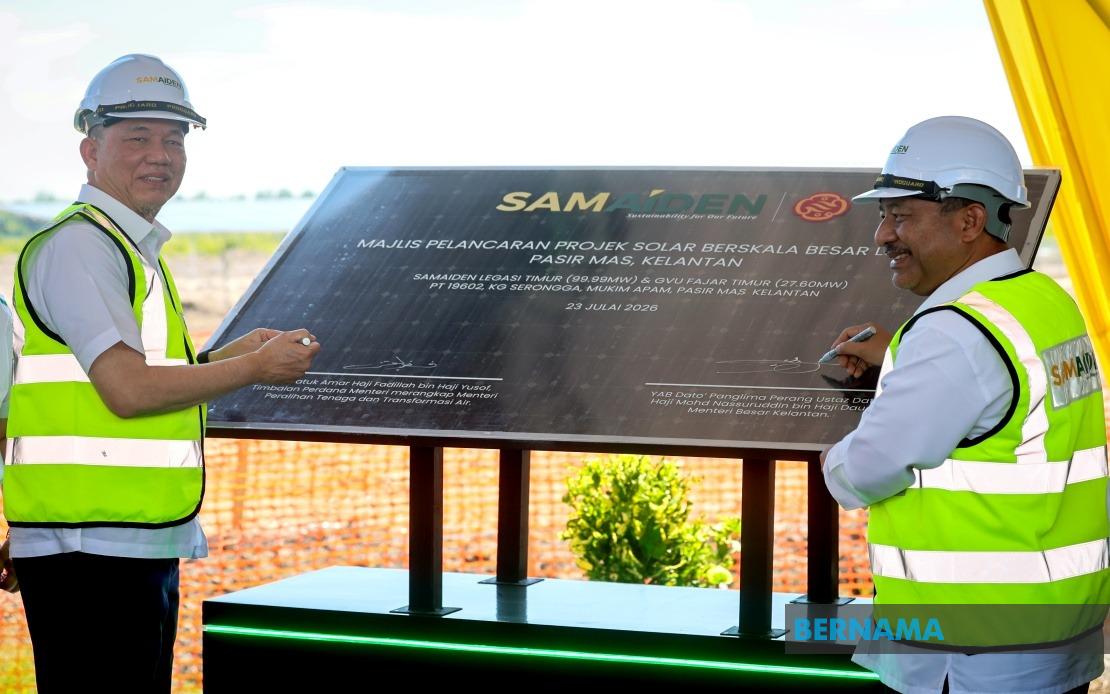
Malaysia is advancing steadily toward its renewable energy ambitions, with installed capacity now standing at nearly 32 per cent as of June, positioning the nation to comfortably meet its 2030 target of 35 per cent. Deputy Prime Minister Datuk Seri Fadillah Yusof made this announcement at the launch of the Large-Scale Solar Project (LSS5) in Pasir Mas, Kelantan, underscoring the government's commitment to an accelerated energy transition across the region. The milestone represents meaningful progress under Malaysia's National Energy Transition Roadmap, a comprehensive blueprint designed to overhaul the country's energy infrastructure and deliver cleaner, more resilient electricity supplies.
The trajectory toward 2030 gains further credibility when viewed against the December 2025 baseline, when Malaysia had already secured 31 per cent renewable energy capacity, demonstrating consistent quarter-on-quarter gains. Beyond the immediate 2030 milestone, the government has committed to an even more ambitious 70 per cent renewable energy capacity by 2050, signalling a long-term strategic pivot away from fossil fuel dependency. This cascading timeline reflects the government's determination to embed sustainability into Malaysia's economic development model, rather than treating energy transition as a peripheral concern. The benchmarks serve as accountability mechanisms, ensuring that successive administrations remain locked into the energy security and climate imperatives that underpin modern growth strategies across Southeast Asia.
Fadillah, who doubles as Minister of Energy Transition and Water Transformation (PETRA), framed the renewable energy push as a non-negotiable strategic necessity rather than an optional policy choice. His articulation highlights a philosophical shift in how Malaysian policymakers now conceptualise energy security, moving away from a purely supply-side calculus toward one that integrates climate resilience, cost stability, and competitive advantage in attracting multinational capital. This recalibration matters enormously for Malaysia's positioning in a region where energy-intensive industries—from semiconductors to data centres to electric vehicle manufacturing—increasingly gravitate toward jurisdictions offering affordable, reliable, and politically stable renewable electricity supplies. The energy transition roadmap thus becomes a tacit recruiting tool for high-value industrial investment, particularly as global supply chains realign and corporations grapple with their own climate commitments.
The government's emphasis on balancing three pillars—energy security, affordability, and sustainability—acknowledges the political economy of energy transition in a developing nation context. Malaysia cannot simply transplant European or Australian renewable energy models; instead, policymakers must ensure that the shift toward renewables does not destabilise electricity prices for households and small businesses, particularly in less urbanised states where grid infrastructure remains nascent. The Large-Scale Solar Project at Pasir Mas exemplifies this measured approach, coupling utility-scale renewable deployment with local economic benefits including employment generation, supply-chain stimulation, and community investment. By distributing the gains from renewable energy development across multiple stakeholder groups, the government seeks to build political consent for an energy transition that will fundamentally reshape Malaysia's power sector over the coming decades.
The launch of LSS5 in Kelantan carries symbolic significance beyond its immediate generating capacity. The state, long viewed as peripheral to Malaysia's industrial and financial hubs, is positioned as a frontier for renewable energy development, particularly given its expansive land availability and supportive state government. Kelantan Menteri Besar Datuk Mohd Nassuruddin Daud explicitly framed the project as a catalyst for attracting quality investments anchored in sustainability and green technology, signalling that peripheral states need not remain economically marginalised. The project thus becomes a proof-of-concept, demonstrating to investors that renewable energy infrastructure can be deployed profitably across Malaysia's diverse geographies, not merely in coastal urban centres. This spatial democratisation of renewable investment aligns with broader federal and state government ambitions to reduce regional economic disparities, a persistent challenge in Malaysian federalism.
The investor confidence reflected in LSS5's realisation underscores the convergence between Malaysia's policy environment and global capital flows seeking renewable energy opportunities. International and domestic investors increasingly view Southeast Asia as a critical frontier for renewable deployment, given the region's abundant solar and wind resources, expanding electricity demand driven by industrial growth and urbanisation, and rising regulatory pressure on carbon emissions within global supply chains. Malaysia's transparent policy framework, articulated through the NETR, reduces investment uncertainty by providing multi-decade visibility into government support mechanisms, grid connection protocols, and power purchase agreements. For investors evaluating competing jurisdictions across the ASEAN region, this policy clarity carries measurable value, particularly when coupled with Malaysia's established track record in infrastructure development and rule-of-law systems.
The Solar ATAP Programme mentioned by Fadillah represents a complementary distributed-generation strategy that extends renewable deployment beyond utility-scale projects into residential and commercial premises. Rooftop solar systems on homes, mosques, and businesses generate electricity at the point of consumption, reducing transmission losses and grid strain whilst building grassroots engagement with renewable energy adoption. This programmatic approach acknowledges that Malaysia's energy transition cannot rely solely on centralised solar farms; rather, it requires a heterogeneous portfolio encompassing utility-scale, distributed, and behind-the-meter generation. The invitation to religious institutions to adopt rooftop solar also carries symbolic importance in a Muslim-majority nation, positioning renewable energy as compatible with spiritual and community values. This cultural embedding of energy transition beyond purely technical or economic registers strengthens political durability and public acceptance.
Kelantan's renewable energy potential extends considerably beyond the LSS5 project, with the state positioning itself to become a hub for green manufacturing and energy-intensive industries that gravitate toward regions offering abundant clean electricity. The state government's commitment to fostering an investor-friendly ecosystem, coupled with federal support for renewable infrastructure, creates conditions for industrial clustering around renewable energy supply. Manufacturing sectors ranging from data centres to battery production to semiconductor fabrication increasingly prioritise locating in jurisdictions with reliable, affordable, clean electricity. By establishing Kelantan as a renewable energy destination now, the state can capture disproportionate shares of such high-value, employment-intensive industries as global supply chains continue realigning away from fossil fuel-dependent jurisdictions.
The energy transition narrative advanced at the Pasir Mas launch also intersects with Malaysia's international climate commitments, particularly its Nationally Determined Contributions under the Paris Agreement and broader pledges to regional climate cooperation forums. Demonstrating tangible progress toward renewable energy targets strengthens Malaysia's diplomatic standing in climate negotiations whilst positioning the country as a credible partner in regional climate finance initiatives. As global capital increasingly channels through climate-focused investment vehicles and as supply-chain scrutiny over carbon intensity intensifies, Malaysia's ability to credibly evidence energy transition progress becomes commercially valuable. Multinational corporations conducting supply-chain carbon audits will increasingly privilege Malaysian suppliers and manufacturers operating within renewable-powered industrial zones, translating climate policy into competitive advantage at the firm level.
The path from 32 per cent to 35 per cent renewable capacity by 2030 remains achievable given present deployment trajectories, though it requires sustained investment and policy continuity. Utility-scale solar projects like LSS5, coupled with distributed rooftop deployment under programmes like Solar ATAP, can plausibly close this gap over the five-year period. However, the jump from 35 per cent in 2030 to 70 per cent by 2050 presents a considerably steeper challenge, requiring transformative investment in grid modernisation, energy storage systems, and potentially hydroelectric or offshore wind capacity to manage seasonal variability in solar generation. The 2030 milestone thus functions as an inflection point, demonstrating whether Malaysia can sustain the policy consistency and capital mobilisation necessary for a genuine energy transition, or whether renewable deployment plateaus as a marginal addition to predominantly fossil-fuel-powered electricity systems. The coming five years will prove instructive for policymakers across Southeast Asia grappling with analogous energy transition imperatives.
For Malaysian readers and investors, the renewable energy trajectory carries immediate implications. Households and businesses planning long-term energy strategies can increasingly rely on the stability of renewable electricity supplies, particularly through the distributed solar pathway. Industrial investors evaluating Malaysian locations can factor renewable energy availability into site-selection calculus. Regional investors monitoring Malaysia's energy sector can identify opportunities across the renewable supply chain, from engineering consultancies to component manufacturing to operations and maintenance services. The energy transition, while a global phenomenon driven by climate imperatives, manifests locally through projects like LSS5, through programmes like Solar ATAP, and through the daily decisions of households, businesses, and investors navigating an increasingly renewable-powered economy.

