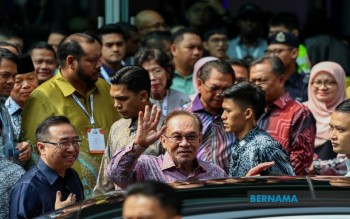
Prime Minister Datuk Seri Anwar Ibrahim has hailed Malaysia's second-quarter economic expansion of six per cent as a significant milestone that underscores the country's appeal to international investors and signals resilience in the regional economy. Speaking at the National Innovation and Commercialisation Expo 2026 at the Kuala Lumpur Convention Centre, Anwar characterised the growth trajectory as an outstanding result that validates Malaysia's strategic positioning within Southeast Asia's competitive investment landscape.
Yet beneath this optimistic assessment lies a more nuanced message that Anwar felt compelled to communicate to policymakers and the public alike. The Prime Minister, who concurrently holds the Finance portfolio, sought to dispel a widespread misconception that has historically clouded economic policy debates in Malaysia: the assumption that robust GDP expansion automatically cascades into expanded government coffers and, by extension, greater budgetary spending capacity. This clarification reflects ongoing tensions in Malaysia's fiscal management philosophy and the political pressures that accompany strong economic performance.
Anwar's intervention addresses a fundamental economic principle that often eludes both casual observers and some policymakers. He articulated that the relationship between headline GDP growth and government revenue generation is far more complex than simple proportionality. Rather than allowing stronger economic output to justify expansionary fiscal policies, the Finance Minister cautioned that such reasoning represents flawed economic thinking. The distinction matters considerably for Malaysia's macroeconomic stability, particularly as the country navigates inflationary pressures and debt management concerns that have preoccupied regional observers.
The Prime Minister specifically highlighted the structural composition of Malaysia's recent growth drivers as critical to understanding why GDP expansion may not immediately boost government revenue. The most dynamic growth sectors—particularly artificial intelligence, data centres, and the broader digital technology ecosystem—operate according to different economic logics than traditional revenue-generating industries. These knowledge-intensive, technology-dependent sectors create value through innovation and capability-building rather than through direct tax contributions or resource extraction that characterises more conventional economic activities.
This distinction carries profound implications for Malaysia's economic transformation agenda. While investments in artificial intelligence and data centres unquestionably position Malaysia as a regional hub for technological advancement, they also represent a delayed-return investment model. The immediate benefits manifest as employment generation, particularly for skilled and semi-skilled workers, and through the development of domestic technological capabilities that enhance long-term competitiveness. These advantages accrue gradually rather than translating into government revenue streams that finance current expenditure, a timing mismatch that complicates fiscal planning for policymakers accustomed to more immediate revenue cycles.
Anwar's comments implicitly acknowledge Malaysia's deliberate pivot toward higher-value economic activities, a strategic reorientation that distinguishes the current policy framework from earlier development approaches. By contrast, conventional manufacturing and agricultural sectors, which have historically anchored Malaysia's export economy, generate more direct and immediate fiscal returns through taxation and export revenues. The transition toward technology and innovation-driven growth thus requires not merely sectoral diversification but also a fundamental recalibration of expectations regarding how economic expansion translates into government resources.
The timing of Anwar's clarification proves particularly significant given Malaysia's fiscal constraints and persistent public dialogue surrounding government spending priorities. Throughout Southeast Asia, including Malaysia, there exists considerable political pressure to translate economic growth into immediate public services expansion and infrastructural investment. By explicitly distinguishing between GDP growth and government revenue capacity, Anwar signals that Malaysia's policymaking establishment recognises the need for disciplined fiscal management even amid robust economic performance. This message carries particular weight in a regional context where several countries have experienced fiscal deterioration despite acceptable growth rates.
Moreover, the Prime Minister's emphasis on the indirect benefits of technology investment reflects Malaysia's strategic acknowledgment that sustainable competitive advantage in the digital era derives from capabilities, innovation ecosystems, and human capital rather than from traditional asset accumulation. The data centre and artificial intelligence sectors represent gateway investments into high-value regional supply chains and digital infrastructure networks that increasingly define economic relationships across East and Southeast Asia. For Malaysia, hosting these facilities and attracting related investments positions the country as an enabling infrastructure provider within broader regional technological architecture.
Anwar's framing also addresses potential criticism from populist voices that might question why government spending does not expand proportionally with economic growth. By articulating the economic reasoning behind fiscal restraint despite GDP expansion, the Prime Minister attempts to build public understanding that responsible economic management sometimes requires counterintuitive policy choices. This educational function proves essential in democracies where fiscal policy operates within contested political terrain and where citizens understandably expect growth to benefit public services and living standards directly.
The six per cent growth figure itself warrants contextualisation within Malaysia's recent economic trajectory and regional comparative performance. As the region's growth rates have moderated from pandemic-era rebounds, Malaysia's sustained six per cent expansion positions it among the stronger performers, lending credibility to Anwar's claims about restored investor confidence. The diversification into technology sectors also suggests that growth is no longer dependent on cyclical commodity exports or tourism flows, historically volatile revenue sources that complicate fiscal planning and economic stability.
Looking forward, Anwar's statement implicitly outlines the parameters of Malaysia's economic development philosophy for coming years. Rather than treating growth as licence for fiscal expansion, the government appears committed to channelling economic gains toward capability development and sectoral transformation. This approach requires patience from constituencies accustomed to more immediate manifestations of economic improvement but ultimately positions Malaysia for more resilient, diversified growth patterns less vulnerable to external commodity price fluctuations or geopolitical disruptions that have historically destabilised Southeast Asian economies.

