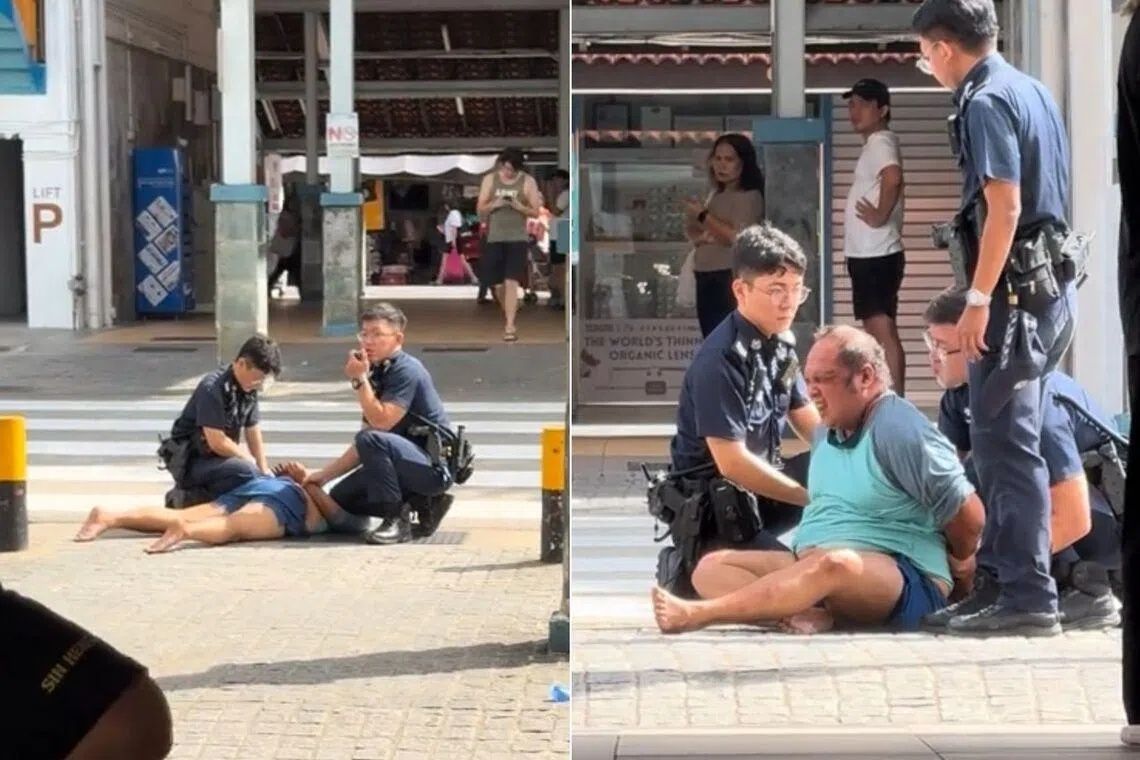
A 36-year-old man is in custody following an incident at a Toa Payoh coffee shop on Sunday morning that resulted in a police officer being assaulted. The incident occurred at Block 184 Toa Payoh Central around 9.45am on June 28, when officers were called to deal with a man causing disturbance in the establishment. What began as a response to disruptive behaviour escalated when the man physically attacked one of the responding officers, striking him in the face as the arrest was being made.
According to the Singapore Police Force, the man faced multiple charges relating to his conduct that morning. The primary charges include committing an obscene act in a public place and voluntarily causing hurt to a public servant with the intention of deterring that officer from performing his duty. The combination of these charges reflects the severity with which authorities treat assaults on law enforcement personnel, particularly when motivated by resistance to lawful arrest.
The incident was captured on video by social media user Kee Wee Shang, whose footage provided a detailed account of how officers managed the situation. In one clip circulating online, two uniformed police officers can be observed physically restraining the barefooted suspect on the ground as they work to subdue him. A subsequent video from the same source shows additional police presence at the scene, with the man now handcuffed and being escorted away by multiple officers. These recordings offer a window into the operational procedures deployed by Singapore police when responding to situations involving non-compliant individuals.
The police officer who was struck during the altercation sustained minor injuries in the encounter. The 19-year-old constable was transported to hospital while remaining conscious, indicating that despite the violent nature of the assault, the injuries did not result in serious trauma. This outcome was likely aided by the swift response of the other officers present, who were able to prevent the situation from escalating further and secure the suspect before additional harm could be inflicted.
For Malaysian and Southeast Asian readers, this incident underscores the operational challenges faced by police forces across the region when responding to public disturbances. Law enforcement personnel in countries throughout ASEAN frequently encounter situations where individuals resist arrest or become violent, often compounded by substance use or mental health crises. The professionalism demonstrated by the Singapore officers in restraining a violent suspect while limiting injury reflects training standards that many regional police forces aspire toward, though implementation varies widely across the region.
The documentation of such incidents through social media represents a contemporary reality of policing in urban Southeast Asia. The immediate availability of smartphone footage means that public incidents involving law enforcement are increasingly recorded and shared, creating both transparency and accountability mechanisms that extend beyond official reporting channels. This digital scrutiny can serve as a form of external oversight, though it also places officers under constant visibility during complex operational situations.
Citing the International Relations and Southeast Asian context, Singapore's relatively low crime rates and efficient police response capabilities have long made the city-state a model for other jurisdictions in the region. However, even in well-resourced and professionally trained police forces, encounters with violent or intoxicated individuals remain unpredictable and potentially dangerous. The speed and coordination with which the Toa Payoh officers managed this situation demonstrates institutional capacity, yet such incidents also occur with enough frequency to suggest that public disturbances remain an ongoing concern even in affluent, developed urban environments.
The charges being pursued in this case carry significant legal weight under Singapore's Penal Code. Assaulting a public servant acting in an official capacity is treated as a serious offence across most Commonwealth jurisdictions, including Singapore, Malaysia, and other ASEAN nations with similar legal frameworks. The explicit reference to intent to deter the officer from his duty elevates the charge beyond simple assault, indicating potential prison time rather than minor penalties. This legal framework reflects a policy decision that protecting law enforcement's ability to perform duties without fear of violence is essential to public order.
Police investigations into the full circumstances of the incident remain ongoing. Authorities will likely examine whether additional factors contributed to the disturbance, including whether the individual was under the influence of alcohol or drugs, experienced a mental health crisis, or had other underlying issues that precipitated the behaviour. Such contextual information often shapes how prosecutorial authorities handle similar cases, potentially influencing whether charges are pursued with maximum severity or whether rehabilitation and diversion programmes are considered alternatives.
The broader implications of this incident extend to discussions about police resources and mental health support within urban policing frameworks. Many disturbances that escalate to violence originate from individuals experiencing psychological distress or substance dependency. Southeast Asian jurisdictions, including Singapore and Malaysia, have been exploring how police forces can better interface with health and social services to address root causes of public disruption rather than relying exclusively on criminal justice responses. This case, while resolved through traditional arrest procedures, illustrates why such integrated approaches remain important policy considerations for regional governments.

