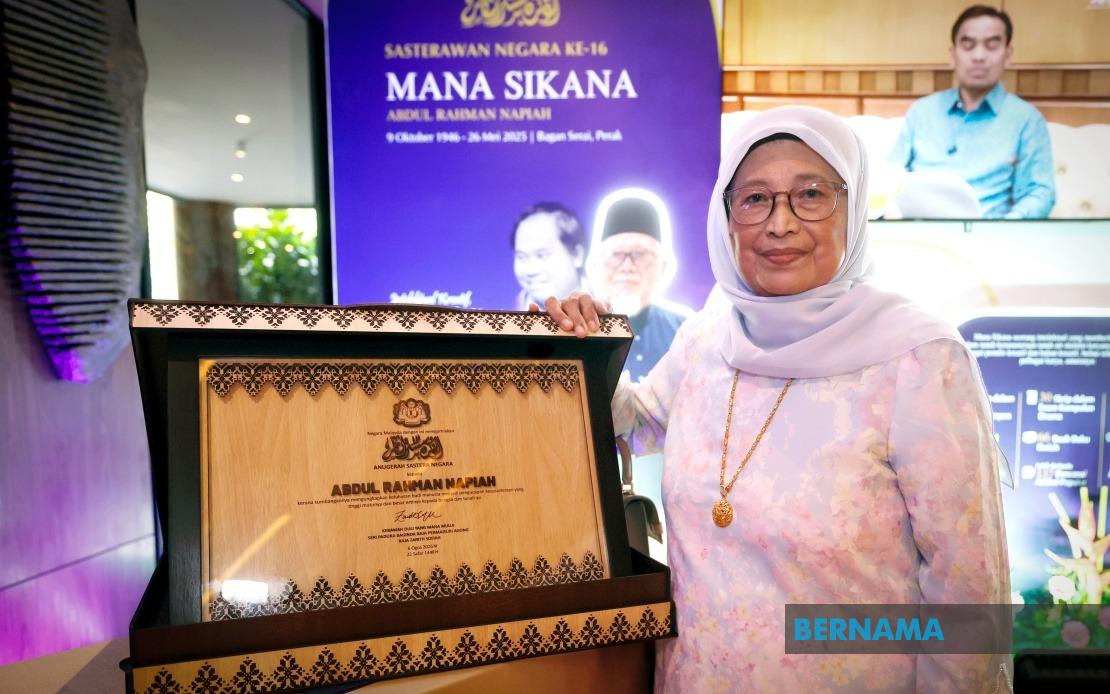
Malaysia's literary establishment has bestowed its highest individual honour on the late Dr Abdul Rahman Napiah, whose pen name Mana Sikana became synonymous with creative excellence across multiple genres. The 16th National Laureate award was presented posthumously at a ceremony in Kuala Lumpur on August 6, with Queen Raja Zarith Sofia performing the presentation to his widow, Salmah Ali, now 82. The recognition arrives seven years after Mana Sikana's death in May at the age of 80, marking a significant moment for his family and the broader literary community that had long anticipated such formal acknowledgement of his work.
Mana Sikana's wife described the honour as validation of aspirations her late husband had nurtured throughout his career. Speaking with evident emotion after receiving the award, Salmah recounted that her husband had learned of the possibility of receiving the National Laureate recognition before his passing, representing a source of hope during his final months. The timing of his death proved cruelly poignant—he collapsed while presenting a research paper to Dewan Bahasa dan Pustaka, the institution responsible for promoting Malay language and literature, an organisation that had been central to his professional mission for decades. His premature death from heart complications prevented him from witnessing the formal conferment, yet the award now stands as testament to his enduring influence on Malaysian literary culture.
The trajectory of Mana Sikana's career demonstrated the breadth of ambition that characterised his engagement with literature and the arts. Born in Bagan Serai, Perak, on October 9, 1946, he began as a schoolteacher before transitioning into higher education, where he eventually achieved professorial rank. This progression was not linear or confined within Malaysian borders. While teaching, he simultaneously produced drama works for Singaporean radio and television networks, an era when his creative output found regular slots on Malaysian television programming as well. His decision to pursue further studies at Universiti Kebangsaan Malaysia (UKM) formalized his academic credentials and provided the foundation for a university career spanning multiple institutions, including stints at Nanyang Technological University in Singapore and Universiti Pendidikan Sultan Idris (UPSI).
Salmah's recounting of her husband's diverse roles illuminates the multifaceted nature of literary contribution that the National Laureate award recognises. Beyond his authorship of novels, short stories, and dramatic works, Mana Sikana developed significant expertise in literary theory and criticism, domains that shaped how Malaysian writers and scholars understood their own craft. His visiting lectureships at Indonesian universities extended his intellectual reach across the region, positioning him as a figure who influenced literary discourse beyond Malaysia's borders. This regional prominence, combined with his sustained domestic output, created a body of work that touched multiple generations of readers and aspiring writers. His influence continued until his death, as he shared knowledge of writing and literature with his four children and twelve grandchildren, embedding his literary philosophy within his own family.
Education Minister Fadhlina Sidek's remarks at the ceremony articulated the official justification for the award, framing Mana Sikana's contributions through the lens of national cultural development. She emphasised his role in strengthening Malaysian literature through creative writing, literary theory, criticism, and academic discourse—categories that collectively describe not merely the production of texts but the intellectual infrastructure supporting literary culture. This framing acknowledges that literary development requires more than talented writers; it demands critics who interpret and evaluate, theorists who articulate principles, and academics who transmit knowledge to successive cohorts of students. Mana Sikana's involvement across these domains positioned him as a foundational figure in Malaysia's modern literary establishment.
The National Laureate award carries particular significance within Malaysian cultural policy as the nation's preeminent recognition of literary achievement. By conferring this honour posthumously on Mana Sikana, Malaysia's cultural institutions signal their assessment of his historical importance to the nation's literary development. The award also reflects the enduring respect for Malay-language literature within Malaysia's official cultural framework, reinforcing the prestige associated with writing in Malay at a moment when global English-language publishing dominates regional discussions. For Southeast Asian observers, Mana Sikana's recognition underscores the continued vitality of national literary traditions and the institutional mechanisms through which societies formally acknowledge cultural contribution.
Salmah's presence at the ceremony embodied the bittersweet nature of posthumous recognition. Her words conveyed not only pride in her husband's achievements but also the poignancy of celebrating milestones without the honouree present to experience them. She noted that Mana Sikana had received literary accolades consistently throughout his life, beginning in his school days, suggesting a precocious talent recognised early and sustained throughout his career. Yet the National Laureate award represented the capstone honour, one he actively anticipated before his illness intervened. The gap between his death in May and the August ceremony meant that Salmah navigated grief while performing the public role of representing her husband's legacy—a dual emotional burden that her emotional composure at the event only partially conveyed.
The circumstances of Mana Sikana's death itself carry symbolic weight within his literary biography. Collapsing while engaged in scholarly presentation for a prestigious national institution connects his death literally to his life's work, blurring the boundaries between professional identity and physical existence. This dramatic collapse at Dewan Bahasa dan Pustaka served as an unintentional final act in a career devoted to advancing Malay language and literature. That same institution became the venue where his scholarly contributions were formally evaluated and honoured, creating an institutional continuity that extends his presence beyond his physical death.
The recognition of Mana Sikana arrives at a moment of broader reflection within Malaysia about literary heritage and cultural continuity. As the nation navigates rapid social change and technological transformation, formal acknowledgement of figures like Mana Sikana reasserts the enduring value of literary contribution to national identity and cultural development. His academic career at multiple institutions suggests that his influence extends through generations of students now working within Malaysia's education system, amplifying the reach of his intellectual contributions beyond his direct publications. By honouring him as the National Laureate, Malaysia's cultural institutions affirm the continuing relevance of the literary traditions and critical frameworks that Mana Sikana helped establish.
For Malaysian and Southeast Asian readers and writers, Mana Sikana's award offers a model of sustained literary engagement across multiple forms and contexts. His career trajectory—from schoolteacher to international academic, from radio dramatist to published author—demonstrates the possibilities for integrating creative and scholarly work, for maintaining literary practice while building institutional influence, and for sustaining intellectual productivity across decades. His regional reach through Indonesian universities and his participation in Singapore's creative industries illustrate how Malaysian literary figures can contribute to broader Southeast Asian cultural conversations. The National Laureate award recognises not merely the quantity of his output but the quality of his influence on how literary culture itself is understood and practiced within his nation and region.

