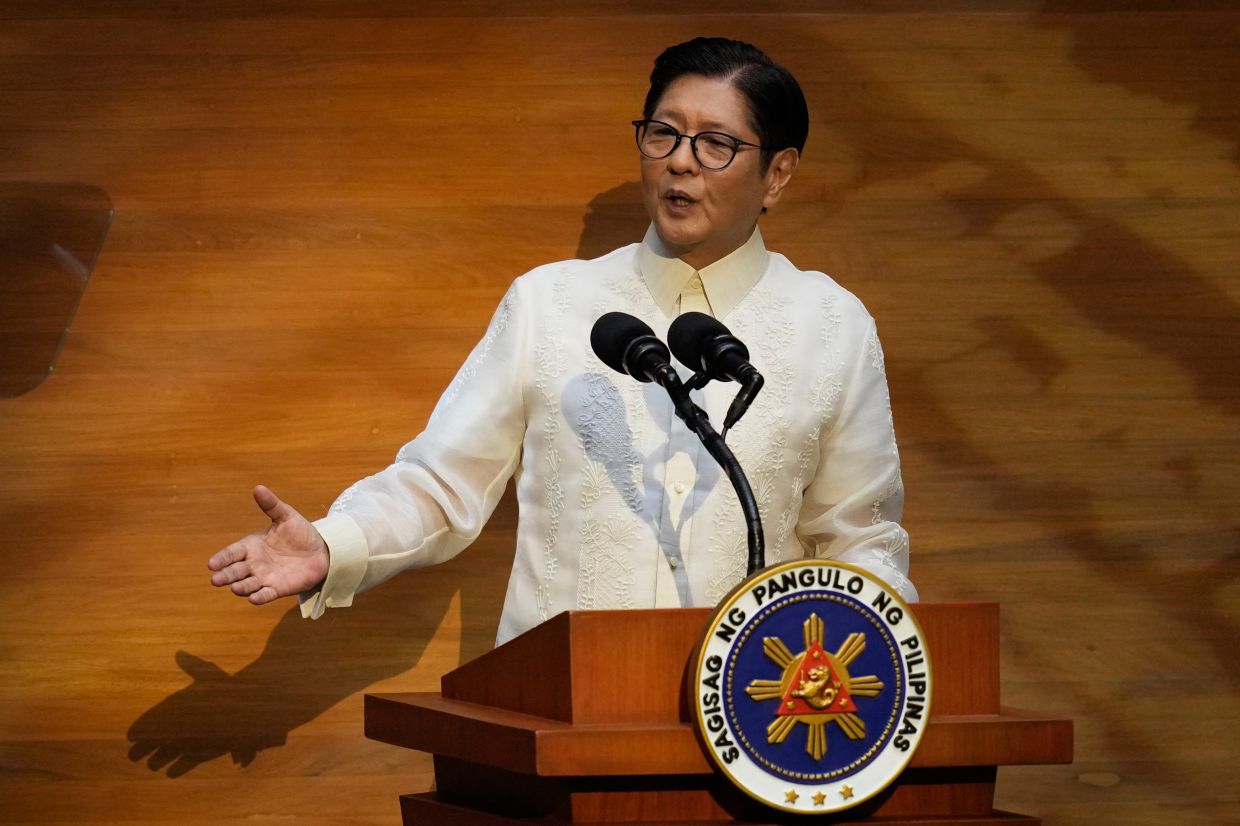
Philippine President Ferdinand Marcos Jr. has mounted a forceful defence of his country's position in one of Asia's most contentious maritime disputes, reaffirming his government's commitment to a 2016 arbitration ruling that invalidated China's sweeping claims in the South China Sea. Speaking to lawmakers during his state of the nation address on Monday, Marcos stopped short of naming China directly but delivered what amounted to a stinging rebuke of Beijing's rejection of the international tribunal's decision, which Philippine officials regard as a binding and definitive benchmark for interpreting maritime law in the region.
The timing of Marcos' pointed comments reflected escalating tensions between Manila and Beijing over competing territorial claims in disputed waters that form one of the world's most strategically vital shipping lanes. His remarks came just days after the Philippine government had summoned the Chinese ambassador to Manila to lodge a formal protest over AI-generated images published by China Daily, a state-controlled media outlet, that depicted Filipinos as monkeys. The animations were created in response to China's long-standing refusal to accept the 2016 arbitration decision, which emerged from a case the Philippines initiated in 2013 following a tense military standoff over a contested shoal.
While Beijing's Foreign Ministry spokesperson Lin Jian attempted to distance the government from the dehumanizing imagery, claiming it did not represent official policy, he simultaneously reasserted China's uncompromising stance on the arbitration ruling. Lin characterised the decision as a "political farce disguised as a legal proceeding" and reiterated that the award is "illegal, null and void" with no binding authority. This public posturing underscores the profound disconnect between Manila's legal interpretation and Beijing's geopolitical position, a chasm that has only widened as Chinese maritime activities in the region have intensified.
Marcos framed the 2016 ruling as a crucial foundation for regional stability and international law, emphasizing that it was based on the 1982 United Nations Convention on the Law of the Sea, a treaty both countries have acknowledged. The president pledged that his administration would exhaust every peaceful and legal mechanism available to defend this achievement, signalling a determination to resist what he characterized as attempts to undermine the tribunal's legitimacy. His assertion that Filipinos "do not yield" served as a nationalist rallying cry, appealing to Filipino pride and resolve in the face of what many in Manila view as a direct assault on national dignity.
For Malaysian and other Southeast Asian observers, Marcos' stance carries significant implications. The disputes in the South China Sea involve multiple claimants, including Malaysia and Brunei, alongside the Philippines, Vietnam, and Taiwan. The arbitration ruling itself has become a watershed moment in international law, with its acceptance or rejection determining how future maritime disagreements will be adjudicated. Malaysia, while maintaining a more cautious diplomatic approach than the Philippines, has nonetheless expressed concern about Chinese assertiveness and has framed its own interests within the bounds of international maritime law.
The territorial confrontations themselves have grown increasingly frequent and dangerous in recent years. Chinese coast guard vessels, fishing fleets, and military assets have become more assertive in waters claimed by the Philippines, Vietnam, and other nations. These incidents have moved beyond diplomatic sparring to involve physical confrontations that risk accidental escalation into something far more serious. The strategic importance of these waters—through which trillions of dollars in global trade passes annually—means that instability here affects not only claimant states but the entire region's economic prosperity and security architecture.
In his domestic political remarks, Marcos demonstrated that his commitment to accountability extends beyond foreign affairs into the contentious realm of internal governance. He disclosed that a special anti-corruption prosecutor would imminently file charges against former House Speaker Martin Romualdez, his own cousin and a significant political ally. The move signals Marcos' willingness to pursue prosecutions even when they implicate figures close to his administration, though critics have noted the selective nature of anti-corruption enforcement in Philippine politics.
Romualdez, who stepped down as House speaker but remains a congressman, had been implicated in a sprawling corruption scandal involving flood control projects. Investigations, both parliamentary and governmental, had identified him alongside several lawmakers and executive branch officials as having allegedly pocketed substantial kickbacks. The former public works secretary, who served under Marcos, along with various government engineers and construction executives, had already been charged and detained, but Romualdez himself had escaped prosecution until now.
Marcos' acknowledgement that pursuing charges against his cousin pained him, yet was necessary for the republic's integrity, reflects the awkward position of fighting corruption within one's own political circle. Nearly 25 billion pesos (approximately 410 million US dollars) in cash and properties connected to suspects had been recovered or frozen, according to the president's account, with portions being returned to the national treasury. This figure, while substantial, remains modest relative to the scale of corruption documented in Philippine governance over decades.
The juxtaposition of Marcos' foreign policy assertiveness with his domestic anti-corruption agenda suggests a president attempting to establish credibility on multiple fronts simultaneously. Success on the South China Sea front requires sustained political will and public support, particularly as Chinese pressure intensifies. Meanwhile, prosecuting powerful political allies tests his commitment to rule of law, a principle essential to democratic legitimacy. How effectively Marcos navigates these dual challenges will shape not only the Philippines' trajectory but also regional dynamics in Southeast Asia, where China's assertiveness continues to test the cohesion and resolve of smaller neighbouring states.

